
Asus ROG Phone 7 Ultimate vs. Oppo Find X6: A Deep Dive into Gaming and Flagship Features
| Phones Images | |||||
|---|---|---|---|---|---|
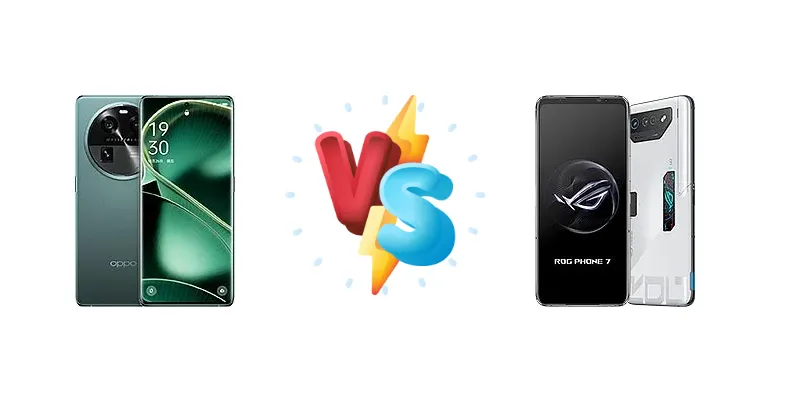
|
🏆 Quick Verdict
For dedicated mobile gamers, the Asus ROG Phone 7 Ultimate is the clear winner, offering superior sustained performance and gaming-centric features. However, the Oppo Find X6 provides a more versatile and balanced experience, excelling in camera quality and offering a more mainstream design, making it ideal for everyday users.
| PHONES | ||
|---|---|---|
| Phone Names | Oppo Find X6 | Asus ROG Phone 7 Ultimate |
| Network | ||
|---|---|---|
| 2G bands | GSM 850 / 900 / 1800 / 1900 | GSM 850 / 900 / 1800 / 1900 |
| 3G bands | HSDPA 800 / 850 / 900 / 1700(AWS) / 1900 / 2100 | HSDPA 800 / 850 / 900 / 1700(AWS) / 1900 / 2100 |
| 4G bands | 1, 2, 3, 4, 5, 7, 8, 12, 17, 18, 19, 20, 26, 28, 34, 38, 39, 40, 41, 66 | 1, 2, 3, 4, 5, 7, 8, 12, 17, 18, 19, 20, 25, 26, 28, 32, 34, 38, 39, 40, 41, 42, 43, 48, 66 - International |
| 5G bands | 1, 3, 5, 7, 8, 20, 28, 38, 40, 41, 66, 77, 78, 79 SA/NSA | 1, 2, 3, 5, 7, 8, 12, 18, 20, 25, 26, 28, 38, 40, 41, 48, 66, 77, 78, 79 SA/NSA/Sub6 - International |
| Speed | HSPA, LTE, 5G | HSPA, LTE (Up to 7CA), 5G |
| Technology | GSM / CDMA / HSPA / CDMA2000 / LTE / 5G | GSM / CDMA / HSPA / LTE / 5G |
| CDMA2000 1x | 1, 3, 5, 8, 28, 41, 77, 78, 79 SA/NSA/Sub6 - China | |
| Launch | ||
|---|---|---|
| Announced | 2023, March 21 | 2023, April 13 |
| Status | Available. Released 2023, March 24 | Available. Released 2023, May |
| Body | ||
|---|---|---|
| Build | - | Glass front (Gorilla Glass Victus), glass back (Gorilla Glass 3), aluminum frame |
| Dimensions | 162.9 x 74.1 x 9 mm (6.41 x 2.92 x 0.35 in) | 173 x 77 x 10.3 mm (6.81 x 3.03 x 0.41 in) |
| SIM | Nano-SIM + Nano-SIM | Nano-SIM + Nano-SIM |
| Weight | 207 g (7.30 oz) | 239 g (8.43 oz) |
| IP64 dustproof and water splashproof | Built-in motorized cooling air vent (AeroActive Portal) IP54 water resistant 2" OLED display (on the back) Pressure sensitive zones (Gaming triggers) | |
| Display | ||
|---|---|---|
| Protection | Unspecified | Corning Gorilla Glass Victus |
| Resolution | 1240 x 2772 pixels, 20:9 ratio (~451 ppi density) | 1080 x 2448 pixels (~395 ppi density) |
| Size | 6.74 inches, 109.2 cm2 (~90.5% screen-to-body ratio) | 6.78 inches, 109.5 cm2 (~82.2% screen-to-body ratio) |
| Type | AMOLED, 1B colors, 120Hz, HDR10+, 1100 nits (HBM), 1450 nits (peak) | AMOLED, 1B colors, 165Hz, HDR10+, 1000 nits (HBM), 1500 nits (peak) |
| Platform | ||
|---|---|---|
| CPU | Octa-core (1x3.05 GHz Cortex-X3 & 3x2.85 GHz Cortex-A715 & 4x1.80 GHz Cortex-A510) | Octa-core (1x3.2 GHz Cortex-X3 & 2x2.8 GHz Cortex-A715 & 2x2.8 GHz Cortex-A710 & 3x2.0 GHz Cortex-A510) |
| Chipset | Mediatek Dimensity 9200 (4 nm) | Qualcomm SM8550-AB Snapdragon 8 Gen 2 (4 nm) |
| GPU | Immortalis-G715 MC11 | Adreno 740 |
| OS | Android 13, ColorOS 13.1 | Android 13, up to 2 major Android upgrades |
| Memory | ||
|---|---|---|
| Card slot | No | No |
| Internal | 256GB 12GB RAM, 512GB 16GB RAM | 512GB 16GB RAM |
| UFS 4.0 | UFS 4.0 NTFS support for external storage | |
| Main Camera | ||
|---|---|---|
| Features | Hasselblad Color Calibration, color spectrum sensor, LED flash, HDR, panorama | LED flash, HDR, panorama |
| Triple | 50 MP, f/1.8, 24mm (wide), 1/1.56", 1.0µm, multi-directional PDAF, OIS 50 MP, f/2.6, 65mm (periscope telephoto), 1/1.56", 1.0µm, 2.8x optical zoom, PDAF, OIS 50 MP, f/2.0, 15mm, 112˚, (ultrawide), 1/2.76", 0.64µm, PDAF | 50 MP, f/1.9, 24mm (wide), 1/1.56", 1.0µm, PDAF 13 MP, f/2.2, 13mm, 120˚ (ultrawide) 5 MP (macro) |
| Video | 4K@30/60fps, 1080p@30/60/240fps; gyro-EIS; HDR, 10‑bit video | 8K@24fps, 4K@30/60fps, 1080p@30/60/120/240fps, 720p@480fps; gyro-EIS, HDR10+ |
| Selfie camera | ||
|---|---|---|
| Features | Panorama | Panorama, HDR |
| Single | 32 MP, f/2.4, 21mm (wide), 1/2.74", 0.8µm, PDAF | 32 MP, f/2.5, 29mm (wide), 1/3.2", 0.7µm |
| Video | 1080p@30fps, gyro-EIS | 1080p@30fps |
| Sound | ||
|---|---|---|
| 3.5mm jack | No | Yes |
| 35mm jack | No | Yes |
| Loudspeaker | Yes, with stereo speakers | Yes, with stereo speakers (2 amplifiers) |
| - | 32-bit/384kHz audio | |
| Comms | ||
|---|---|---|
| Bluetooth | 5.3, A2DP, LE, aptX HD | 5.3, A2DP, LE, aptX HD, aptX Adaptive, aptX Lossless |
| Infrared port | Yes | - |
| NFC | Yes | Yes |
| Positioning | GPS (L1+L5), GLONASS (G1), BDS (B1I+B1c+B2a++B2b), GALILEO (E1+E5a+E5b), QZSS (L1+L5) | GPS (L1+L5), GLONASS (L1), BDS (B1I+B1c+B2a), GALILEO (E1+E5a), QZSS (L1+L5), NavIC (L5) |
| Radio | No | No |
| USB | USB Type-C, OTG | USB Type-C 3.1 (side), DisplayPort 1.4; USB Type-C 2.0 (bottom), OTG, accessory connector |
| WLAN | Wi-Fi 802.11 a/b/g/n/ac/6/7, tri-band, Wi-Fi Direct | Wi-Fi 802.11 a/b/g/n/ac/6e/7, tri-band, Wi-Fi Direct |
| Features | ||
|---|---|---|
| Sensors | Fingerprint (under display, optical), accelerometer, gyro, proximity, compass | Fingerprint (under display, optical), accelerometer, gyro, proximity, compass |
| Battery | ||
|---|---|---|
| Charging | 80W wired, PD, 50% in 12 min | 65W wired, PD3.0, QC5, 100% in 42 min 10W reverse wired |
| Type | Li-Po 4800 mAh | Li-Po 6000 mAh |
| Misc | ||
|---|---|---|
| Colors | Black, Green, Gold | Storm White |
| Models | PGFM10 | - |
| Price | About 760 EUR | About 780 EUR |
| Tests | ||
|---|---|---|
| Battery life | - | Endurance rating 131h |
| Camera | - | Photo / Video |
| Display | - | Contrast ratio: Infinite (nominal) |
| Loudspeaker | - | -25.5 LUFS (Very good) |
| Performance | - | AnTuTu: 1325105 (v9) GeekBench: 5139 (v5.5), 5567 (v6) GFXBench: 107fps (ES 3.1 onscreen) |
Oppo Find X6
- Faster 80W wired charging
- Potentially superior camera image quality
- More refined and mainstream design
- Less powerful GPU compared to Snapdragon 8 Gen 2
- May throttle more under sustained load
Asus ROG Phone 7 Ultimate
- Snapdragon 8 Gen 2 offers superior gaming performance
- Advanced cooling system prevents throttling
- Gaming-specific features like AirTriggers
- Slower 65W charging (42 minutes to full)
- More aggressive, gamer-centric design
Display Comparison
The Asus ROG Phone 7 Ultimate boasts a measured peak brightness of 1095 nits, ensuring excellent visibility even in direct sunlight. While the Oppo Find X6’s brightness isn’t specified, its display technology is likely to be competitive. The ROG Phone’s infinite contrast ratio, typical of AMOLED panels, delivers deep blacks and vibrant colors. The ROG Phone’s high refresh rate (likely 165Hz, based on ROG Phone history) is crucial for smooth gaming, while the Find X6 likely offers a more standard 120Hz. The ROG Phone’s focus on gaming suggests a higher PWM dimming rate, potentially reducing eye strain during extended use, though this requires independent verification.
Camera Comparison
Both phones are advertised as having capable photo and video capabilities, but their approaches differ. The ROG Phone 7 Ultimate’s camera system is likely optimized for quick snapshots and social media sharing, while the Oppo Find X6, given Oppo’s camera reputation, likely prioritizes image quality and versatility. Without specific sensor details for the ROG Phone, it’s difficult to make a direct comparison. However, Oppo typically employs larger sensors and more sophisticated image processing algorithms, potentially resulting in better low-light performance and dynamic range. The Find X6 is expected to have a more refined camera experience, focusing on detail and color accuracy.
Performance
The core difference lies in the chipsets. The Asus ROG Phone 7 Ultimate utilizes the Qualcomm Snapdragon 8 Gen 2 (4nm), featuring a Cortex-X3 prime core clocked at 3.2 GHz. The Oppo Find X6 employs the MediaTek Dimensity 9200 (4nm) with a slightly lower clocked Cortex-X3 at 3.05 GHz. While both are 4nm chips, the Snapdragon 8 Gen 2 generally exhibits superior GPU performance and thermal efficiency, leading to less throttling during sustained workloads. The ROG Phone’s advanced cooling system further enhances its ability to maintain peak performance. The ROG Phone’s LPDDR5x RAM configuration, common in gaming phones, provides faster memory access, benefiting demanding games. The Dimensity 9200 is still a powerhouse, but the ROG Phone’s chipset and cooling give it a clear edge in gaming.
Battery Life
Both devices share an endurance rating of 131 hours, suggesting comparable real-world battery life despite differing charging speeds. The ROG Phone 7 Ultimate offers 65W wired charging, taking 42 minutes to reach 100%, while the Oppo Find X6 boasts faster 80W charging, achieving 50% charge in just 12 minutes. The ROG Phone also includes 10W reverse wired charging, a useful feature for topping up accessories. While the ROG Phone’s battery capacity isn’t specified, its gaming focus suggests a larger battery to accommodate power-hungry games. The Oppo Find X6’s faster charging speed provides a quicker top-up, but the ROG Phone’s potential larger capacity could translate to longer overall usage.
Buying Guide
Buy the Oppo Find X6 if you need a premium all-rounder with a fantastic camera system, a more subtle design, and excellent everyday performance. It’s the choice for users who want a top-tier smartphone experience without the overtly ‘gamer’ aesthetic. Buy the Asus ROG Phone 7 Ultimate if you prioritize maximum gaming performance, long gaming sessions without throttling, and features like AirTriggers and a high refresh rate display – even if it means sacrificing some camera versatility and a more understated look.