
Oppo Find X6 Pro vs Huawei P60 Pro: The Ultimate Showdown
| Phones Images | |||||
|---|---|---|---|---|---|
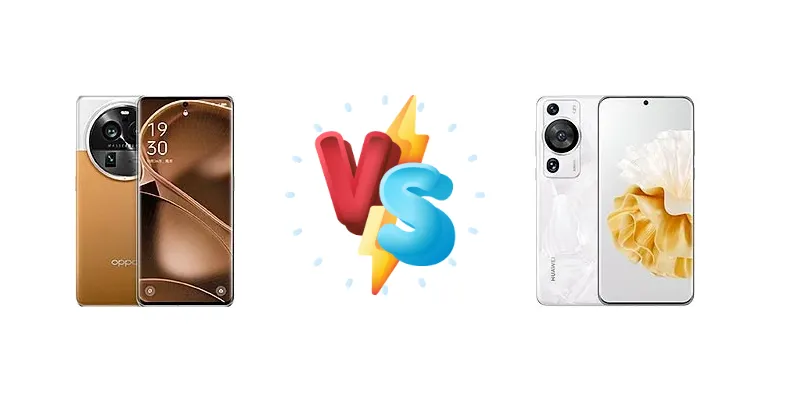
|
🏆 Quick Verdict
The Oppo Find X6 Pro takes the crown with its superior Snapdragon 8 Gen 2 chipset, faster charging speeds, and brighter display. However, the Huawei P60 Pro excels in certain camera scenarios and offers a unique design. Ultimately, the choice depends on your priorities.
| PHONES | ||
|---|---|---|
| Phone Names | Oppo Find X6 Pro | Huawei P60 Pro |
| Network | ||
|---|---|---|
| 2G bands | GSM 850 / 900 / 1800 / 1900 | GSM 850 / 900 / 1800 / 1900 |
| 3G bands | HSDPA 800 / 850 / 900 / 1700(AWS) / 1900 / 2100 | HSDPA 800 / 850 / 900 / 1700(AWS) / 1900 / 2100 |
| 4G bands | 1, 2, 3, 4, 5, 7, 8, 12, 17, 18, 19, 20, 26, 28, 34, 38, 39, 40, 41, 66 | 1, 2, 3, 4, 5, 7, 8, 12, 13, 17, 18, 19, 20, 26, 28, 32, 34, 38, 39, 40, 41, 66 - International |
| 5G bands | 1, 3, 5, 7, 8, 20, 28, 38, 40, 41, 66, 77, 78, 79 SA/NSA | - |
| Speed | HSPA, LTE, 5G | HSPA, LTE |
| Technology | GSM / CDMA / HSPA / CDMA2000 / LTE / 5G | GSM / CDMA / HSPA / CDMA2000 / LTE |
| CDMA2000 1x | 1, 2, 3, 4, 5, 7, 8, 12, 17, 18, 19, 20, 26, 28, 34, 38, 39, 40, 41 - China | |
| Launch | ||
|---|---|---|
| Announced | 2023, March 21 | 2023, March 23 |
| Status | Available. Released 2023, March 24 | Available. Released 2023, March 31 |
| Body | ||
|---|---|---|
| Build | Glass front (Gorilla Glass Victus 2), glass back (Gorilla Glass 5) or eco leather back, aluminum frame | - |
| Dimensions | 164.8 x 76.2 x 9.1 mm or 9.5 mm | 161 x 74.5 x 8.3 mm (6.34 x 2.93 x 0.33 in) |
| SIM | Nano-SIM + Nano-SIM | · Nano-SIM· Nano-SIM + Nano-SIM |
| Weight | 216 g or 218 g (7.62 oz) | 200 g (7.05 oz) |
| IP68 dust/water resistant (up to 1.5m for 30 min) | IP68 dust/water resistant (up to 1.5m for 30 min) | |
| Display | ||
|---|---|---|
| Protection | Corning Gorilla Glass Victus 2 | Kunlun Glass |
| Resolution | 1440 x 3168 pixels (~510 ppi density) | 1220 x 2700 pixels (~444 ppi density) |
| Size | 6.82 inches, 113.0 cm2 (~90.0% screen-to-body ratio) | 6.67 inches, 107.7 cm2 (~89.8% screen-to-body ratio) |
| Type | LTPO3 AMOLED, 1B colors, 120Hz, Dolby Vision, HDR10+, 800 nits (typ), 1500 nits (HBM), 2500 nits (peak) | LTPO OLED, 1B colors, 120Hz |
| Platform | ||
|---|---|---|
| CPU | Octa-core (1x3.2 GHz Cortex-X3 & 2x2.8 GHz Cortex-A715 & 2x2.8 GHz Cortex-A710 & 3x2.0 GHz Cortex-A510) | Octa-core (1x3.19 GHz Cortex-X2 & 3x2.75 GHz Cortex-A710 & 4x2.0 GHz Cortex-A510) |
| Chipset | Qualcomm SM8550-AB Snapdragon 8 Gen 2 (4 nm) | Qualcomm SM8475 Snapdragon 8+ Gen 1 4G (4 nm) |
| GPU | Adreno 740 | Adreno 730 |
| OS | Android 13, up to 4 major Android upgrades, ColorOS 14 | HarmonyOS 3.1 (China), EMUI 13.1 (Europe), no Google Play Services |
| Memory | ||
|---|---|---|
| Card slot | No | Nano Memory (uses shared SIM slot) |
| Internal | 256GB 12GB RAM, 256GB 16GB RAM, 512GB 16GB RAM | 256GB 8GB RAM, 256GB 12GB RAM, 512GB 12GB RAM |
| UFS 4.0 | UFS | |
| Main Camera | ||
|---|---|---|
| Features | Laser AF, color spectrum sensor, Hasselblad Color Calibration, LED flash, HDR, panorama | Laser AF, color spectrum sensor, LED flash, HDR, panorama |
| Triple | 50 MP, f/1.8, 23mm (wide), 1.0"-type, 1.6µm, dual pixel PDAF, OIS 50 MP, f/2.6, 65mm (periscope telephoto), 1/1.56", 1.0µm, 2.8x optical zoom, multi-directional PDAF, OIS 50 MP, f/2.2, 15mm, 110˚ (ultrawide), 1/1.56", 1.0µm, multi-directional PDAF | 48 MP, f/1.4-f/4.0, 25mm (wide), PDAF, OIS 48 MP, f/2.1, 90mm (telephoto), PDAF, sensor-shift OIS, 3.5x optical zoom 13 MP, f/2.2, 13mm (ultrawide), AF |
| Video | 4K@30/60fps, 1080p@30/60/240fps; gyro-EIS; HDR, 10‑bit video, Dolby Vision | 4K@30/60fps, 1080p@30/60fps, 1080p@960fps; gyro-EIS, HDR Vivid |
| Selfie camera | ||
|---|---|---|
| Features | Panorama | Panorama, HDR |
| Single | 32 MP, f/2.4, 21mm (wide), 1/2.74", 0.8µm, PDAF | 13 MP, f/2.4, (ultrawide) |
| Video | 4K@30fps, gyro-EIS | 4K@30/60fps, 1080p@30fps, HDR Vivid |
| Sound | ||
|---|---|---|
| 3.5mm jack | No | No |
| 35mm jack | No | No |
| Loudspeaker | Yes, with stereo speakers | Yes, with stereo speakers |
| Comms | ||
|---|---|---|
| Bluetooth | 5.3, A2DP, LE, aptX HD | 5.2, A2DP, LE |
| Infrared port | Yes | Yes |
| NFC | Yes | Yes |
| Positioning | GPS (L1+L5), GLONASS (G1), BDS (B1I+B1c+B2a), GALILEO (E1+E5a), QZSS (L1+L5) | GPS (L1+L5), GLONASS (B1I+B1c+B2a), BDS (B1I+B1c+B2a), GALILEO (E1+E5a), QZSS (L1+L5), NavIC |
| Radio | No | No |
| USB | USB Type-C 3.1, OTG | USB Type-C 3.1, OTG |
| WLAN | Wi-Fi 802.11 a/b/g/n/ac/6e/7, tri-band, Wi-Fi Direct | Wi-Fi 802.11 a/b/g/n/ac/6, dual-band, Wi-Fi Direct |
| Features | ||
|---|---|---|
| Sensors | Fingerprint (under display, optical), accelerometer, gyro, proximity, compass | Fingerprint (under display, optical), accelerometer, gyro, proximity, compass |
| - | BDS Satellite Message | |
| Battery | ||
|---|---|---|
| Charging | 100W wired, PD, 45% in 10 min, 100% in 30 min 50W wireless, 50% in 22 min, 100% in 51 min 10W reverse wireless | 88W wired 50W wireless Reverse wireless |
| Type | Li-Po 5000 mAh | Li-Po 4815 mAh |
| Misc | ||
|---|---|---|
| Colors | Black, Green, Brown | Black, Green, Violet, Rococo Pearl |
| Models | PGEM110, PGEM10 | MNA-AL00, MNA-LX9 |
| Price | About 820 EUR | € 738.50 |
| Tests | ||
|---|---|---|
| Battery life | Endurance rating 114h | Endurance rating 96h |
| Camera | Photo / Video | Photo / Video |
| Display | Contrast ratio: Infinite (nominal) | Contrast ratio: Infinite (nominal) |
| Loudspeaker | -25.1 LUFS (Very good) | -27.3 LUFS (Good) |
| Performance | AnTuTu: 1294797 (v9) GeekBench: 4791 (v5.1), 5226 (v6) GFXBench: 60fps (ES 3.1 onscreen) | AnTuTu: 1030473 (v9) GeekBench: 4422 (v6) GFXBench: 65fps (ES 3.1 onscreen) |
Oppo Find X6 Pro
- Superior Performance (Snapdragon 8 Gen 2)
- Faster Charging (100W wired)
- Brighter Display (1318 nits)
- Longer Battery Life (114h Endurance)
- Reverse Wireless Charging
- Design might be less distinctive than P60 Pro
- Software experience may not appeal to all
Huawei P60 Pro
- Exceptional Zoom Capabilities
- Unique Design
- Excellent Camera Hardware
- Refined User Experience (HarmonyOS)
- Slower Performance (Snapdragon 8+ Gen 1)
- Slower Charging
- 4G-only connectivity
- HarmonyOS ecosystem limitations
Display Comparison
Both phones feature stunning OLED displays with infinite contrast ratios. However, the Oppo Find X6 Pro boasts a significantly brighter peak brightness of 1318 nits compared to the P60 Pro's 1135 nits, making it easier to view in direct sunlight. Color accuracy is excellent on both, but Oppo's calibration might offer a slightly more vibrant experience.
Camera Comparison
Both phones offer exceptional camera systems. The P60 Pro shines with its impressive telephoto lens and exceptional zoom capabilities, particularly at longer ranges. The Find X6 Pro delivers excellent all-around performance, with a versatile main sensor and strong video recording capabilities. Low-light performance is competitive on both.
Performance
The Oppo Find X6 Pro holds a clear advantage here. Its Snapdragon 8 Gen 2 chipset is noticeably faster and more efficient than the P60 Pro's Snapdragon 8+ Gen 1. This translates to smoother multitasking, faster app loading times, and better gaming performance. The P60 Pro's 4G-only connectivity is also a limitation.
Battery Life
The Oppo Find X6 Pro boasts a larger battery and significantly faster charging speeds (100W wired, 50W wireless) compared to the P60 Pro (88W wired, 50W wireless). The Find X6 Pro's endurance rating of 114h also surpasses the P60 Pro's 96h, suggesting longer battery life in real-world usage.
Buying Guide
Who should buy the Oppo Find X6 Pro? Users prioritizing raw performance, faster charging, and a brighter screen. Who should buy the Huawei P60 Pro? Those seeking exceptional zoom capabilities, a distinctive design, and a refined user experience (assuming HarmonyOS compatibility is acceptable).