
Oppo Find X5 vs Oppo Reno8 Pro: A Detailed Showdown
| Phones Images | |||||
|---|---|---|---|---|---|
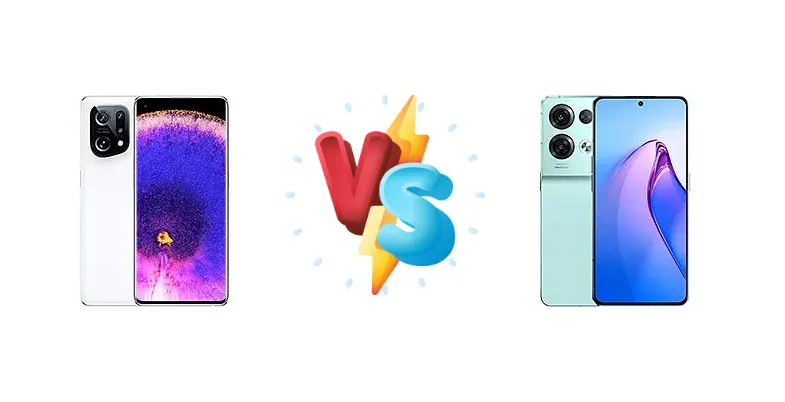
|
🏆 Quick Verdict
The Oppo Reno8 Pro edges out the Find X5 thanks to its slightly brighter display, faster charging, and the more modern Dimensity 8100 Max chipset. While the Find X5 boasts a Snapdragon 888, the Reno8 Pro's overall package provides a more compelling experience for most users.
| PHONES | ||
|---|---|---|
| Phone Names | Oppo Find X5 | Oppo Reno8 Pro |
| Network | ||
|---|---|---|
| 2G bands | GSM 850 / 900 / 1800 / 1900 | GSM 850 / 900 / 1800 / 1900 |
| 3G bands | HSDPA 800 / 850 / 900 / 1700(AWS) / 1900 / 2100 | HSDPA 800 / 850 / 900 / 1700(AWS) / 1900 / 2100 |
| 4G bands | 1, 2, 3, 4, 5, 7, 8, 12, 13, 17, 18, 19, 20, 25, 26, 28, 32, 34, 38, 39, 40, 41, 42, 66 - Global | 1, 2, 3, 4, 5, 7, 8, 12, 17, 18, 19, 20, 26, 28, 32, 38, 39, 40, 41 |
| 5G bands | 1, 3, 5, 7, 8, 12, 13, 18, 20, 26, 28, 38, 40, 41, 66, 77, 78 SA/NSA - Global | 1, 3, 5, 7, 8, 20, 28, 38, 40, 41, 77, 78 SA/NSA |
| Speed | HSPA, LTE, 5G | HSPA, LTE, 5G |
| Technology | GSM / CDMA / HSPA / CDMA2000 / LTE / 5G | GSM / HSPA / LTE / 5G |
| 1, 2, 3, 5, 8, 20, 28, 38, 41, 66, 77, 78, 79 SA/NSA - China | - | |
| Launch | ||
|---|---|---|
| Announced | 2022, February 24 | 2022, July 18 |
| Status | Available. Released 2022, March 14 | Available. Released 2022, July 19 |
| Body | ||
|---|---|---|
| Build | Glass front (Gorilla Glass Victus), glass back, aluminum frame | Glass front (Gorilla Glass 5), aluminum frame, glass back |
| Dimensions | 160.3 x 72.6 x 8.7 mm (6.31 x 2.86 x 0.34 in) | 161.2 x 74.2 x 7.3 mm (6.35 x 2.92 x 0.29 in) |
| SIM | Nano-SIM + eSIM | Nano-SIM + Nano-SIM |
| Weight | 196 g (6.91 oz) | 183 g (6.46 oz) |
| Display | ||
|---|---|---|
| Protection | Corning Gorilla Glass Victus | Corning Gorilla Glass 5 |
| Resolution | 1080 x 2400 pixels, 20:9 ratio (~402 ppi density) | 1080 x 2412 pixels, 20:9 ratio (~394 ppi density) |
| Size | 6.55 inches, 103.6 cm2 (~89.0% screen-to-body ratio) | 6.7 inches, 108.0 cm2 (~90.3% screen-to-body ratio) |
| Type | AMOLED, 1B colors, 120Hz, HDR10+, 500 nits (typ), 800 nits (HBM), 1000 nits (peak) | AMOLED, 1B colors, 120Hz, HDR10+, 500 nits (typ), 800 nits (HBM), 950 nits (peak) |
| Platform | ||
|---|---|---|
| CPU | Octa-core (1x2.84 GHz Cortex-X1 & 3x2.42 GHz Cortex-A78 & 4x1.80 GHz Cortex-A55 | Octa-core (4x2.85 GHz Cortex-A78 & 4x2.0 GHz Cortex-A55) |
| Chipset | Qualcomm SM8350 Snapdragon 888 5G (5 nm) | Mediatek Dimensity 8100 Max (5 nm) |
| GPU | Adreno 660 | Mali-G610 MC6 |
| OS | Android 12, upgradable to Android 14, ColorOS 14 | Android 12, upgradable to Android 14, ColorOS 14 |
| Memory | ||
|---|---|---|
| Card slot | No | No |
| Internal | 128GB 8GB RAM, 256GB 8GB RAM, 256GB 12GB RAM | 256GB 8GB RAM, 256GB 12GB RAM |
| UFS 3.1 | UFS 3.1 | |
| Main Camera | ||
|---|---|---|
| Features | Hasselblad Color Calibration, color spectrum sensor, LED flash, HDR, panorama | Color spectrum sensor, LED flash, HDR, panorama |
| Single | 32 MP, f/2.4, 25mm (wide), 1/2.74", 0.8µm | 32 MP, f/2.4, 22mm (wide), 1/2.74", 0.8µm, AF |
| Triple | 50 MP, f/1.8, 24mm (wide), 1/1.56", 1.0µm, multi-directional PDAF, OIS 13 MP, f/2.4, 52mm (telephoto), 1/3.4", 2x optical zoom, PDAF 50 MP, f/2.2, 15mm, 110˚ (ultrawide), 1/1.56", 1.0µm, multi-directional PDAF | 50 MP, f/1.8, 23mm (wide), 1/1.56", 1.0µm, multi-directional PDAF 8 MP, f/2.2, 16mm, 112˚ (ultrawide), 1/4.0", 1.12µm 2 MP (macro) |
| Video | 4K@30/60fps, 1080p@30/60/240fps; gyro-EIS; HDR, 10‑bit video | 4K@30fps, 1080p@30/60/120/240fps, 720p@960fps, gyro-EIS |
| Selfie camera | ||
|---|---|---|
| Features | Panorama | Panorama, HDR |
| Single | 32 MP, f/2.4, 25mm (wide), 1/2.74", 0.8µm | 32 MP, f/2.4, 22mm (wide), 1/2.74", 0.8µm, AF |
| Video | 1080p@30fps, gyro-EIS | 1080p@30fps, gyro-EIS |
| Sound | ||
|---|---|---|
| 3.5mm jack | No | No |
| 35mm jack | No | No |
| Loudspeaker | Yes, with stereo speakers | Yes, with stereo speakers |
| Comms | ||
|---|---|---|
| Bluetooth | 5.2, A2DP, LE, aptX HD | 5.3, A2DP, LE, aptX HD |
| NFC | Yes | Yes |
| Positioning | GPS (L1), GLONASS (L1), BDS (B1I+B1c), GALILEO (E1+E5a), QZSS (L1) | GPS (L1+L5), GLONASS (L1), BDS (B1I+B2a), GALILEO (E1+E5a), QZSS (L1+L5) |
| Radio | No | No |
| USB | USB Type-C 3.1, OTG | USB Type-C 2.0, OTG |
| WLAN | Wi-Fi 802.11 a/b/g/n/ac/6, dual-band, Wi-Fi Direct | Wi-Fi 802.11 a/b/g/n/ac/6, dual-band, Wi-Fi Direct |
| Features | ||
|---|---|---|
| Sensors | Fingerprint (under display, optical), accelerometer, gyro, proximity, compass | Fingerprint (under display, optical), accelerometer, gyro, proximity, compass |
| Battery | ||
|---|---|---|
| Charging | 80W wired, PD 30W wireless 10W reverse wireless | 80W wired, 45% in 10 min, 100% in 31 min Reverse wired |
| Type | Li-Po 4800 mAh | Li-Po 4500 mAh |
| Misc | ||
|---|---|---|
| Colors | Black, White, Purple | Glazed Green, Glazed Black, House of the Dragon |
| Models | PFFM10, CPH2307 | CPH2357 |
| Price | $ 950.00 / £ 218.30 / € 339.00 | ₹ 28,490 |
| Tests | ||
|---|---|---|
| Battery life | Endurance rating 108h | Endurance rating 100h |
| Camera | Photo / Video | Photo / Video |
| Display | Contrast ratio: Infinite (nominal) | Contrast ratio: Infinite (nominal) |
| Loudspeaker | -26.3 LUFS (Good) | -25.5 LUFS (Very good) |
| Performance | AnTuTu: 810715 (v9) GeekBench: 3331 (v5.1) GFXBench: 59fps (ES 3.1 onscreen) | AnTuTu: 718351 (v9) GeekBench: 3395 (v5.1) GFXBench: 44fps (ES 3.1 onscreen) |
Oppo Find X5
- Established Snapdragon 888 chipset
- Potentially refined camera processing
- Excellent display quality
- 80W wired charging
- Slightly older chipset
- Charging speed not specified, likely slower than Reno8 Pro
- Can throttle under sustained load
Oppo Reno8 Pro
- Modern Dimensity 8100 Max chipset
- Brighter display (818 nits)
- Faster 80W wired charging (31 min to 100%)
- Efficient performance
- Camera processing might be slightly less refined than Find X5
- Reverse wired charging not specified
Display Comparison
Both phones feature excellent displays with infinite contrast ratios. The Reno8 Pro takes a slight lead with a measured peak brightness of 818 nits compared to the Find X5's 807 nits. Both offer vibrant colors and sharp details, making them enjoyable for media consumption. The difference in brightness is subtle but noticeable in direct sunlight.
Camera Comparison
Both phones offer excellent camera systems, but the Find X5 is generally considered to have a slightly more refined image processing pipeline. Both capture detailed photos and videos in various lighting conditions. The Reno8 Pro might offer slightly more versatile zoom capabilities depending on the specific lens configurations (information not provided in the specs). Low-light performance is comparable on both devices.
Performance
The Reno8 Pro's Mediatek Dimensity 8100 Max generally offers better performance than the Find X5's Snapdragon 888, especially in sustained workloads. The Dimensity 8100 Max's architecture is more efficient and modern. While the Snapdragon 888 is still a capable chip, it can throttle under heavy load more readily. Gaming performance is also slightly better on the Reno8 Pro.
Battery Life
Both phones offer impressive battery life, with endurance ratings of 108h and 100h respectively. The Reno8 Pro's 80W wired charging is significantly faster, reaching 100% in just 31 minutes, compared to the Find X5's charging time (not specified, but likely longer). Both support wireless charging.
Buying Guide
The Oppo Find X5 is ideal for users prioritizing a slightly more established chipset and potentially a more refined camera experience (though both are excellent). The Oppo Reno8 Pro is a better choice for those who value a brighter display, faster charging speeds, and the latest generation Dimensity processor for smoother performance.