
Oppo Find X5 vs OnePlus 11R: A Detailed Comparison of Performance, Battery, and Value
| Phones Images | |||||
|---|---|---|---|---|---|
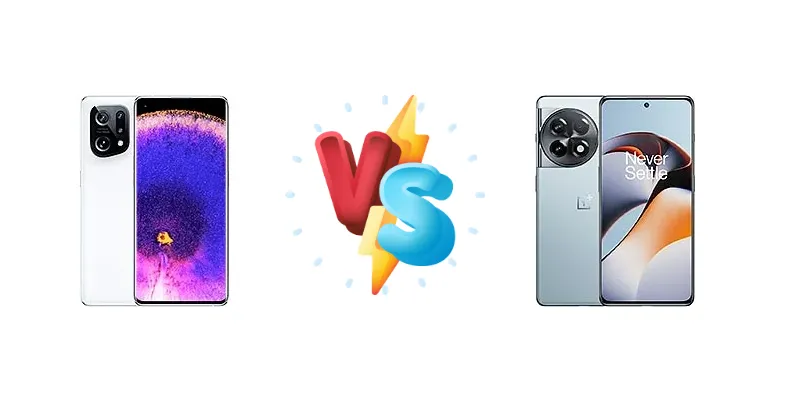
|
🏆 Quick Verdict
For most users, the OnePlus 11R emerges as the better buy. Its Snapdragon 8+ Gen 1 chipset offers a significant performance uplift over the Find X5’s Snapdragon 888, and the 100W charging is noticeably faster. While the Find X5 holds its own, the 11R provides a more future-proof experience.
| PHONES | ||
|---|---|---|
| Phone Names | Oppo Find X5 | OnePlus 11R |
| Network | ||
|---|---|---|
| 2G bands | GSM 850 / 900 / 1800 / 1900 | GSM 850 / 900 / 1800 / 1900 |
| 3G bands | HSDPA 800 / 850 / 900 / 1700(AWS) / 1900 / 2100 | HSDPA 850 / 900 / 1700(AWS) / 2100 |
| 4G bands | 1, 2, 3, 4, 5, 7, 8, 12, 13, 17, 18, 19, 20, 25, 26, 28, 32, 34, 38, 39, 40, 41, 42, 66 - Global | 1, 3, 4, 5, 8, 28, 34, 38, 39, 40, 41 |
| 5G bands | 1, 3, 5, 7, 8, 12, 13, 18, 20, 26, 28, 38, 40, 41, 66, 77, 78 SA/NSA - Global | 1, 3, 5, 8, 28, 40, 41, 77, 78 SA/NSA |
| Speed | HSPA, LTE, 5G | HSPA, LTE (3CA), 5G |
| Technology | GSM / CDMA / HSPA / CDMA2000 / LTE / 5G | GSM / CDMA / HSPA / LTE / 5G |
| 1, 2, 3, 5, 8, 20, 28, 38, 41, 66, 77, 78, 79 SA/NSA - China | CDMA 800 | |
| Launch | ||
|---|---|---|
| Announced | 2022, February 24 | 2023, February 07 |
| Status | Available. Released 2022, March 14 | Available. Released 2023, February 21 |
| Body | ||
|---|---|---|
| Build | Glass front (Gorilla Glass Victus), glass back, aluminum frame | Glass front, glass back (Gorilla Glass 5), plastic frame |
| Dimensions | 160.3 x 72.6 x 8.7 mm (6.31 x 2.86 x 0.34 in) | 163.4 x 74.3 x 8.7 mm (6.43 x 2.93 x 0.34 in) |
| SIM | Nano-SIM + eSIM | Nano-SIM + Nano-SIM |
| Weight | 196 g (6.91 oz) | 204 g (7.20 oz) |
| Display | ||
|---|---|---|
| Protection | Corning Gorilla Glass Victus | - |
| Resolution | 1080 x 2400 pixels, 20:9 ratio (~402 ppi density) | 1240 x 2772 pixels, 20:9 ratio (~451 ppi density) |
| Size | 6.55 inches, 103.6 cm2 (~89.0% screen-to-body ratio) | 6.74 inches, 109.2 cm2 (~90.0% screen-to-body ratio) |
| Type | AMOLED, 1B colors, 120Hz, HDR10+, 500 nits (typ), 800 nits (HBM), 1000 nits (peak) | Fluid AMOLED, 1B colors, 120Hz, HDR10+, 1450 nits (peak) |
| Platform | ||
|---|---|---|
| CPU | Octa-core (1x2.84 GHz Cortex-X1 & 3x2.42 GHz Cortex-A78 & 4x1.80 GHz Cortex-A55 | Octa-core (1x3.0 GHz Cortex-X2 & 3x2.5 GHz Cortex-A710 & 4x1.80 GHz Cortex-A510) |
| Chipset | Qualcomm SM8350 Snapdragon 888 5G (5 nm) | Qualcomm SM8475 Snapdragon 8+ Gen 1 (4 nm) |
| GPU | Adreno 660 | Adreno 730 |
| OS | Android 12, upgradable to Android 14, ColorOS 14 | Android 13, upgradable to Android 15, OxygenOS 15 |
| Memory | ||
|---|---|---|
| Card slot | No | No |
| Internal | 128GB 8GB RAM, 256GB 8GB RAM, 256GB 12GB RAM | 128GB 8GB RAM, 256GB 16GB RAM, 512GB 18GB RAM |
| UFS 3.1 | UFS 3.1 | |
| Main Camera | ||
|---|---|---|
| Features | Hasselblad Color Calibration, color spectrum sensor, LED flash, HDR, panorama | Color spectrum sensor, LED flash, HDR, panorama |
| Single | 32 MP, f/2.4, 25mm (wide), 1/2.74", 0.8µm | 16 MP, f/2.4, 24mm (wide), 1/3.09", 1.0µm |
| Triple | 50 MP, f/1.8, 24mm (wide), 1/1.56", 1.0µm, multi-directional PDAF, OIS 13 MP, f/2.4, 52mm (telephoto), 1/3.4", 2x optical zoom, PDAF 50 MP, f/2.2, 15mm, 110˚ (ultrawide), 1/1.56", 1.0µm, multi-directional PDAF | 50 MP, f/1.8, 24mm (wide), 1/1.56", 1.0µm, multi-directional PDAF, OIS 8 MP, f/2.2, 120˚ (ultrawide), 1/4.0", 1.12µm 2 MP (macro) |
| Video | 4K@30/60fps, 1080p@30/60/240fps; gyro-EIS; HDR, 10‑bit video | 4K@30/60fps, 1080p@30/60/240fps, gyro-EIS |
| Selfie camera | ||
|---|---|---|
| Features | Panorama | HDR |
| Single | 32 MP, f/2.4, 25mm (wide), 1/2.74", 0.8µm | 16 MP, f/2.4, 24mm (wide), 1/3.09", 1.0µm |
| Video | 1080p@30fps, gyro-EIS | 1080p@30fps |
| Sound | ||
|---|---|---|
| 3.5mm jack | No | No |
| 35mm jack | No | No |
| Loudspeaker | Yes, with stereo speakers | Yes, with stereo speakers |
| - | 24-bit/192kHz audio | |
| Comms | ||
|---|---|---|
| Bluetooth | 5.2, A2DP, LE, aptX HD | 5.3, A2DP, LE, aptX HD |
| Infrared port | - | Yes |
| NFC | Yes | Yes |
| Positioning | GPS (L1), GLONASS (L1), BDS (B1I+B1c), GALILEO (E1+E5a), QZSS (L1) | GPS (L1+L5), GLONASS (G1), BDS (B1I+B1c+B2a), GALILEO (E1+E5a), QZSS (L1+L5) |
| Radio | No | No |
| USB | USB Type-C 3.1, OTG | USB Type-C 2.0 |
| WLAN | Wi-Fi 802.11 a/b/g/n/ac/6, dual-band, Wi-Fi Direct | Wi-Fi 802.11 a/b/g/n/ac/6, dual-band |
| Features | ||
|---|---|---|
| Sensors | Fingerprint (under display, optical), accelerometer, gyro, proximity, compass | Fingerprint (under display, optical), accelerometer, gyro, proximity, compass |
| Battery | ||
|---|---|---|
| Charging | 80W wired, PD 30W wireless 10W reverse wireless | 100W wired |
| Type | Li-Po 4800 mAh | Li-Po 5000 mAh |
| Misc | ||
|---|---|---|
| Colors | Black, White, Purple | Galactic Silver, Sonic Black, Solar Red |
| Models | PFFM10, CPH2307 | CPH2487 |
| Price | $ 950.00 / £ 218.30 / € 339.00 | About 600 EUR |
| SAR | - | 1.16 W/kg (head) 0.61 W/kg (body) |
| Tests | ||
|---|---|---|
| Battery life | Endurance rating 108h | - |
| Camera | Photo / Video | - |
| Display | Contrast ratio: Infinite (nominal) | - |
| Loudspeaker | -26.3 LUFS (Good) | - |
| Performance | AnTuTu: 810715 (v9) GeekBench: 3331 (v5.1) GFXBench: 59fps (ES 3.1 onscreen) | - |
Oppo Find X5
- Versatile charging options (wired, wireless, reverse wireless)
- Potentially lower price point due to age
- Established camera system (based on Oppo's reputation)
- Older Snapdragon 888 chipset
- Less efficient 5nm process
- Slower charging compared to the 11R
OnePlus 11R
- Faster Snapdragon 8+ Gen 1 chipset
- More efficient 4nm process
- 100W SuperVOOC charging for rapid refills
- Missing wireless charging capabilities
- Potentially higher price
- Camera performance details are unknown
Display Comparison
The Oppo Find X5 boasts a display capable of reaching 807 nits of peak brightness, ensuring excellent visibility even outdoors. While the OnePlus 11R’s display specifications aren’t provided, OnePlus typically prioritizes high refresh rates and color accuracy in this segment. The Find X5’s ‘Infinite’ contrast ratio suggests a high-quality OLED panel, but without comparable data for the 11R, it’s difficult to definitively declare a winner. Both likely employ PWM dimming, but specific frequencies aren’t available to assess potential flicker sensitivity.
Camera Comparison
Both devices are listed as having Photo/Video capabilities, but detailed camera specifications are absent. Given Oppo’s strong camera reputation, the Find X5 likely features a more refined image processing pipeline. However, without sensor size, aperture, or OIS details, a direct comparison is impossible. It’s reasonable to assume both phones offer competent camera systems for everyday use, but the Find X5 may have an edge in image quality due to Oppo’s software optimization. We can safely ignore the presence of a likely low-resolution 2MP macro lens on either device.
Performance
This is where the OnePlus 11R pulls ahead. The Snapdragon 8+ Gen 1 (4nm) is a substantial upgrade over the Oppo Find X5’s Snapdragon 888 (5nm). The 8+ Gen 1’s more efficient 4nm process translates to better thermal management and sustained performance under load. The 11R’s CPU configuration – a Cortex-X2 prime core clocked at 3.0 GHz alongside three Cortex-A710 performance cores – provides a noticeable boost in both single-core and multi-core tasks compared to the Find X5’s Cortex-X1 and A78 setup. The 11R is the clear choice for gamers and power users.
Battery Life
The Oppo Find X5 has an endurance rating of 108 hours, indicating solid battery life. It supports 80W wired charging, 30W wireless, and 10W reverse wireless – a versatile charging suite. The OnePlus 11R counters with a blazing-fast 100W wired charging solution, significantly reducing charge times. While the 11R’s battery capacity isn’t specified, the faster charging speed likely compensates for any potential difference in capacity, making it more convenient for users who prioritize quick top-ups.
Buying Guide
Buy the Oppo Find X5 if you prioritize a potentially lower price point and are comfortable with a slightly older chipset. Its well-rounded feature set and established camera system still deliver a premium experience. Buy the OnePlus 11R if you demand the best possible performance for the price, value rapid charging, and want a phone that will handle demanding tasks and games with ease.