
Asus ROG Phone 6 Pro vs. Oppo Find X5: A Deep Dive into Gaming and Flagship Features
| Phones Images | |||||
|---|---|---|---|---|---|
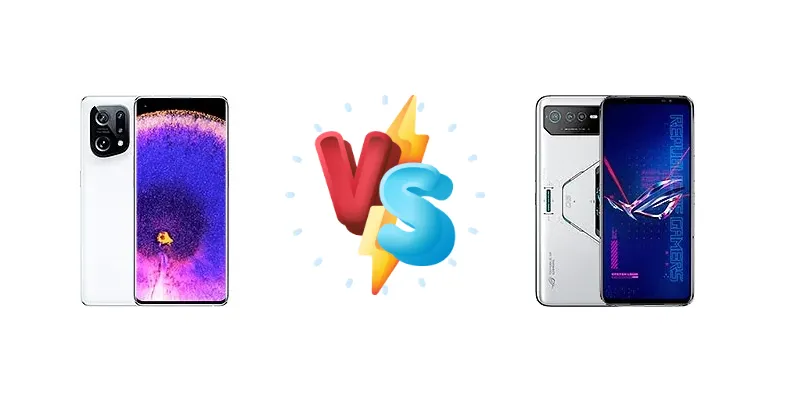
|
🏆 Quick Verdict
For the average user prioritizing a balanced experience with a strong camera and elegant design, the Oppo Find X5 is the better choice. However, if mobile gaming is your primary focus, the Asus ROG Phone 6 Pro’s superior chipset and optimized cooling system deliver unmatched performance.
| PHONES | ||
|---|---|---|
| Phone Names | Oppo Find X5 | Asus ROG Phone 6 Pro |
| Network | ||
|---|---|---|
| 2G bands | GSM 850 / 900 / 1800 / 1900 | GSM 850 / 900 / 1800 / 1900 |
| 3G bands | HSDPA 800 / 850 / 900 / 1700(AWS) / 1900 / 2100 | HSDPA 800 / 850 / 900 / 1700(AWS) / 1900 / 2100 |
| 4G bands | 1, 2, 3, 4, 5, 7, 8, 12, 13, 17, 18, 19, 20, 25, 26, 28, 32, 34, 38, 39, 40, 41, 42, 66 - Global | 1, 2, 3, 4, 5, 7, 8, 12, 13, 17, 18, 19, 20, 25, 26, 28, 29, 30, 32, 34, 38, 39, 40, 41, 42, 43, 48, 66, 71 - Version A |
| 5G bands | 1, 3, 5, 7, 8, 12, 13, 18, 20, 26, 28, 38, 40, 41, 66, 77, 78 SA/NSA - Global | 1, 2, 3, 5, 7, 8, 12, 13, 18, 20, 25, 26, 28, 38, 40, 41, 48, 66, 71, 77, 78, 79 SA/NSA/Sub6 - Version A |
| Speed | HSPA, LTE, 5G | HSPA 42.2/5.76 Mbps, LTE (6CA) Cat20 2024/210 Mbps, 5G |
| Technology | GSM / CDMA / HSPA / CDMA2000 / LTE / 5G | GSM / CDMA / HSPA / LTE / 5G |
| 1, 2, 3, 5, 8, 20, 28, 38, 41, 66, 77, 78, 79 SA/NSA - China | 1, 3, 5, 8, 28, 41, 77, 78, 79 - Version B | |
| Launch | ||
|---|---|---|
| Announced | 2022, February 24 | 2022, July 05 |
| Status | Available. Released 2022, March 14 | Available. Released 2022, July 13 |
| Body | ||
|---|---|---|
| Build | Glass front (Gorilla Glass Victus), glass back, aluminum frame | Glass front (Gorilla Glass Victus), glass back (Gorilla Glass 3), aluminum frame |
| Dimensions | 160.3 x 72.6 x 8.7 mm (6.31 x 2.86 x 0.34 in) | 173 x 77 x 10.3 mm (6.81 x 3.03 x 0.41 in) |
| SIM | Nano-SIM + eSIM | Nano-SIM + Nano-SIM |
| Weight | 196 g (6.91 oz) | 239 g (8.43 oz) |
| - | IPX4 water resistant 2" OLED display (on the back) Pressure sensitive zones (Gaming triggers) | |
| Display | ||
|---|---|---|
| Protection | Corning Gorilla Glass Victus | Corning Gorilla Glass Victus |
| Resolution | 1080 x 2400 pixels, 20:9 ratio (~402 ppi density) | 1080 x 2448 pixels (~395 ppi density) |
| Size | 6.55 inches, 103.6 cm2 (~89.0% screen-to-body ratio) | 6.78 inches, 109.5 cm2 (~82.2% screen-to-body ratio) |
| Type | AMOLED, 1B colors, 120Hz, HDR10+, 500 nits (typ), 800 nits (HBM), 1000 nits (peak) | AMOLED, 1B colors, 165Hz, HDR10+, 800 nits (typ), 1200 nits (peak) |
| Platform | ||
|---|---|---|
| CPU | Octa-core (1x2.84 GHz Cortex-X1 & 3x2.42 GHz Cortex-A78 & 4x1.80 GHz Cortex-A55 | Octa-core (1x3.19 GHz Cortex-X2 & 3x2.75 GHz Cortex-A710 & 4x1.80 GHz Cortex-A510) |
| Chipset | Qualcomm SM8350 Snapdragon 888 5G (5 nm) | Qualcomm SM8475 Snapdragon 8+ Gen 1 (4 nm) |
| GPU | Adreno 660 | Adreno 730 |
| OS | Android 12, upgradable to Android 14, ColorOS 14 | Android 12, upgradable to Android 13 |
| Memory | ||
|---|---|---|
| Card slot | No | No |
| Internal | 128GB 8GB RAM, 256GB 8GB RAM, 256GB 12GB RAM | 512GB 18GB RAM |
| UFS 3.1 | UFS 3.1 NTFS support for external storage | |
| Main Camera | ||
|---|---|---|
| Features | Hasselblad Color Calibration, color spectrum sensor, LED flash, HDR, panorama | LED flash, HDR, panorama |
| Single | 32 MP, f/2.4, 25mm (wide), 1/2.74", 0.8µm | - |
| Triple | 50 MP, f/1.8, 24mm (wide), 1/1.56", 1.0µm, multi-directional PDAF, OIS 13 MP, f/2.4, 52mm (telephoto), 1/3.4", 2x optical zoom, PDAF 50 MP, f/2.2, 15mm, 110˚ (ultrawide), 1/1.56", 1.0µm, multi-directional PDAF | 50 MP, f/1.9, (wide), 1/1.56", 1.0µm, PDAF 13 MP, f/2.2, (ultrawide) 5 MP (macro) |
| Video | 4K@30/60fps, 1080p@30/60/240fps; gyro-EIS; HDR, 10‑bit video | 8K@24fps, 4K@30/60/120fps, 1080p@30/60/120/240fps, 720p@480fps; gyro-EIS |
| Selfie camera | ||
|---|---|---|
| Features | Panorama | Panorama, HDR |
| Single | 32 MP, f/2.4, 25mm (wide), 1/2.74", 0.8µm | 12 MP, 28mm (wide) |
| Video | 1080p@30fps, gyro-EIS | 1080p@30fps |
| Sound | ||
|---|---|---|
| 3.5mm jack | No | Yes |
| 35mm jack | No | Yes |
| Loudspeaker | Yes, with stereo speakers | Yes, with stereo speakers (2 amplifiers) |
| - | 32-bit/384kHz audio | |
| Comms | ||
|---|---|---|
| Bluetooth | 5.2, A2DP, LE, aptX HD | 5.2, A2DP, LE, aptX HD, aptX Adaptive, aptX Lossless |
| NFC | Yes | Yes |
| Positioning | GPS (L1), GLONASS (L1), BDS (B1I+B1c), GALILEO (E1+E5a), QZSS (L1) | GPS (L1+L5), GLONASS (L1), BDS (B1I+B1c+B2a), GALILEO (E1+E5a), QZSS (L1+L5), NavIC (L5) |
| Radio | No | No |
| USB | USB Type-C 3.1, OTG | USB Type-C 3.1 (side), USB Type-C 2.0 (bottom), OTG, accessory connector |
| WLAN | Wi-Fi 802.11 a/b/g/n/ac/6, dual-band, Wi-Fi Direct | Wi-Fi 802.11 a/b/g/n/ac/6e, tri-band, Wi-Fi Direct |
| Features | ||
|---|---|---|
| Sensors | Fingerprint (under display, optical), accelerometer, gyro, proximity, compass | Fingerprint (under display, optical), accelerometer, gyro, proximity, compass |
| Battery | ||
|---|---|---|
| Charging | 80W wired, PD 30W wireless 10W reverse wireless | 65W wired, PD3.0, QC5, 100% in 42 min 10W reverse wired |
| Type | Li-Po 4800 mAh | Li-Po 6000 mAh |
| Misc | ||
|---|---|---|
| Colors | Black, White, Purple | Storm White |
| Models | PFFM10, CPH2307 | AI2201_D |
| Price | $ 950.00 / £ 218.30 / € 339.00 | About 800 EUR |
| Tests | ||
|---|---|---|
| Battery life | Endurance rating 108h | Endurance rating 119h |
| Camera | Photo / Video | Photo / Video |
| Display | Contrast ratio: Infinite (nominal) | Contrast ratio: Infinite (nominal) |
| Loudspeaker | -26.3 LUFS (Good) | -24.1 LUFS (Very good) |
| Performance | AnTuTu: 810715 (v9) GeekBench: 3331 (v5.1) GFXBench: 59fps (ES 3.1 onscreen) | AnTuTu: 973756 (v8), 1103188 (v9) GeekBench: 3980 (v5.1) GFXBench: 79fps (ES 3.1 onscreen) |
Oppo Find X5
- Sleek and refined design
- Potentially superior camera system
- Faster wireless charging (30W)
- Older Snapdragon 888 chipset
- Shorter battery life compared to ROG Phone 6 Pro
- Less focused on gaming
Asus ROG Phone 6 Pro
- Significantly more powerful Snapdragon 8+ Gen 1
- Longer battery life and endurance
- Optimized for gaming with likely high refresh rate display
- Bulky and aggressive design
- Camera likely secondary to gaming features
- Less emphasis on everyday photography
Display Comparison
Both devices feature displays with an 'Infinite' (nominal) contrast ratio, indicating excellent black levels. However, the ROG Phone 6 Pro edges out the Find X5 with a measured peak brightness of 829 nits compared to the Find X5’s 807 nits, offering slightly better visibility in direct sunlight. While both are excellent, the ROG Phone 6 Pro’s larger display and higher refresh rate (likely 165Hz, based on ROG Phone tradition, though not specified) contribute to a more immersive gaming experience. The Find X5 likely prioritizes color accuracy for content consumption, while the ROG Phone 6 Pro leans towards responsiveness.
Camera Comparison
Both phones are listed as having 'Photo / Video' capabilities, but the context data lacks specifics. Given Oppo’s strong camera reputation, the Find X5 likely boasts a more versatile and refined camera system, potentially with a larger main sensor and more advanced image processing algorithms. The ROG Phone 6 Pro, while capable, likely prioritizes camera functionality as a secondary feature. Without sensor size or aperture information, it’s difficult to make a definitive judgment, but the Find X5 is expected to excel in everyday photography and videography.
Performance
The Asus ROG Phone 6 Pro’s Qualcomm SM8475 Snapdragon 8+ Gen 1 (4nm) represents a significant leap over the Oppo Find X5’s Snapdragon 888 (5nm). The 4nm process node delivers improved thermal efficiency, meaning the ROG Phone 6 Pro can sustain peak performance for longer periods without throttling. The ROG Phone 6 Pro’s CPU, featuring a Cortex-X2 prime core clocked at 3.19 GHz, outperforms the Find X5’s Cortex-X1 at 2.84 GHz. This translates to faster app loading times, smoother multitasking, and a noticeable advantage in demanding games. The ROG Phone 6 Pro’s likely inclusion of faster LPDDR5X RAM further enhances performance.
Battery Life
The Asus ROG Phone 6 Pro boasts a slightly longer endurance rating of 119 hours compared to the Oppo Find X5’s 108 hours. This, combined with the more efficient Snapdragon 8+ Gen 1, suggests superior battery life, especially during gaming. While the Find X5 offers faster 80W wired charging and 30W wireless charging, the ROG Phone 6 Pro’s 65W wired charging (and 42-minute 0-100% claim) is still competitive. The ROG Phone 6 Pro also includes 10W reverse *wired* charging, a feature absent in the Find X5’s 10W reverse *wireless* charging.
Buying Guide
Buy the Oppo Find X5 if you need a premium smartphone with a focus on photography, a sleek design, and fast charging, and don't require the absolute highest gaming performance. Buy the Asus ROG Phone 6 Pro if you prioritize maximum gaming performance, extended battery life during intense sessions, and are willing to accept a more aggressive design aesthetic and larger form factor.