
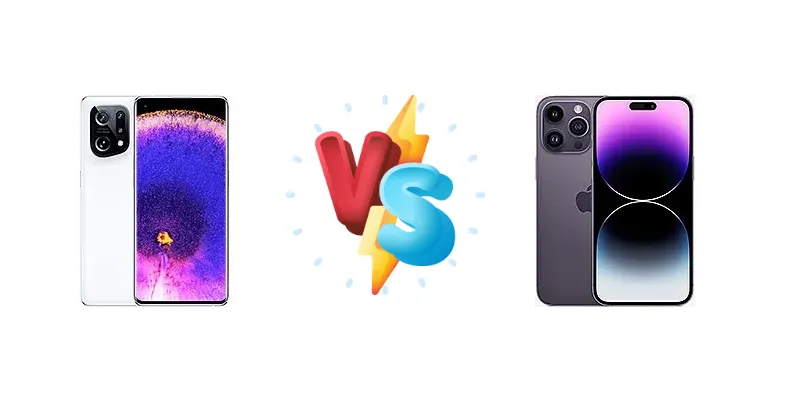
Oppo Find X5 vs. iPhone 14 Pro Max: A Deep Dive into Display, Performance, and Battery
| Phones Images | |||||
|---|---|---|---|---|---|
|
🏆 Quick Verdict
For most users, the iPhone 14 Pro Max emerges as the superior choice. Its significantly brighter display, more efficient A16 Bionic chip, and slightly longer battery life justify the higher price tag. However, the Oppo Find X5’s faster 80W wired charging provides a convenience the iPhone lacks.
| PHONES | ||
|---|---|---|
| Phone Names | Oppo Find X5 | Apple iPhone 14 Pro Max |
| Network | ||
|---|---|---|
| 2G bands | GSM 850 / 900 / 1800 / 1900 | GSM 850 / 900 / 1800 / 1900 |
| 3G bands | HSDPA 800 / 850 / 900 / 1700(AWS) / 1900 / 2100 | HSDPA 850 / 900 / 1700(AWS) / 1900 / 2100 |
| 4G bands | 1, 2, 3, 4, 5, 7, 8, 12, 13, 17, 18, 19, 20, 25, 26, 28, 32, 34, 38, 39, 40, 41, 42, 66 - Global | 1, 2, 3, 4, 5, 7, 8, 12, 13, 17, 18, 19, 20, 25, 26, 28, 30, 32, 34, 38, 39, 40, 41, 42, 46, 48, 66 - A2894, A2896 |
| 5G bands | 1, 3, 5, 7, 8, 12, 13, 18, 20, 26, 28, 38, 40, 41, 66, 77, 78 SA/NSA - Global | 1, 2, 3, 5, 7, 8, 12, 20, 25, 26, 28, 30, 38, 40, 41, 48, 66, 70, 77, 78, 79 SA/NSA/Sub6 - A2894, A2896 |
| Speed | HSPA, LTE, 5G | HSPA, LTE, 5G, EV-DO Rev.A 3.1 Mbps |
| Technology | GSM / CDMA / HSPA / CDMA2000 / LTE / 5G | GSM / CDMA / HSPA / EVDO / LTE / 5G |
| 1, 2, 3, 5, 8, 20, 28, 38, 41, 66, 77, 78, 79 SA/NSA - China | 1, 2, 3, 5, 7, 8, 12, 20, 25, 26, 28, 30, 38, 40, 41, 48, 66, 70, 77, 78, 79 SA/NSA/Sub6 - A2895 | |
| Launch | ||
|---|---|---|
| Announced | 2022, February 24 | 2022, September 07 |
| Status | Available. Released 2022, March 14 | Available. Released 2022, September 16 |
| Body | ||
|---|---|---|
| Build | Glass front (Gorilla Glass Victus), glass back, aluminum frame | Glass front, glass back, stainless steel frame |
| Dimensions | 160.3 x 72.6 x 8.7 mm (6.31 x 2.86 x 0.34 in) | 160.7 x 77.6 x 7.9 mm (6.33 x 3.06 x 0.31 in) |
| SIM | Nano-SIM + eSIM | · Nano-SIM + eSIM + eSIM (max 2 at a time; International)· eSIM + eSIM (8 or more, max 2 at a time; USA)· Nano-SIM + Nano-SIM (China) |
| Weight | 196 g (6.91 oz) | 240 g (8.47 oz) |
| - | IP68 dust/water resistant (up to 6m for 30 min) Apple Pay (Visa, MasterCard, AMEX certified) | |
| Display | ||
|---|---|---|
| Protection | Corning Gorilla Glass Victus | Ceramic Shield glass |
| Resolution | 1080 x 2400 pixels, 20:9 ratio (~402 ppi density) | 1290 x 2796 pixels, 19.5:9 ratio (~460 ppi density) |
| Size | 6.55 inches, 103.6 cm2 (~89.0% screen-to-body ratio) | 6.7 inches, 110.2 cm2 (~88.3% screen-to-body ratio) |
| Type | AMOLED, 1B colors, 120Hz, HDR10+, 500 nits (typ), 800 nits (HBM), 1000 nits (peak) | LTPO Super Retina XDR OLED, 120Hz, HDR10, Dolby Vision, 1000 nits (typ), 2000 nits (HBM) |
| - | Always-On display | |
| Platform | ||
|---|---|---|
| CPU | Octa-core (1x2.84 GHz Cortex-X1 & 3x2.42 GHz Cortex-A78 & 4x1.80 GHz Cortex-A55 | Hexa-core (2x3.46 GHz Everest + 4x2.02 GHz Sawtooth) |
| Chipset | Qualcomm SM8350 Snapdragon 888 5G (5 nm) | Apple A16 Bionic (4 nm) |
| GPU | Adreno 660 | Apple GPU (5-core graphics) |
| OS | Android 12, upgradable to Android 14, ColorOS 14 | iOS 16, upgradable to iOS 26.1 |
| Memory | ||
|---|---|---|
| Card slot | No | No |
| Internal | 128GB 8GB RAM, 256GB 8GB RAM, 256GB 12GB RAM | 128GB 6GB RAM, 256GB 6GB RAM, 512GB 6GB RAM, 1TB 6GB RAM |
| UFS 3.1 | NVMe | |
| Main Camera | ||
|---|---|---|
| Features | Hasselblad Color Calibration, color spectrum sensor, LED flash, HDR, panorama | Dual-LED dual-tone flash, HDR (photo/panorama) |
| Single | 32 MP, f/2.4, 25mm (wide), 1/2.74", 0.8µm | 12 MP, f/1.9, 23mm (wide), 1/3.6", PDAF, OIS (unconfirmed) SL 3D, (depth/biometrics sensor) |
| Triple | 50 MP, f/1.8, 24mm (wide), 1/1.56", 1.0µm, multi-directional PDAF, OIS 13 MP, f/2.4, 52mm (telephoto), 1/3.4", 2x optical zoom, PDAF 50 MP, f/2.2, 15mm, 110˚ (ultrawide), 1/1.56", 1.0µm, multi-directional PDAF | 48 MP, f/1.8, 24mm (wide), 1/1.28", 1.22µm, dual pixel PDAF, sensor-shift OIS 12 MP, f/2.8, 77mm (telephoto), 1/3.5", 1.0µm, PDAF, OIS, 3x optical zoom 12 MP, f/2.2, 13mm, 120˚ (ultrawide), 1/2.55", 1.4µm, dual pixel PDAF TOF 3D LiDAR scanner (depth) |
| Video | 4K@30/60fps, 1080p@30/60/240fps; gyro-EIS; HDR, 10‑bit video | 4K@24/25/30/60fps, 1080p@25/30/60/120/240fps, 10-bit HDR, Dolby Vision HDR (up to 60fps), ProRes, stereo sound rec. |
| Selfie camera | ||
|---|---|---|
| Features | Panorama | HDR |
| Single | 32 MP, f/2.4, 25mm (wide), 1/2.74", 0.8µm | 12 MP, f/1.9, 23mm (wide), 1/3.6", 1.0µm, PDAF, OIS SL 3D, (depth/biometrics sensor) |
| Video | 1080p@30fps, gyro-EIS | 4K@24/25/30/60fps, 1080p@25/30/60/120fps, gyro-EIS |
| Sound | ||
|---|---|---|
| 3.5mm jack | No | No |
| 35mm jack | No | No |
| Loudspeaker | Yes, with stereo speakers | Yes, with stereo speakers |
| Comms | ||
|---|---|---|
| Bluetooth | 5.2, A2DP, LE, aptX HD | 5.3, A2DP, LE |
| NFC | Yes | Yes |
| Positioning | GPS (L1), GLONASS (L1), BDS (B1I+B1c), GALILEO (E1+E5a), QZSS (L1) | GPS (L1+L5), GLONASS, GALILEO, BDS, QZSS |
| Radio | No | No |
| USB | USB Type-C 3.1, OTG | Lightning, USB 2.0 |
| WLAN | Wi-Fi 802.11 a/b/g/n/ac/6, dual-band, Wi-Fi Direct | Wi-Fi 802.11 a/b/g/n/ac/6, dual-band, hotspot |
| Features | ||
|---|---|---|
| Sensors | Fingerprint (under display, optical), accelerometer, gyro, proximity, compass | Face ID, accelerometer, gyro, proximity, compass, barometer |
| - | Ultra Wideband (UWB) support Emergency SOS via satellite (SMS sending/receiving) | |
| Battery | ||
|---|---|---|
| Charging | 80W wired, PD 30W wireless 10W reverse wireless | Wired, PD2.0, 50% in 30 min 15W wireless (MagSafe) 15W wireless (Qi2) - requires iOS 17.2 update |
| Type | Li-Po 4800 mAh | Li-Ion 4323 mAh (16.68 Wh) |
| Misc | ||
|---|---|---|
| Colors | Black, White, Purple | Space Black, Silver, Gold, Deep Purple |
| Models | PFFM10, CPH2307 | A2894, A2651, A2893, A2895, A2896, iphone15,3 |
| Price | $ 950.00 / £ 218.30 / € 339.00 | € 530.79 / $ 489.81 / £ 446.75 |
| SAR | - | 1.15 W/kg (head) 1.07 W/kg (body) |
| SAR EU | - | 0.99 W/kg (head) 0.98 W/kg (body) |
| Tests | ||
|---|---|---|
| Battery life | Endurance rating 108h | Endurance rating 121h |
| Camera | Photo / Video | Photo / Video |
| Display | Contrast ratio: Infinite (nominal) | Contrast ratio: Infinite (nominal) |
| Loudspeaker | -26.3 LUFS (Good) | -24.3 LUFS (Very good) |
| Performance | AnTuTu: 810715 (v9) GeekBench: 3331 (v5.1) GFXBench: 59fps (ES 3.1 onscreen) | AnTuTu: 955884 (v9) GeekBench: 5423 (v5.1) GFXBench: 54fps (ES 3.1 onscreen) |
Oppo Find X5
- 80W wired charging is significantly faster than the iPhone.
- Potentially lower price point, offering better value.
- Android ecosystem provides greater customization options.
- Less powerful processor compared to the A16 Bionic.
- Lower peak display brightness impacts outdoor visibility.
- Shorter battery endurance.
Apple iPhone 14 Pro Max
- Significantly brighter display for superior outdoor visibility.
- A16 Bionic chip delivers class-leading performance.
- Longer battery life and efficient power management.
- Slower wired charging speed.
- Higher price point.
- Less customization options within the iOS ecosystem.
Display Comparison
The iPhone 14 Pro Max boasts a dramatically brighter display, peaking at 1760 nits, compared to the Oppo Find X5’s 807 nits. This difference is immediately noticeable in direct sunlight, where the iPhone remains perfectly readable. Both displays share an infinite (nominal) contrast ratio, but the iPhone’s higher peak brightness translates to a more vibrant and dynamic image. While both are excellent, the iPhone’s display is a clear winner for outdoor visibility and HDR content consumption. The iPhone also benefits from ProMotion, Apple’s adaptive refresh rate technology, which isn’t explicitly stated for the Find X5, suggesting a potentially less fluid scrolling experience.
Camera Comparison
Both devices offer capable camera systems, but the iPhone 14 Pro Max likely holds an edge in image processing and overall consistency. While both are listed as capable of Photo/Video, the iPhone’s computational photography prowess, driven by the A16 Bionic, delivers superior dynamic range and detail in challenging lighting conditions. Sensor sizes aren’t specified for the Find X5, but Apple’s larger sensors and advanced image stabilization (OIS) contribute to sharper images and smoother videos. The Oppo Find X5 may excel in specific scenarios, but the iPhone offers a more reliable and versatile camera experience.
Performance
The Apple A16 Bionic chip in the iPhone 14 Pro Max, fabricated on a 4nm process, represents a significant leap in efficiency and performance over the Oppo Find X5’s 5nm Qualcomm Snapdragon 888. The A16’s hexa-core architecture (2x3.46 GHz Everest + 4x2.02 GHz Sawtooth) is optimized for both single-core and multi-core tasks, resulting in faster app launches, smoother multitasking, and superior gaming performance. While the Snapdragon 888 is still capable, the A16’s efficiency translates to less thermal throttling during sustained workloads. The iPhone’s unified memory architecture also contributes to faster data access and overall system responsiveness.
Battery Life
The iPhone 14 Pro Max achieves a slightly longer endurance rating of 121 hours compared to the Oppo Find X5’s 108 hours. This difference, while not massive, is attributable to the A16 Bionic’s superior power efficiency. However, the Oppo Find X5 compensates with significantly faster charging: 80W wired, 30W wireless, and 10W reverse wireless, compared to the iPhone’s wired PD2.0 (50% in 30 min) and 15W MagSafe/Qi2 wireless charging. The Find X5 can fully charge in under 40 minutes, while the iPhone takes considerably longer. The iPhone 14 Pro Max requires the iOS 17.2 update to fully utilize the Qi2 standard.
Buying Guide
Buy the Oppo Find X5 if you prioritize incredibly fast wired charging and prefer the Android ecosystem, especially if you can find it at a substantial discount. Buy the Apple iPhone 14 Pro Max if you demand the brightest possible display, the smoothest performance, and a premium camera experience, and are invested in the Apple ecosystem.