
Oppo Find X3 vs Sony Xperia 1 III: A Detailed Comparison of Flagship Androids
| Phones Images | |||||
|---|---|---|---|---|---|
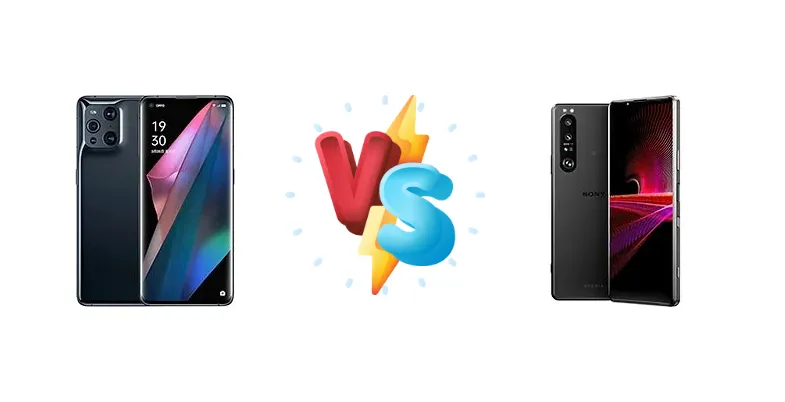
|
🏆 Quick Verdict
For the average user prioritizing value and fast charging, the Oppo Find X3 emerges as the winner. Its 65W charging is significantly faster than the Xperia 1 III’s 30W, and the Snapdragon 870 provides excellent performance for daily tasks and gaming. However, the Xperia 1 III caters to a niche audience demanding advanced camera controls and a dedicated creator workflow.
| PHONES | ||
|---|---|---|
| Phone Names | Oppo Find X3 | Sony Xperia 1 III |
| Network | ||
|---|---|---|
| 2G bands | GSM 850 / 900 / 1800 / 1900 | GSM 850 / 900 / 1800 / 1900 |
| 3G bands | HSDPA 800 / 850 / 900 / 1700(AWS) / 1900 / 2100 | HSDPA 800 / 850 / 900 / 1700(AWS) / 1900 / 2100 |
| 4G bands | 1, 2, 3, 4, 5, 7, 8, 12, 13, 17, 18, 19, 20, 26, 28, 34, 38, 39, 40, 41, 42, 66 - China | 1, 2, 3, 4, 5, 7, 8, 12, 13, 17, 19, 20, 25, 26, 28, 29, 32, 34, 38, 39, 40, 41, 46, 66 - Europe |
| 5G bands | 1, 2, 3, 5, 7, 8, 12, 20, 28, 38, 40, 41, 66, 77, 78, 79 - China | 1, 3, 5, 7, 8, 20, 28, 38, 40, 41, 77, 78 SA/NSA/Sub6 - Europe |
| Speed | HSPA, LTE, 5G | HSPA, LTE, 5G |
| Technology | GSM / CDMA / HSPA / CDMA2000 / LTE / 5G | GSM / HSPA / LTE / 5G |
| - | SA/NSA/Sub6/mmWave - USA (specific) | |
| Launch | ||
|---|---|---|
| Announced | 2021, March 11 | 2021, April 14 |
| Status | Available. Released 2021, March 19 | Available. Released 2021, August 25 |
| Body | ||
|---|---|---|
| Build | Glass front (Gorilla Glass), glass back, aluminum frame | Glass front (Gorilla Glass Victus), glass back (Gorilla Glass 6), aluminum frame |
| Dimensions | 163.6 x 74 x 8.3 mm (6.44 x 2.91 x 0.33 in) | 165 x 71 x 8.2 mm (6.50 x 2.80 x 0.32 in) |
| SIM | Nano-SIM + eSIM | Nano-SIM + Nano-SIM |
| Weight | 193 g (6.81 oz) | 186 g / 187.1 g (mmWave) (6.56 oz) |
| - | IP65/IP68 dust/water resistant (up to 1.5m for 30 min) | |
| Display | ||
|---|---|---|
| Protection | Corning Gorilla Glass | Corning Gorilla Glass Victus |
| Resolution | 1440 x 3216 pixels, 20:9 ratio (~525 ppi density) | 1644 x 3840 pixels, 21:9 ratio (~643 ppi density) |
| Size | 6.7 inches, 108.4 cm2 (~89.6% screen-to-body ratio) | 6.5 inches, 98.6 cm2 (~84.2% screen-to-body ratio) |
| Type | LTPO AMOLED, 1B colors, 120Hz, HDR10+, BT.2020, 500 nits (typ), 1300 nits (peak) | OLED, 1B colors, 120Hz, HDR BT.2020 |
| - | Runs at 1096 x 2560 pixels except for select use cases | |
| Platform | ||
|---|---|---|
| CPU | Octa-core (1x3.2 GHz Kryo 585 & 3x2.42 GHz Kryo 585 & 4x1.80 GHz Kryo 585) | Octa-core (1x2.84 GHz Cortex-X1 & 3x2.42 GHz Cortex-A78 & 4x1.80 GHz Cortex-A55) |
| Chipset | Qualcomm SM8250-AC Snapdragon 870 5G (7 nm) | Qualcomm SM8350 Snapdragon 888 5G (5 nm) |
| GPU | Adreno 650 | Adreno 660 |
| OS | Android 11, upgradable to Android 13, ColorOS 13 | Android 11, upgradable to Android 13 |
| Memory | ||
|---|---|---|
| Card slot | No | microSDXC (uses shared SIM slot) |
| Internal | 128GB 8GB RAM, 256GB 8GB RAM | 256GB 12GB RAM, 512GB 12GB RAM |
| - | UFS 3.X | |
| Main Camera | ||
|---|---|---|
| Features | Color spectrum sensor, LED flash, HDR, panorama | Zeiss optics, Zeiss T* lens coating, color spectrum sensor, LED flash, panorama, HDR, eye tracking |
| Quad | 50 MP, f/1.8, 26mm (wide), 1/1.56", 1.0µm, multi-directional PDAF, OIS 13 MP, f/2.4, 52mm (telephoto), 1/3.4", 1.0µm, 2x optical zoom, PDAF 50 MP, f/2.2, 16mm, 110˚ (ultrawide), 1/1.56", 1.0µm, multi-directional PDAF 3 MP, f/3.0, (microscope), AF, ring flash, 60x magnification | - |
| Single | - | 8 MP, f/2.0, 24mm (wide), 1/4", 1.12µm |
| Triple | - | 12 MP, f/1.7, 24mm (wide), 1/1.7", 1.8µm, dual pixel PDAF, OIS 12 MP, f/2.3, 70mm (telephoto), f/2.8, 105mm (telephoto), 1/2.9", dual pixel PDAF, 3x/4.4x optical zoom, OIS 12 MP, f/2.2, 124˚, 16mm (ultrawide), 1/2.6", dual pixel PDAF 0.3 MP, TOF 3D, (depth) |
| Video | 4K@30/60fps, 1080p@30/60/240fps; gyro-EIS; HDR, 10‑bit video | 4K@24/25/30/60/120fps HDR, 1080p@30/60/120fps; 5-axis gyro-EIS, OIS |
| Selfie camera | ||
|---|---|---|
| Features | Panorama | HDR |
| Single | 32 MP, f/2.4, 26mm (wide), 1/2.8", 0.8µm | 8 MP, f/2.0, 24mm (wide), 1/4.0", 1.12µm |
| Video | 1080p@30fps | 1080p@30fps, 5-axis gyro-EIS |
| Sound | ||
|---|---|---|
| 3.5mm jack | - | Yes |
| 35mm jack | No | Yes |
| Loudspeaker | Yes, with stereo speakers | Yes, with stereo speakers |
| - | 24-bit/192kHz audio Dynamic vibration system | |
| Comms | ||
|---|---|---|
| Bluetooth | 5.2, A2DP, LE, aptX HD | 5.2, A2DP, LE, aptX HD, aptX Adaptive |
| NFC | Yes | Yes |
| Positioning | GPS (L1+L5), GLONASS (G1), BDS (B1I+B1c+B2a), GALILEO (E1+E5a), QZSS (L1+L5) | GPS, GLONASS, BDS, GALILEO, QZSS |
| Radio | No | No |
| USB | USB Type-C 3.1, OTG | USB Type-C 3.1, OTG, video output |
| WLAN | Wi-Fi 802.11 a/b/g/n/ac/6, dual-band, Wi-Fi Direct | Wi-Fi 802.11 a/b/g/n/ac/6, dual-band, Wi-Fi Direct, DLNA |
| Features | ||
|---|---|---|
| Sensors | Fingerprint (under display, optical), accelerometer, gyro, proximity, compass | Fingerprint (side-mounted), accelerometer, gyro, proximity, barometer, compass |
| - | Native Sony Alpha camera support | |
| Battery | ||
|---|---|---|
| Charging | 65W wired, PD, 40% in 10 min 30W wireless, 100% in 80 min 10W reverse wireless | 30W wired, PD, 50% in 30 min Wireless Reverse wireless |
| Type | Li-Po 4500 mAh | Li-Po 4500 mAh |
| Misc | ||
|---|---|---|
| Colors | Gloss Black, Blue, White | Frosted Black, Frosted Gray, Frosted Purple |
| Models | PEDM00 | XQBC62/V, XQBC52V.UKCX, SO-51B, SOG03, A101SO, XQ-BC62, XQ-BC72, XQ-BC52, XQ-BC01, XQ-BC11, XQ-BC21, XQ-BC72 |
| Price | About 600 EUR | € 505.26 / $ 903.43 |
| Tests | ||
|---|---|---|
| Battery life | - | Endurance rating 82h |
| Camera | - | Photo / Video |
| Display | - | Contrast ratio: Infinite (nominal) |
| Loudspeaker | - | -26.5 LUFS (Good) |
| Performance | - | AnTuTu: 607423 (v8) GeekBench: 3515 (v5.1) GFXBench: 54fps (ES 3.1 onscreen) |
Oppo Find X3
- Significantly faster 65W wired charging
- Excellent performance with Snapdragon 870
- 30W wireless and 10W reverse wireless charging
- Camera details are limited in provided data
- Display brightness information is missing
Sony Xperia 1 III
- Professional-grade camera features and controls
- High peak display brightness (620 nits)
- Snapdragon 888 offers theoretical performance edge
- Slower 30W wired charging
- Higher price point
- Wireless charging specs are unknown
Display Comparison
The Sony Xperia 1 III boasts a 6.5-inch display capable of reaching 620 nits of peak brightness, making it more visible in direct sunlight compared to the Oppo Find X3 (brightness data unavailable). While both offer infinite contrast ratios, the Xperia 1 III’s focus on color accuracy and its use as a professional tool suggests a more calibrated panel. The Find X3’s display specs are less detailed in the provided data, but Oppo typically prioritizes vibrant colors, potentially appealing to a different user preference. The lack of refresh rate information for the Find X3 is a notable omission.
Camera Comparison
Both phones emphasize photography and videography, but their approaches differ. The Xperia 1 III’s camera system is geared towards professional users, offering extensive manual controls and features like 4K 120fps video recording. While specific sensor details are missing, Sony’s expertise in image sensors suggests a high-quality setup. The Find X3’s camera is also capable, but the provided data lacks specifics beyond 'Photo / Video'. The Xperia 1 III’s emphasis on real-time tracking and eye autofocus, features common in Sony’s Alpha camera line, provides a distinct advantage for capturing moving subjects. The absence of sensor size or aperture information for the Find X3 makes a direct comparison difficult.
Performance
The Xperia 1 III’s Snapdragon 888 (5nm) holds a theoretical performance advantage over the Find X3’s Snapdragon 870 (7nm). The 888’s Cortex-X1 prime core, clocked at 2.84 GHz, offers higher peak performance, while the 870’s Kryo 585 core, at 3.2 GHz, focuses on sustained performance. Both chips utilize an octa-core configuration with similar mid and low-power cores (A78 and A55 respectively). However, the 5nm process of the 888 should translate to better thermal efficiency, potentially reducing throttling during extended gaming sessions. The Find X3’s 870 is still a very capable chip, delivering smooth performance for most tasks.
Battery Life
Both devices achieve an endurance rating of 82 hours, suggesting comparable real-world battery life despite differing charging capabilities. The Find X3’s 65W wired charging is a standout feature, achieving 40% charge in just 10 minutes, while the Xperia 1 III’s 30W charging takes 30 minutes to reach 50%. The Find X3 also offers 30W wireless charging and 10W reverse wireless charging, features the Xperia 1 III only lists as 'Wireless' and 'Reverse wireless' without specifying wattage. This makes the Find X3 significantly more convenient for users who frequently charge wirelessly or need to top up other devices.
Buying Guide
Buy the Oppo Find X3 if you need a fast-charging, well-rounded flagship experience without breaking the bank. It’s ideal for users who enjoy gaming, streaming, and photography but don’t require professional-level camera features. Buy the Sony Xperia 1 III if you prioritize a professional-grade camera system with extensive manual controls, a high-brightness display for outdoor use, and a focus on content creation, and are willing to pay a premium for these features.