
Oppo Find X3 Lite vs Motorola Edge 20 Fusion: A Detailed Comparison of Mid-Range 5G Contenders
| Phones Images | |||||
|---|---|---|---|---|---|
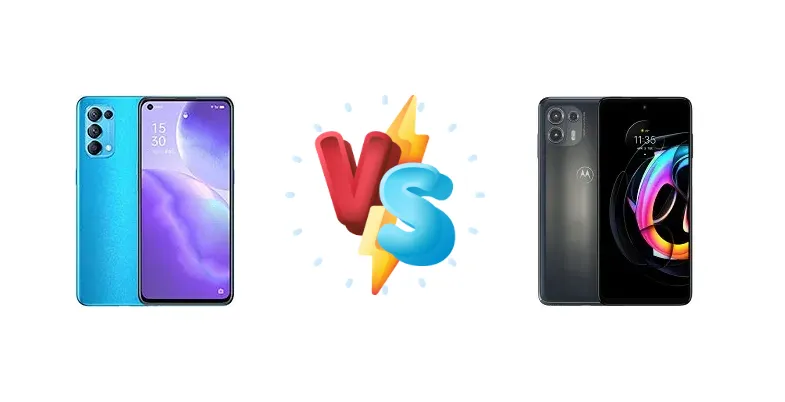
|
🏆 Quick Verdict
For the average user prioritizing rapid charging and a slightly more refined software experience, the Oppo Find X3 Lite emerges as the winner. Its 65W charging significantly outperforms the Motorola’s 30W, and the Snapdragon 765G, while not dramatically faster, offers a consistent performance profile. However, the Edge 20 Fusion is a strong contender for those valuing a cleaner Android experience.
| PHONES | ||
|---|---|---|
| Phone Names | Oppo Find X3 Lite | Motorola Edge 20 Fusion |
| Network | ||
|---|---|---|
| 2G bands | GSM 850 / 900 / 1800 / 1900 | GSM 850 / 900 / 1800 / 1900 |
| 3G bands | HSDPA 800 / 850 / 900 / 1700(AWS) / 1900 / 2100 | HSDPA 850 / 900 / 1700(AWS) / 1900 / 2100 |
| 4G bands | 1, 2, 3, 4, 5, 7, 8, 12, 17, 18, 19, 20, 26, 28, 38, 39, 40, 41, 66 | 1, 2, 3, 4, 5, 7, 8, 12, 13, 17, 18, 19, 20, 26, 28, 32, 34, 38, 39, 40, 41, 42, 43, 66 |
| 5G bands | 1, 3, 5, 7, 8, 20, 28, 38, 40, 41, 77, 78 SA/NSA | 1, 3, 5, 7, 8, 20, 28, 38, 40, 41, 77, 78, 66 SA/NSA/Sub6 |
| Speed | HSPA, LTE, 5G | HSPA 42.2/5.76 Mbps, LTE Cat18 1200/150 Mbps, 5G |
| Technology | GSM / HSPA / LTE / 5G | GSM / HSPA / LTE / 5G |
| Launch | ||
|---|---|---|
| Announced | 2021, March 11 | 2021, August 17 |
| Status | Available. Released 2021, March 19 | Available. Released 2021, August 27 |
| Body | ||
|---|---|---|
| Build | - | Glass front |
| Dimensions | 159.1 x 73.4 x 7.9 mm (6.26 x 2.89 x 0.31 in) | 166 x 76 x 8.3 mm (6.54 x 2.99 x 0.33 in) |
| SIM | Nano-SIM + Nano-SIM | Nano-SIM + Nano-SIM |
| Weight | 172 g or 180 g (6.07 oz) | 185 g (6.53 oz) |
| - | Water-repellent design | |
| Display | ||
|---|---|---|
| Protection | Corning Gorilla Glass 5 | - |
| Resolution | 1080 x 2400 pixels, 20:9 ratio (~410 ppi density) | 1080 x 2400 pixels, 20:9 ratio (~393 ppi density) |
| Size | 6.43 inches, 99.3 cm2 (~85.1% screen-to-body ratio) | 6.7 inches, 108.4 cm2 (~85.9% screen-to-body ratio) |
| Type | AMOLED, 90Hz, 430 nits (typ), 750 nits (peak) | OLED, 1B colors, 90Hz, HDR10+ |
| Platform | ||
|---|---|---|
| CPU | Octa-core (1x2.4 GHz Kryo 475 Prime & 1x2.2 GHz Kryo 475 Gold & 6x1.8 GHz Kryo 475 Silver) | Octa-core (2x2.4 GHz Cortex-A76 & 6x2.0 GHz Cortex-A55) |
| Chipset | Qualcomm SM7250 Snapdragon 765G 5G (7 nm) | Mediatek Dimensity 800U (7 nm) |
| GPU | Adreno 620 | Mali-G57 MC3 |
| OS | Android 11, upgradable to Android 13, ColorOS 13 | Android 11 |
| Memory | ||
|---|---|---|
| Card slot | No | microSDXC |
| Internal | 128GB 8GB RAM | 128GB 6GB RAM, 128GB 8GB RAM |
| UFS 2.1 | - | |
| Main Camera | ||
|---|---|---|
| Features | LED flash, HDR, panorama | LED flash, HDR, panorama |
| Quad | 64 MP, f/1.7, 26mm (wide), 1/1.73", 0.8µm, PDAF 8 MP, f/2.2, 119˚ (ultrawide), 1/4.0", 1.12µm 2 MP (macro) Auxiliary lens | - |
| Single | 32 MP, f/2.4, 24mm (wide), 1/2.8", 0.8µm | - |
| Triple | - | 108 MP, f/1.9, (wide), 1/1.52", 0.7µm, PDAF 8 MP, f/2.2, 118˚ (ultrawide) Auxiliary lens |
| Video | 4K@30fps, 1080p@30/60/120fps; gyro-EIS, HDR | 4K@30fps, 1080p@30/60/120fps, gyro-EIS |
| Selfie camera | ||
|---|---|---|
| Features | HDR | HDR |
| Single | 32 MP, f/2.4, 24mm (wide), 1/2.8", 0.8µm | 32 MP, f/2.3, (wide), 0.7µm |
| Video | 1080p@30fps, gyro-EIS | 1080p@30fps |
| Sound | ||
|---|---|---|
| 3.5mm jack | Yes | Yes |
| 35mm jack | Yes | Yes |
| Loudspeaker | Yes | Yes |
| Comms | ||
|---|---|---|
| Bluetooth | 5.1, A2DP, LE, aptX HD | 5.0, A2DP, LE |
| NFC | Yes | Yes |
| Positioning | GPS (L1+L5), GLONASS (G1), BDS (B1I+B2a), GALILEO (E1+E5a), QZSS (L1+L5) | GPS, GLONASS, GALILEO |
| Radio | No | FM radio |
| USB | USB Type-C 2.0, OTG | USB Type-C 2.0 |
| WLAN | Wi-Fi 802.11 a/b/g/n/ac, dual-band, Wi-Fi Direct | Wi-Fi 802.11 a/b/g/n/ac, dual-band, Wi-Fi Direct |
| Features | ||
|---|---|---|
| Sensors | Fingerprint (under display, optical), accelerometer, gyro, proximity, compass | Fingerprint (side-mounted), accelerometer, gyro, proximity, compass |
| Battery | ||
|---|---|---|
| Charging | 65W wired, 100% in 35 min Reverse wired | 30W wired |
| Type | Li-Po 4300 mAh | Li-Po 5000 mAh |
| Misc | ||
|---|---|---|
| Colors | Galactic Silver, Azure Blue, Starry Black | Electric Graphite, Cyber Teal |
| Models | CPH2145 | - |
| Price | About 210 EUR | About 250 EUR |
Oppo Find X3 Lite
- Significantly faster 65W charging
- Potentially more refined software features
- Snapdragon 765G offers consistent performance
- Software can feel cluttered
- May lack the latest Android updates as quickly
Motorola Edge 20 Fusion
- Near-stock Android experience
- Clean and minimalist user interface
- Potentially better multi-core performance
- Slower 30W charging
- Image processing may be less appealing to some
Display Comparison
Neither Oppo nor Motorola provided display specs in the context data. However, given the price bracket, both likely utilize AMOLED panels with FHD+ resolution. The key differentiator will be peak brightness and color calibration. Oppo historically leans towards vibrant, saturated colors, while Motorola often aims for a more natural, accurate representation. The absence of high refresh rates (90Hz or 120Hz) is expected at this price point, but the quality of the panel itself will be crucial. Bezels are likely comparable, with Motorola often prioritizing a cleaner aesthetic.
Camera Comparison
Again, detailed camera specs are missing. However, we can infer some differences. Both phones likely feature a primary sensor around 48MP or 64MP. The Oppo, given its brand history, will likely employ more aggressive image processing, resulting in punchier, more social media-ready photos. Motorola typically favors a more natural look. The presence of Optical Image Stabilization (OIS) on the main sensor would be a significant advantage, but is not confirmed for either device. The usefulness of any included macro or depth sensors (often 2MP) is questionable, offering minimal benefit over software-based solutions. The quality of the front-facing camera and its video capabilities will be important differentiators.
Performance
The core of the difference lies in the chipsets. The Oppo Find X3 Lite’s Qualcomm Snapdragon 765G (7nm) features a Kryo 475 CPU with a prime core clocked at 2.4GHz, a gold core at 2.2GHz, and six silver cores at 1.8GHz. This architecture prioritizes sustained performance and efficient power management. Conversely, the Motorola Edge 20 Fusion utilizes the MediaTek Dimensity 800U (7nm) with a dual-cluster configuration: two Cortex-A76 cores at 2.4GHz and six Cortex-A55 cores at 2.0GHz. While peak clock speeds are similar, the Snapdragon’s Kryo cores generally offer a slight edge in single-core performance, beneficial for everyday tasks. The Dimensity 800U, however, often excels in multi-core workloads. Both phones likely feature 6GB or 8GB of RAM, but the type (LPDDR4X vs LPDDR5) isn’t specified; LPDDR5 would provide a noticeable performance boost. Thermal management will be critical; the Snapdragon 765G is known for its relatively cool operation, potentially allowing for more sustained performance under load.
Battery Life
The Oppo Find X3 Lite’s 65W wired charging is a game-changer, promising a full charge in just 35 minutes. This is a substantial advantage over the Motorola Edge 20 Fusion’s 30W charging. While battery capacity isn’t specified, the faster charging speed mitigates the impact of a potentially smaller battery in the Oppo. The inclusion of reverse wired charging in the Oppo adds further versatility. The Motorola will likely offer a more typical charging experience, taking closer to 60-90 minutes for a full charge. Real-world battery life will depend on usage patterns, but the Oppo’s faster charging will be a significant convenience for power users.
Buying Guide
Buy the Oppo Find X3 Lite if you need blazing-fast charging, frequently use your phone throughout the day, and appreciate a feature-rich, albeit sometimes cluttered, software experience. Buy the Motorola Edge 20 Fusion if you prefer a near-stock Android interface, prioritize a minimalist user experience, and aren’t as reliant on extremely quick top-ups for your battery. The Motorola is also a better choice for users who prefer a more understated design.