
Oppo Find X3 Lite vs Google Pixel 5a 5G: A Detailed Comparison
| Phones Images | |||||
|---|---|---|---|---|---|
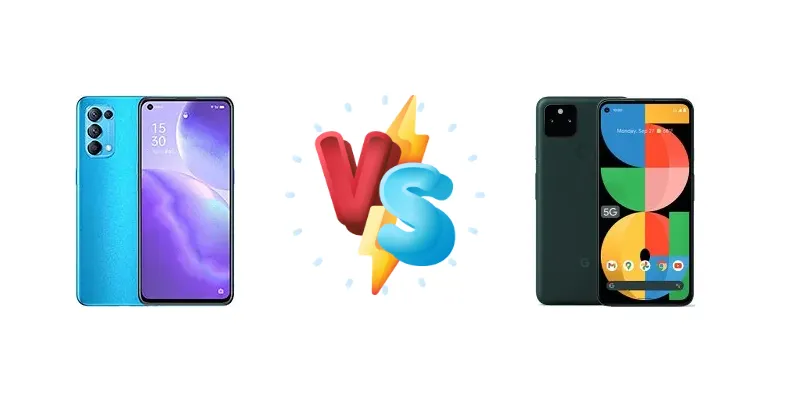
|
🏆 Quick Verdict
For most users, the Oppo Find X3 Lite offers a more compelling package. Its blazing-fast 65W charging significantly outperforms the Pixel 5a’s 18W, and while software isn't as refined, the price-to-performance ratio is superior. The Pixel 5a excels in display brightness and camera processing, but the trade-offs aren't substantial enough for the average buyer.
| PHONES | ||
|---|---|---|
| Phone Names | Oppo Find X3 Lite | Google Pixel 5a 5G |
| Network | ||
|---|---|---|
| 2G bands | GSM 850 / 900 / 1800 / 1900 | GSM 850 / 900 / 1800 / 1900 |
| 3G bands | HSDPA 800 / 850 / 900 / 1700(AWS) / 1900 / 2100 | HSDPA 850 / 900 / 1700(AWS) / 1900 / 2100 |
| 4G bands | 1, 2, 3, 4, 5, 7, 8, 12, 17, 18, 19, 20, 26, 28, 38, 39, 40, 41, 66 | 1, 2, 3, 4, 5, 7, 8, 12, 13, 14, 17, 18, 19, 20, 25, 26, 28, 29, 30, 32, 38, 39, 40, 41, 42, 46, 48, 66, 71 |
| 5G bands | 1, 3, 5, 7, 8, 20, 28, 38, 40, 41, 77, 78 SA/NSA | 1, 2, 5, 12, 25, 28, 41, 66, 71, 77, 78 SA/NSA/Sub6 |
| Speed | HSPA, LTE, 5G | HSPA, LTE, 5G |
| Technology | GSM / HSPA / LTE / 5G | GSM / HSPA / EVDO / LTE / 5G |
| - | CDMA2000 1xEV-DO | |
| Launch | ||
|---|---|---|
| Announced | 2021, March 11 | 2021, August 17 |
| Status | Available. Released 2021, March 19 | Available. Released 2021, August 26 |
| Body | ||
|---|---|---|
| Build | - | Glass front (Gorilla Glass 3), aluminum frame, aluminum back |
| Dimensions | 159.1 x 73.4 x 7.9 mm (6.26 x 2.89 x 0.31 in) | 156.2 x 73.2 x 8.8 mm (6.15 x 2.88 x 0.35 in) |
| SIM | Nano-SIM + Nano-SIM | Nano-SIM + eSIM |
| Weight | 172 g or 180 g (6.07 oz) | 183 g (6.46 oz) |
| - | IP67 dust/water resistant (up to 1m for 30 min) | |
| Display | ||
|---|---|---|
| Protection | Corning Gorilla Glass 5 | Corning Gorilla Glass 3 |
| Resolution | 1080 x 2400 pixels, 20:9 ratio (~410 ppi density) | 1080 x 2400 pixels, 20:9 ratio (~415 ppi density) |
| Size | 6.43 inches, 99.3 cm2 (~85.1% screen-to-body ratio) | 6.34 inches, 97.0 cm2 (~84.9% screen-to-body ratio) |
| Type | AMOLED, 90Hz, 430 nits (typ), 750 nits (peak) | OLED, HDR |
| - | Always-on display | |
| Platform | ||
|---|---|---|
| CPU | Octa-core (1x2.4 GHz Kryo 475 Prime & 1x2.2 GHz Kryo 475 Gold & 6x1.8 GHz Kryo 475 Silver) | Octa-core (1x2.4 GHz Kryo 475 Prime & 1x2.2 GHz Kryo 475 Gold & 6x1.8 GHz Kryo 475 Silver) |
| Chipset | Qualcomm SM7250 Snapdragon 765G 5G (7 nm) | Qualcomm SM7250 Snapdragon 765G 5G (7 nm) |
| GPU | Adreno 620 | Adreno 620 |
| OS | Android 11, upgradable to Android 13, ColorOS 13 | Android 11, upgradable to Android 14 |
| Memory | ||
|---|---|---|
| Card slot | No | No |
| Internal | 128GB 8GB RAM | 128GB 6GB RAM |
| UFS 2.1 | - | |
| Main Camera | ||
|---|---|---|
| Dual | - | 12.2 MP, f/1.7, 27mm, (wide), 1/2.55", 1.4µm, dual pixel PDAF, OIS 16 MP, f/2.2, 119˚ (ultrawide), 1.0µm |
| Features | LED flash, HDR, panorama | LED flash, Pixel Shift, Auto-HDR, panorama |
| Quad | 64 MP, f/1.7, 26mm (wide), 1/1.73", 0.8µm, PDAF 8 MP, f/2.2, 119˚ (ultrawide), 1/4.0", 1.12µm 2 MP (macro) Auxiliary lens | - |
| Single | 32 MP, f/2.4, 24mm (wide), 1/2.8", 0.8µm | 8 MP, f/2.0, 24mm (wide), 1.12µm |
| Video | 4K@30fps, 1080p@30/60/120fps; gyro-EIS, HDR | 4K@30/60fps, 1080p@30/60/120/240fps; gyro-EIS |
| Selfie camera | ||
|---|---|---|
| Features | HDR | HDR |
| Single | 32 MP, f/2.4, 24mm (wide), 1/2.8", 0.8µm | 8 MP, f/2.0, 24mm (wide), 1.12µm |
| Video | 1080p@30fps, gyro-EIS | 1080p@30fps |
| Sound | ||
|---|---|---|
| 3.5mm jack | Yes | Yes |
| 35mm jack | Yes | Yes |
| Loudspeaker | Yes | Yes, with stereo speakers |
| Comms | ||
|---|---|---|
| Bluetooth | 5.1, A2DP, LE, aptX HD | 5.0, A2DP, LE, aptX HD |
| NFC | Yes | Yes |
| Positioning | GPS (L1+L5), GLONASS (G1), BDS (B1I+B2a), GALILEO (E1+E5a), QZSS (L1+L5) | GPS, GLONASS, GALILEO, QZSS, BDS |
| Radio | No | No |
| USB | USB Type-C 2.0, OTG | USB Type-C 3.1 |
| WLAN | Wi-Fi 802.11 a/b/g/n/ac, dual-band, Wi-Fi Direct | Wi-Fi 802.11 a/b/g/n/ac, dual-band, Wi-Fi Direct |
| Features | ||
|---|---|---|
| Sensors | Fingerprint (under display, optical), accelerometer, gyro, proximity, compass | Fingerprint (rear-mounted), accelerometer, gyro, proximity, compass, barometer |
| Battery | ||
|---|---|---|
| Charging | 65W wired, 100% in 35 min Reverse wired | 18W wired, PD2.0 |
| Type | Li-Po 4300 mAh | Li-Po 4680 mAh |
| Misc | ||
|---|---|---|
| Colors | Galactic Silver, Azure Blue, Starry Black | Mostly Black |
| Models | CPH2145 | G1F8F, G4S1M |
| Price | About 210 EUR | $ 189.00 / C$ 249.99 |
| Tests | ||
|---|---|---|
| Battery life | - | Endurance rating 122h |
| Display | - | Contrast ratio: Infinite (nominal) |
| Performance | - | AnTuTu: 291303 (v8) GeekBench: 1337 (v5.1) GFXBench: 19fps (ES 3.1 onscreen) |
Oppo Find X3 Lite
- Blazing-fast 65W charging
- Competitive price point
- Generally vibrant display
- Software experience isn't as refined as Pixel
- Display brightness likely lower than Pixel 5a
Google Pixel 5a 5G
- Excellent display brightness (861 nits)
- Superior camera image processing
- Clean and optimized Google software
- Slow 18W charging
- Potentially higher price
- Less aggressive thermal management
Display Comparison
Both phones utilize OLED panels, but the Pixel 5a 5G boasts a measured peak brightness of 861 nits, a significant advantage for outdoor visibility. While the Oppo Find X3 Lite’s display specs aren’t explicitly stated, it’s likely lower. The Pixel 5a’s ‘infinite’ contrast ratio, typical of OLED technology, delivers deep blacks and vibrant colors. The lack of high refresh rate on either device is a common compromise in this price bracket, but the Pixel’s brightness is a clear win for users who spend a lot of time outdoors.
Camera Comparison
While both phones feature capable camera systems, Google’s computational photography prowess gives the Pixel 5a 5G an edge. The Pixel’s image processing algorithms are renowned for their ability to extract detail and dynamic range, particularly in challenging lighting conditions. The Oppo Find X3 Lite likely relies more on hardware capabilities, and while it can produce good results, it won’t match the Pixel’s software-driven enhancements. Details on the Oppo’s sensor size and aperture are missing, but the Pixel’s focus on software processing is a key differentiator.
Performance
Both the Oppo Find X3 Lite and Google Pixel 5a 5G are powered by the Qualcomm Snapdragon 765G 5G (7 nm) chipset, featuring an octa-core CPU configuration (1x2.4 GHz Kryo 475 Prime, 1x2.2 GHz Kryo 475 Gold, and 6x1.8 GHz Kryo 475 Silver). This means raw processing power will be nearly identical for most tasks. However, thermal management could differ. Oppo often prioritizes sustained performance through aggressive cooling, while Google tends to favor a more conservative approach. The Pixel 5a’s software optimization might provide a smoother experience in some scenarios, but the core performance is fundamentally the same.
Battery Life
The Google Pixel 5a 5G has an endurance rating of 122 hours, indicating excellent battery life. However, the Oppo Find X3 Lite compensates with its incredibly fast 65W wired charging, achieving a full charge in just 35 minutes. The Pixel 5a 5G’s 18W charging with PD2.0 is significantly slower. While the Pixel’s battery endurance is commendable, the Oppo’s charging speed is a game-changer for users who dislike waiting for their phone to power up. The convenience of a quick top-up can offset a slightly smaller battery capacity.
Buying Guide
Buy the Oppo Find X3 Lite if you prioritize rapid charging, a generally vibrant display, and maximizing value for your money. It’s ideal for users who frequently top up their phones and want a device that can keep pace with their busy lifestyles. Buy the Google Pixel 5a 5G if you value a consistently bright display for outdoor use, Google’s clean software experience, and a camera that excels in computational photography, even if it means slower charging and a potentially higher price.