
Oppo Find X3 Lite vs. iPhone SE (2022): A Detailed Comparison of Performance and Value
| Phones Images | |||||
|---|---|---|---|---|---|
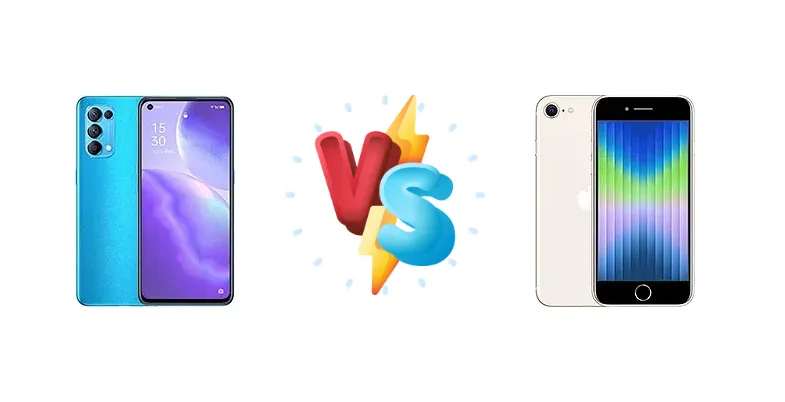
|
🏆 Quick Verdict
For the average user prioritizing raw speed and long-term software support, the iPhone SE (2022) is the clear winner, despite its older battery technology. However, the Oppo Find X3 Lite offers significantly faster charging and a more modern feature set for those less invested in the Apple ecosystem.
| PHONES | ||
|---|---|---|
| Phone Names | Oppo Find X3 Lite | Apple iPhone SE (2022) |
| Network | ||
|---|---|---|
| 2G bands | GSM 850 / 900 / 1800 / 1900 | GSM 850 / 900 / 1800 / 1900 |
| 3G bands | HSDPA 800 / 850 / 900 / 1700(AWS) / 1900 / 2100 | HSDPA 850 / 900 / 1700(AWS) / 1900 / 2100 |
| 4G bands | 1, 2, 3, 4, 5, 7, 8, 12, 17, 18, 19, 20, 26, 28, 38, 39, 40, 41, 66 | 1, 2, 3, 4, 5, 7, 8, 12, 13, 17, 18, 19, 20, 25, 26, 28, 30, 32, 34, 38, 39, 40, 41, 42, 46, 48, 66 - A2783, A2784, A2785 |
| 5G bands | 1, 3, 5, 7, 8, 20, 28, 38, 40, 41, 77, 78 SA/NSA | 1, 2, 3, 5, 7, 8, 12, 20, 25, 28, 30, 38, 40, 41, 48, 66, 77, 78, 79 SA/NSA/Sub6 - A2783, A2784, A2785, A2782 |
| Speed | HSPA, LTE, 5G | HSPA, LTE, 5G, EV-DO Rev.A 3.1 Mbps |
| Technology | GSM / HSPA / LTE / 5G | GSM / CDMA / HSPA / EVDO / LTE / 5G |
| - | 1, 2, 3, 5, 7, 8, 12, 20, 25, 28, 29, 30, 38, 40, 41, 48, 66, 71, 77, 78, 79 SA/NSA/Sub6 - A2595 | |
| Launch | ||
|---|---|---|
| Announced | 2021, March 11 | 2022, March 08 |
| Status | Available. Released 2021, March 19 | Available. Released 2022, March 18 |
| Body | ||
|---|---|---|
| Build | - | Glass front, glass back, aluminum frame |
| Dimensions | 159.1 x 73.4 x 7.9 mm (6.26 x 2.89 x 0.31 in) | 138.4 x 67.3 x 7.3 mm (5.45 x 2.65 x 0.29 in) |
| SIM | Nano-SIM + Nano-SIM | Nano-SIM + eSIM |
| Weight | 172 g or 180 g (6.07 oz) | 144 g (5.08 oz) |
| - | IP67 dust/water resistant (up to 1m for 30 min) Apple Pay (Visa, MasterCard, AMEX certified) | |
| Display | ||
|---|---|---|
| Protection | Corning Gorilla Glass 5 | Ion-strengthened glass |
| Resolution | 1080 x 2400 pixels, 20:9 ratio (~410 ppi density) | 750 x 1334 pixels, 16:9 ratio (~326 ppi density) |
| Size | 6.43 inches, 99.3 cm2 (~85.1% screen-to-body ratio) | 4.7 inches, 60.9 cm2 (~65.4% screen-to-body ratio) |
| Type | AMOLED, 90Hz, 430 nits (typ), 750 nits (peak) | Retina IPS LCD, 625 nits (typ) |
| Platform | ||
|---|---|---|
| CPU | Octa-core (1x2.4 GHz Kryo 475 Prime & 1x2.2 GHz Kryo 475 Gold & 6x1.8 GHz Kryo 475 Silver) | Hexa-core (2x3.22 GHz Avalanche + 4x1.82 GHz Blizzard) |
| Chipset | Qualcomm SM7250 Snapdragon 765G 5G (7 nm) | Apple A15 Bionic (5 nm) |
| GPU | Adreno 620 | Apple GPU (4-core graphics) |
| OS | Android 11, upgradable to Android 13, ColorOS 13 | iOS 15.4, upgradable to iOS 26.1 |
| Memory | ||
|---|---|---|
| Card slot | No | No |
| Internal | 128GB 8GB RAM | 64GB 4GB RAM, 128GB 4GB RAM, 256GB 4GB RAM |
| UFS 2.1 | NVMe | |
| Main Camera | ||
|---|---|---|
| Features | LED flash, HDR, panorama | Quad-LED dual-tone flash, HDR, panorama |
| Quad | 64 MP, f/1.7, 26mm (wide), 1/1.73", 0.8µm, PDAF 8 MP, f/2.2, 119˚ (ultrawide), 1/4.0", 1.12µm 2 MP (macro) Auxiliary lens | - |
| Single | 32 MP, f/2.4, 24mm (wide), 1/2.8", 0.8µm | 12 MP, f/1.8 (wide), PDAF, OIS |
| Video | 4K@30fps, 1080p@30/60/120fps; gyro-EIS, HDR | 4K@24/30/60fps, 1080p@30/60/120/240fps, HDR, OIS, stereo sound rec. |
| Selfie camera | ||
|---|---|---|
| Features | HDR | HDR |
| Single | 32 MP, f/2.4, 24mm (wide), 1/2.8", 0.8µm | 7 MP, f/2.2 |
| Video | 1080p@30fps, gyro-EIS | 1080p@30/120fps; gyro-EIS |
| Sound | ||
|---|---|---|
| 3.5mm jack | Yes | No |
| 35mm jack | Yes | No |
| Loudspeaker | Yes | Yes, with stereo speakers |
| Comms | ||
|---|---|---|
| Bluetooth | 5.1, A2DP, LE, aptX HD | 5.0, A2DP, LE |
| NFC | Yes | Yes |
| Positioning | GPS (L1+L5), GLONASS (G1), BDS (B1I+B2a), GALILEO (E1+E5a), QZSS (L1+L5) | GPS, GLONASS, GALILEO, BDS, QZSS |
| Radio | No | No |
| USB | USB Type-C 2.0, OTG | Lightning, USB 2.0 |
| WLAN | Wi-Fi 802.11 a/b/g/n/ac, dual-band, Wi-Fi Direct | Wi-Fi 802.11 a/b/g/n/ac/6, dual-band, hotspot |
| Features | ||
|---|---|---|
| Sensors | Fingerprint (under display, optical), accelerometer, gyro, proximity, compass | Fingerprint (front-mounted), accelerometer, proximity, gyro, compass, barometer |
| Battery | ||
|---|---|---|
| Charging | 65W wired, 100% in 35 min Reverse wired | 20W wired, 50% in 30 min 7.5W wireless (Qi) |
| Type | Li-Po 4300 mAh | Li-Ion 2018 mAh (6.96 Wh) |
| Misc | ||
|---|---|---|
| Colors | Galactic Silver, Azure Blue, Starry Black | Midnight, Starlight, Red |
| Models | CPH2145 | A2783, A2595, A2785, A2782, A2784, iphone14,6 |
| Price | About 210 EUR | $ 119.84 / C$ 199.99 / £ 142.00 / € 173.00 |
| SAR | - | 0.98 W/kg (head) 0.99 W/kg (body) |
| SAR EU | - | 1.20 W/kg (head) 1.19 W/kg (body) |
| Tests | ||
|---|---|---|
| Battery life | - | Endurance rating 62h |
| Camera | - | Photo / Video |
| Display | - | Contrast ratio: 1424:1 (nominal) |
| Loudspeaker | - | -25.2 LUFS (Very good) |
| Performance | - | AnTuTu: 723486 (v9) GeekBench: 4629 (v5.1) GFXBench: 60fps (ES 3.1 onscreen) |
Oppo Find X3 Lite
- Significantly faster 65W charging
- Reverse wired charging capability
- Potentially more versatile camera system (depending on software)
- Less powerful processor than the A15 Bionic
- Uncertain display quality compared to iPhone SE
Apple iPhone SE (2022)
- Industry-leading A15 Bionic performance
- Compact and pocketable design
- Long-term software support from Apple
- Slow 20W charging
- Limited battery capacity (implied by endurance rating)
- Older design with larger bezels
Display Comparison
Both devices feature a 1424:1 contrast ratio, suggesting similar panel characteristics in terms of black levels. However, the iPhone SE (2022) boasts a measured peak brightness of 605 nits, which will provide better visibility in direct sunlight. The Find X3 Lite’s display specifications are not provided, making a direct comparison difficult, but typically phones in this price range offer lower peak brightness. The iPhone SE’s smaller display size (not specified in data, but known to be 4.7 inches) contributes to a higher pixel density, resulting in a sharper image. Neither device specifies refresh rate, but the iPhone SE is known to be 60Hz, while the Find X3 Lite is likely also 60Hz given its market segment.
Camera Comparison
Both phones are listed as having 'Photo / Video' capabilities, but detailed sensor information is lacking for the Oppo Find X3 Lite. The iPhone SE (2022) benefits from Apple’s renowned image processing pipeline, delivering consistent and high-quality photos and videos. Without knowing the main sensor size or aperture of the Find X3 Lite, it’s difficult to assess its low-light performance. The iPhone SE’s image stabilization (OIS is not confirmed in the data, but likely present) will provide sharper images and smoother videos. The absence of detailed camera specs for the Oppo makes a direct comparison challenging, but it likely relies on software algorithms to compensate for potentially less capable hardware.
Performance
The Apple A15 Bionic, fabricated on a 5nm process, demonstrably outperforms the Qualcomm Snapdragon 765G (7nm) in both CPU and GPU benchmarks. The A15’s hexa-core configuration, with two high-performance Avalanche cores clocked at 3.22 GHz, provides a significant advantage in single-core tasks and responsiveness. While the Snapdragon 765G’s octa-core setup offers multi-core performance, it cannot match the A15’s efficiency and raw power. This translates to faster app loading times, smoother multitasking, and a better gaming experience on the iPhone SE (2022). The iPhone SE’s LPDDR4X RAM (spec not provided in data, but standard for the device) is likely faster than the Find X3 Lite’s RAM, further contributing to its performance edge.
Battery Life
Both devices share an endurance rating of 62 hours, suggesting similar real-world battery life despite differing battery capacities (not specified). However, the charging speeds are drastically different. The Oppo Find X3 Lite’s 65W wired charging can fully charge the battery in just 35 minutes, a significant advantage over the iPhone SE (2022)’s 20W charging, which takes 30 minutes to reach 50%. The Find X3 Lite also offers reverse wired charging, a feature absent on the iPhone SE. The iPhone SE (2022) does support 7.5W wireless charging (Qi), providing an alternative charging method, but it’s considerably slower than both wired options.
Buying Guide
Buy the Oppo Find X3 Lite if you need fast 65W charging, a more versatile camera system (potentially, depending on software tuning), and prefer the flexibility of Android. Buy the Apple iPhone SE (2022) if you prioritize peak performance for demanding apps and games, value Apple’s ecosystem and software updates, and prefer a compact, pocketable form factor.