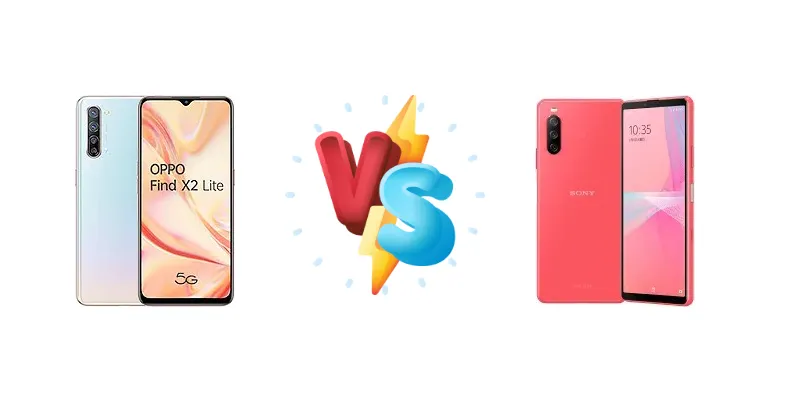
Both the Oppo Find X2 Lite and the Sony Xperia 10 III Lite represent attempts to deliver 5G connectivity at a more accessible price point. However, they achieve this with different approaches to chipset selection and feature prioritization. This comparison dissects the core differences to determine which device offers the best value for your money.
🏆 Quick Verdict
For the average user prioritizing performance and responsiveness, the Oppo Find X2 Lite is the better choice. Its Snapdragon 765G chipset provides a noticeable performance advantage over the Xperia 10 III Lite’s Snapdragon 690, making it more suitable for demanding apps and gaming. While both offer 30W charging, the X2 Lite’s superior processing power gives it the edge.
| Network |
|---|
| 2G bands | GSM 850 / 900 / 1800 / 1900 | GSM 850 / 900 / 1800 / 1900 |
| 3G bands | HSDPA 800 / 850 / 900 / 1700(AWS) / 1900 / 2100 | HSDPA 850 / 1900 |
| 4G bands | 1, 2, 3, 4, 5, 7, 8, 12, 17, 18, 19, 20, 26, 28, 38, 39, 40, 41, 66 | 1, 3, 4, 12, 18, 19, 38, 41 |
| 5G bands | 1, 3, 5, 7, 28, 40, 78 SA/NSA | 77, 78 SA/NSA |
| Speed | HSPA, LTE, 5G (1.9 Gbps DL) | HSPA, LTE, 5G |
| Technology | GSM / HSPA / LTE / 5G | GSM / HSPA / LTE / 5G |
| Launch |
|---|
| Announced | 2020, April 20. Released 2020, May 21 | 2021, August 20 |
| Status | Discontinued | Available. Released 2021, August 27 |
| Body |
|---|
| Build | Glass front (Gorilla Glass 5), glass back (Gorilla Glass 5), aluminum frame | Glass front (Gorilla Glass 6), glass back (Gorilla Glass 6), plastic frame |
| Dimensions | 160.3 x 74.3 x 8 mm (6.31 x 2.93 x 0.31 in) | 154 x 68 x 8.3 mm (6.06 x 2.68 x 0.33 in) |
| SIM | · Nano-SIM· Nano-SIM + Nano-SIM | Nano-SIM + eSIM |
| Weight | 180 g (6.35 oz) | 169 g (5.96 oz) |
| Display |
|---|
| Protection | Corning Gorilla Glass 5 | Corning Gorilla Glass 6 |
| Resolution | 1080 x 2400 pixels, 20:9 ratio (~408 ppi density) | 1080 x 2520 pixels, 21:9 ratio (~457 ppi density) |
| Size | 6.4 inches, 100.4 cm2 (~84.3% screen-to-body ratio) | 6.0 inches, 84.1 cm2 (~80.3% screen-to-body ratio) |
| Type | AMOLED, 430 nits (typ) | OLED, 1B colors, HDR |
| Platform |
|---|
| CPU | Octa-core (1x2.4 GHz Kryo 475 Prime & 1x2.2 GHz Kryo 475 Gold & 6x1.8 GHz Kryo 475 Silver) | Octa-core (2x2.0 GHz Kryo 560 Gold & 6x1.7 GHz Kryo 560 Silver) |
| Chipset | Qualcomm SM7250 Snapdragon 765G 5G (7 nm) | Qualcomm SM6350 Snapdragon 690 5G (8 nm) |
| GPU | Adreno 620 | Adreno 619 |
| OS | Android 10, ColorOS 7 | Android 11 |
| Memory |
|---|
| Card slot | No | microSDXC (uses shared SIM slot) |
| Internal | 128GB 8GB RAM | 64GB 6GB RAM |
| | UFS 2.1 | - |
| Main Camera |
|---|
| Features | LED flash, HDR, panorama | LED flash, HDR, panorama |
| Quad | 48 MP, f/1.7, 26mm (wide), 1/2.0", 0.8µm, PDAF
8 MP, f/2.2, 13mm (ultrawide), 1/4.0", 1.12µm
2 MP B/W, f/2.4, 1/5.0", 1.75µm
Auxiliary lens | - |
| Triple | - | 12 MP, f/1.8, 27mm (wide), 1/2.8", PDAF
8 MP, f/2.4, 54mm (telephoto), 1/4.0", PDAF, 2x optical zoom
8 MP, f/2.2, 16mm, 120˚ (ultrawide), 1/4.0" |
| Video | 4K@30fps, 1080p@30/60fps; gyro-EIS | 4K@30fps, 1080p@30fps |
| Selfie camera |
|---|
| Features | HDR | HDR |
| Single | 32 MP, f/2.0, 26mm (wide), 1/2.8", 0.8µm | 8 MP, f/2.0, 24mm (wide), 1/4.0" |
| Video | 1080p@30fps | 1080p@30fps |
| Sound |
|---|
| 3.5mm jack | Yes | Yes |
| 35mm jack | Yes | Yes |
| Loudspeaker | Yes | Yes |
| Comms |
|---|
| Bluetooth | 5.1, A2DP, LE | 5.1, A2DP, LE, aptX HD |
| NFC | Yes | Yes |
| Positioning | GPS (L1+L5), GLONASS (G1), BDS (B1I+B2a), GALILEO (E1+E5a), QZSS (L1+L5) | GPS, GLONASS, GALILEO, BDS, QZSS |
| Radio | No | No |
| USB | USB Type-C 2.0, OTG | USB Type-C 3.1, OTG, video output |
| WLAN | Wi-Fi 802.11 a/b/g/n/ac/6, dual-band, Wi-Fi Direct | Wi-Fi 802.11 a/b/g/n/ac, dual-band, Wi-Fi Direct |
| Features |
|---|
| Sensors | Fingerprint (under display, optical), accelerometer, gyro, proximity, compass | Fingerprint (side-mounted), accelerometer, proximity, compass |
| Battery |
|---|
| Charging | 30W wired, 50% in 20 min | 30W wired, PD, QC |
| Type | Li-Po 4025 mAh | Li-Po 4500 mAh |
| Misc |
|---|
| Colors | Moonlight Black, Pearl White | Black, White, Blue, Pink |
| Models | CPH2005 | XQ-BT44 |
| Price | About 200 EUR | About 370 EUR |
Oppo Find X2 Lite
- More powerful Snapdragon 765G chipset
- Faster overall performance
- Potentially better image processing
- Potentially lower battery life under heavy load
- Software experience may be less minimalist than Sony
Sony Xperia 10 III Lite
- Potentially better battery life during light usage
- Support for Power Delivery and Quick Charge
- Sony’s minimalist software approach (based on brand reputation)
- Less powerful Snapdragon 690 chipset
- Slower performance in demanding tasks
Display Comparison
Neither device boasts a standout display. While specific panel details (like OLED vs LCD) are missing, the focus here is on performance. The display quality will likely be similar, with both targeting the mid-range segment. Bezels are likely comparable, and without specific color accuracy data, it's difficult to differentiate. The lack of high refresh rates on either device suggests a focus on power efficiency over visual fluidity.
Camera Comparison
Without detailed sensor information, a direct camera comparison is challenging. However, the chipset’s image signal processor (ISP) plays a crucial role. The Snapdragon 765G generally offers a more capable ISP than the 690, potentially leading to better image processing, especially in low-light conditions. The absence of information regarding OIS or lens apertures makes it difficult to assess image quality further. It's reasonable to assume both phones will feature a multi-camera setup, but the X2 Lite’s superior processing power likely gives it an edge in computational photography.
Performance
The core difference lies in the chipsets. The Oppo Find X2 Lite’s Snapdragon 765G (7nm) is architecturally more advanced than the Sony Xperia 10 III Lite’s Snapdragon 690 (8nm). The 765G features a Kryo 475 Prime core clocked at 2.4GHz, offering a significant performance boost over the 690’s 2.0GHz Kryo 560 Gold cores. This translates to faster app loading times, smoother multitasking, and better gaming performance. The 7nm process node of the 765G also suggests potentially better thermal efficiency, reducing the likelihood of throttling under sustained load. While the 690 is still a capable 5G chip, the 765G is demonstrably more powerful.
Battery Life
Both phones support 30W wired charging, with the Oppo claiming 50% charge in 20 minutes. The Xperia 10 III Lite adds support for Power Delivery (PD) and Quick Charge (QC), offering broader compatibility with chargers. While battery capacity isn’t specified, the Snapdragon 690’s 8nm process *could* translate to slightly better battery life during light usage, but the more powerful 765G in the X2 Lite will consume more power under load. The inclusion of PD/QC on the Xperia offers a convenience factor, but the 30W charging speed is the primary commonality.
Buying Guide
Buy the Oppo Find X2 Lite if you need a phone capable of handling more demanding tasks like gaming or video editing, and if you value a smoother overall user experience. Buy the Sony Xperia 10 III Lite if you prioritize a potentially more efficient chipset for extended battery life during light usage, and if you appreciate Sony’s minimalist software approach and focus on audio quality (based on brand reputation).
Frequently Asked Questions
❓ Will the Snapdragon 690 in the Xperia 10 III Lite struggle with graphically intensive games like PUBG or Call of Duty?
The Snapdragon 690 is capable of running these games, but you’ll likely need to lower the graphics settings to achieve a smooth frame rate. The Oppo Find X2 Lite’s Snapdragon 765G will provide a significantly better gaming experience with higher settings and more consistent performance.
❓ Does the Oppo Find X2 Lite overheat during prolonged gaming sessions?
While the Snapdragon 765G is more powerful, its 7nm process node helps with thermal efficiency. However, sustained gaming will inevitably generate heat. The phone likely has thermal management systems in place to prevent overheating, but performance throttling is possible during extended play sessions. The Xperia 10 III Lite might run cooler, but at the cost of performance.
❓ Is the 30W charging on both phones equally fast in real-world use?
The charging speeds are likely comparable, with both reaching around 50% in approximately 20-30 minutes. The Xperia 10 III Lite’s support for PD and QC offers wider charger compatibility, which could be beneficial if you already own a compatible charger.