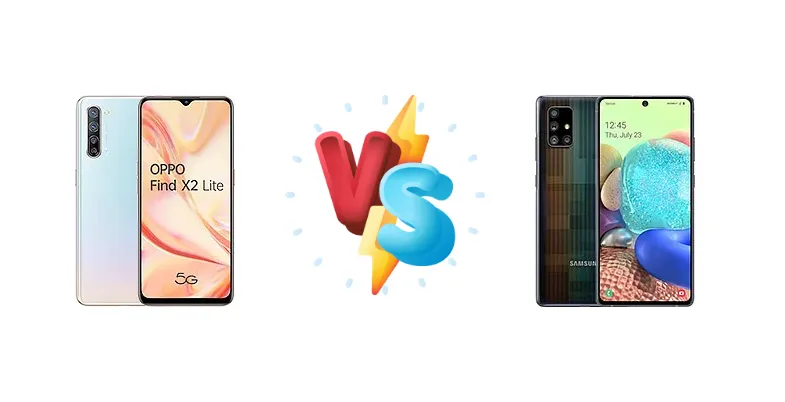
Both the Oppo Find X2 Lite and the Samsung Galaxy A71 5G UW target the increasingly competitive mid-range 5G market. While both leverage the Qualcomm Snapdragon 765G chipset, subtle differences in charging technology and overall design philosophy create distinct user experiences. This comparison dissects these nuances to determine which device offers the best value for your money.
🏆 Quick Verdict
For the average user prioritizing rapid charging and a slightly more streamlined experience, the Oppo Find X2 Lite emerges as the winner. Its 30W charging significantly outperforms the A71 5G UW’s 25W, translating to less time tethered to an outlet. However, Samsung’s brand recognition and software features may appeal to some.
| Network |
|---|
| 2G bands | GSM 850 / 900 / 1800 / 1900 | GSM 850 / 900 / 1800 / 1900 |
| 3G bands | HSDPA 800 / 850 / 900 / 1700(AWS) / 1900 / 2100 | HSDPA 850 / 900 / 1900 / 2100 |
| 4G bands | 1, 2, 3, 4, 5, 7, 8, 12, 17, 18, 19, 20, 26, 28, 38, 39, 40, 41, 66 | 2, 3, 4, 5, 7, 12, 13, 20, 28, 66 |
| 5G bands | 1, 3, 5, 7, 28, 40, 78 SA/NSA | 260, 261 SA/NSA/mmWave |
| Speed | HSPA, LTE, 5G (1.9 Gbps DL) | HSPA, LTE, 5G |
| Technology | GSM / HSPA / LTE / 5G | GSM / HSPA / LTE / 5G |
| Launch |
|---|
| Announced | 2020, April 20. Released 2020, May 21 | 2020, July 07 |
| Status | Discontinued | Available. Released 2020, July 16 |
| Body |
|---|
| Build | Glass front (Gorilla Glass 5), glass back (Gorilla Glass 5), aluminum frame | Glass front (Gorilla Glass 3), plastic back, aluminum frame |
| Dimensions | 160.3 x 74.3 x 8 mm (6.31 x 2.93 x 0.31 in) | 162.8 x 75.7 x 8.4 mm (6.41 x 2.98 x 0.33 in) |
| SIM | · Nano-SIM· Nano-SIM + Nano-SIM | Nano-SIM (pre-installed) |
| Weight | 180 g (6.35 oz) | 188 g (6.63 oz) |
| Display |
|---|
| Protection | Corning Gorilla Glass 5 | Corning Gorilla Glass 3 |
| Resolution | 1080 x 2400 pixels, 20:9 ratio (~408 ppi density) | 1080 x 2400 pixels, 20:9 ratio (~393 ppi density) |
| Size | 6.4 inches, 100.4 cm2 (~84.3% screen-to-body ratio) | 6.7 inches, 108.4 cm2 (~87.9% screen-to-body ratio) |
| Type | AMOLED, 430 nits (typ) | Super AMOLED Plus |
| Platform |
|---|
| CPU | Octa-core (1x2.4 GHz Kryo 475 Prime & 1x2.2 GHz Kryo 475 Gold & 6x1.8 GHz Kryo 475 Silver) | Octa-core (1x2.4 GHz Kryo 475 Prime & 1x2.2 GHz Kryo 475 Gold & 6x1.8 GHz Kryo 475 Silver) |
| Chipset | Qualcomm SM7250 Snapdragon 765G 5G (7 nm) | Qualcomm SM7250 Snapdragon 765G 5G (7 nm) |
| GPU | Adreno 620 | Adreno 620 |
| OS | Android 10, ColorOS 7 | Android 10, One UI 2.1 |
| Memory |
|---|
| Card slot | No | microSDXC (dedicated slot) |
| Internal | 128GB 8GB RAM | 128GB 8GB RAM |
| | UFS 2.1 | UFS 2.1 |
| Main Camera |
|---|
| Features | LED flash, HDR, panorama | LED flash, panorama, HDR |
| Quad | 48 MP, f/1.7, 26mm (wide), 1/2.0", 0.8µm, PDAF
8 MP, f/2.2, 13mm (ultrawide), 1/4.0", 1.12µm
2 MP B/W, f/2.4, 1/5.0", 1.75µm
Auxiliary lens | 64 MP, f/1.8, 26mm (wide), 1/1.72", 0.8µm, PDAF
12 MP, f/2.2, 123˚ (ultrawide)
5 MP (macro)
Auxiliary lens |
| Video | 4K@30fps, 1080p@30/60fps; gyro-EIS | 4K@30fps, 1080p@30/240fps, 1080p@960fps; gyro-EIS |
| Selfie camera |
|---|
| Features | HDR | HDR |
| Single | 32 MP, f/2.0, 26mm (wide), 1/2.8", 0.8µm | 32 MP, f/2.2, 26mm (wide), 1/2.8", 0.8µm |
| Video | 1080p@30fps | 4K@30fps, 1080p@30fps |
| Sound |
|---|
| 3.5mm jack | Yes | Yes |
| 35mm jack | Yes | Yes |
| Loudspeaker | Yes | Yes |
| Comms |
|---|
| Bluetooth | 5.1, A2DP, LE | 5.0, A2DP, LE |
| NFC | Yes | No |
| Positioning | GPS (L1+L5), GLONASS (G1), BDS (B1I+B2a), GALILEO (E1+E5a), QZSS (L1+L5) | GPS, GLONASS, GALILEO, BDS |
| Radio | No | No |
| USB | USB Type-C 2.0, OTG | USB Type-C 2.0, OTG |
| WLAN | Wi-Fi 802.11 a/b/g/n/ac/6, dual-band, Wi-Fi Direct | Wi-Fi 802.11 a/b/g/n/ac, dual-band, Wi-Fi Direct |
| Features |
|---|
| Sensors | Fingerprint (under display, optical), accelerometer, gyro, proximity, compass | Fingerprint (under display, optical), accelerometer, gyro, proximity, compass |
| | - | ANT+ |
| Battery |
|---|
| Charging | 30W wired, 50% in 20 min | 25W wired |
| Type | Li-Po 4025 mAh | Li-Po 4500 mAh |
| Misc |
|---|
| Colors | Moonlight Black, Pearl White | Prism Bricks Black |
| Models | CPH2005 | SM-A716V |
| Price | About 200 EUR | - |
| SAR | - | 0.50 W/kg (head) 0.78 W/kg (body) |
Oppo Find X2 Lite
- Faster 30W charging for quicker top-ups
- Potentially more compact and lightweight design
- Oppo’s ColorOS offers a clean and customizable experience
- Brand recognition is lower than Samsung
- Camera system details are less prominent in marketing
Samsung Galaxy A71 5G UW
- Larger display for immersive media consumption
- Samsung’s One UI provides a feature-rich software experience
- Potentially wider carrier compatibility, especially with UW 5G
- Slower 25W charging
- Likely larger and heavier form factor
- Samsung’s software can be perceived as bloated by some
Display Comparison
While both devices likely feature AMOLED panels (based on market segment), specific details like peak brightness and color accuracy are unavailable. The A71 5G UW’s larger 6.7-inch display will offer a more immersive viewing experience for media consumption, but the Find X2 Lite’s potentially smaller size (speculation based on 'Lite' branding) could be preferable for one-handed use. The absence of high refresh rate information suggests neither prioritizes buttery-smooth scrolling.
Camera Comparison
Without detailed sensor specifications, a direct camera comparison is challenging. However, the mid-range positioning suggests both will rely on multi-camera setups. The A71 5G UW’s marketing often emphasizes its camera capabilities, potentially indicating a larger main sensor or more advanced image processing algorithms. The Find X2 Lite may focus on a more balanced approach. It’s crucial to note that the inclusion of 2MP macro or depth sensors on either device adds minimal value to the overall photography experience.
Performance
Both the Oppo Find X2 Lite and the Samsung Galaxy A71 5G UW are powered by the Qualcomm Snapdragon 765G 5G (7 nm) chipset, featuring an octa-core CPU configuration with the same Kryo 475 core arrangement (1x2.4 GHz Prime, 1x2.2 GHz Gold, 6x1.8 GHz Silver). This means CPU performance will be virtually identical. The real-world difference will likely come down to thermal management and sustained performance. While both use 7nm fabrication, Oppo’s generally more aggressive thermal design could allow for slightly longer peak performance during demanding tasks. RAM configurations are unknown, but LPDDR4X is a likely candidate for both.
Battery Life
The key differentiator here is charging speed. The Oppo Find X2 Lite boasts 30W wired charging, capable of reaching 50% charge in just 20 minutes. The Samsung Galaxy A71 5G UW is limited to 25W charging. While battery capacity is unknown for both, the faster charging of the Oppo mitigates the impact of a potentially smaller battery. This translates to significantly less downtime for users who need a quick power boost.
Buying Guide
Buy the Oppo Find X2 Lite if you need faster charging speeds and a lighter, more compact form factor. This phone is ideal for users who frequently top up their battery throughout the day and value portability. Buy the Samsung Galaxy A71 5G UW if you prefer a larger display, Samsung’s One UI software ecosystem, and potentially wider carrier compatibility, particularly with UW 5G networks in the US.
Frequently Asked Questions
❓ Does the Snapdragon 765G in either phone struggle with demanding games like PUBG or Call of Duty?
The Snapdragon 765G is a capable mid-range chipset. While it won't deliver flagship-level performance, it can handle PUBG and Call of Duty at medium to high settings. Sustained performance will depend on thermal management, and both phones may experience some throttling during extended gaming sessions. Expect playable frame rates, but don't anticipate consistently hitting maximum graphical settings.
❓ Is the 5G connectivity on the A71 5G UW truly 'UW' (Ultra Wideband) and does that matter?
The 'UW' designation on the Samsung Galaxy A71 5G UW indicates support for specific 5G frequencies used by T-Mobile in the US. This allows for faster peak 5G speeds in areas with UW coverage. However, UW coverage is still limited, and the phone will fall back to slower 5G bands when UW is unavailable. If you live in an area with robust UW 5G coverage, this is a significant advantage.
❓ How does Oppo’s ColorOS compare to Samsung’s One UI in terms of updates and long-term software support?
Historically, Samsung has offered better long-term software support than Oppo. One UI typically receives more frequent security updates and major Android version upgrades. Oppo’s ColorOS has improved in recent years, but it still lags behind Samsung in terms of update consistency. If long-term software support is a priority, the A71 5G UW is the safer bet.