
Oppo Find X2 Lite vs Nokia 8.3 5G: A Detailed Comparison of Two Snapdragon 765G Contenders
| Phones Images | |||||
|---|---|---|---|---|---|
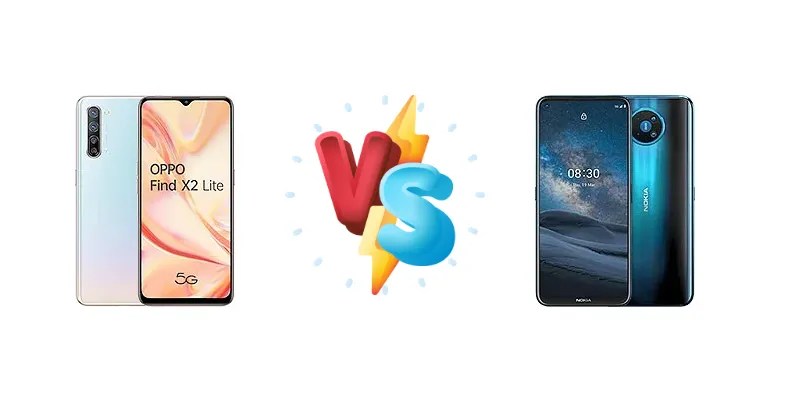
|
🏆 Quick Verdict
For the average user prioritizing quick top-ups and a slightly more refined experience, the Oppo Find X2 Lite emerges as the winner. Its 30W charging significantly outperforms the Nokia 8.3 5G’s 18W, reducing downtime and making it ideal for those constantly on the move. While both phones offer similar performance, the charging advantage tips the scales.
| PHONES | ||
|---|---|---|
| Phone Names | Oppo Find X2 Lite | Nokia 8.3 5G |
| Network | ||
|---|---|---|
| 2G bands | GSM 850 / 900 / 1800 / 1900 | GSM 850 / 900 / 1800 / 1900 |
| 3G bands | HSDPA 800 / 850 / 900 / 1700(AWS) / 1900 / 2100 | HSDPA 850 / 900 / 1700(AWS) / 1900 / 2100 |
| 4G bands | 1, 2, 3, 4, 5, 7, 8, 12, 17, 18, 19, 20, 26, 28, 38, 39, 40, 41, 66 | 1, 2, 3, 4, 5, 7, 8, 12, 13, 17, 20, 28, 32, 38, 39, 40, 41, 66, 71 |
| 5G bands | 1, 3, 5, 7, 28, 40, 78 SA/NSA | 1, 2, 3, 5, 7, 8, 28, 38, 40, 41, 66, 71, 78 SA/NSA |
| Speed | HSPA, LTE, 5G (1.9 Gbps DL) | HSPA 42.2/5.76 Mbps, LTE (4CA) Cat18 1200/150 Mbps, 5G 2.4/1.2 Gbps |
| Technology | GSM / HSPA / LTE / 5G | GSM / HSPA / LTE / 5G |
| Launch | ||
|---|---|---|
| Announced | 2020, April 20. Released 2020, May 21 | 2020, March 19. Released 2020, September 15 |
| Status | Discontinued | Discontinued |
| Body | ||
|---|---|---|
| Build | Glass front (Gorilla Glass 5), glass back (Gorilla Glass 5), aluminum frame | Glass front, plastic frame, glass back |
| Dimensions | 160.3 x 74.3 x 8 mm (6.31 x 2.93 x 0.31 in) | 171.9 x 78.6 x 9 mm (6.77 x 3.09 x 0.35 in) |
| SIM | · Nano-SIM· Nano-SIM + Nano-SIM | · Nano-SIM· Nano-SIM + Nano-SIM |
| Weight | 180 g (6.35 oz) | 220 g (7.76 oz) |
| Display | ||
|---|---|---|
| Protection | Corning Gorilla Glass 5 | - |
| Resolution | 1080 x 2400 pixels, 20:9 ratio (~408 ppi density) | 1080 x 2400 pixels, 20:9 ratio (~386 ppi density) |
| Size | 6.4 inches, 100.4 cm2 (~84.3% screen-to-body ratio) | 6.81 inches, 112.0 cm2 (~82.9% screen-to-body ratio) |
| Type | AMOLED, 430 nits (typ) | IPS LCD |
| Platform | ||
|---|---|---|
| CPU | Octa-core (1x2.4 GHz Kryo 475 Prime & 1x2.2 GHz Kryo 475 Gold & 6x1.8 GHz Kryo 475 Silver) | Octa-core (1x2.4 GHz Kryo 475 Prime & 1x2.2 GHz Kryo 475 Gold & 6x1.8 GHz Kryo 475 Silver) |
| Chipset | Qualcomm SM7250 Snapdragon 765G 5G (7 nm) | Qualcomm SM7250 Snapdragon 765G 5G (7 nm) |
| GPU | Adreno 620 | Adreno 620 |
| OS | Android 10, ColorOS 7 | Android 10, upgradable to Android 12, Android One |
| Memory | ||
|---|---|---|
| Card slot | No | microSDXC (uses shared SIM slot) |
| Internal | 128GB 8GB RAM | 64GB 6GB RAM, 64GB 8GB RAM, 128GB 8GB RAM |
| UFS 2.1 | - | |
| Main Camera | ||
|---|---|---|
| Features | LED flash, HDR, panorama | Zeiss optics, Dual-LED flash, panorama, HDR |
| Quad | 48 MP, f/1.7, 26mm (wide), 1/2.0", 0.8µm, PDAF 8 MP, f/2.2, 13mm (ultrawide), 1/4.0", 1.12µm 2 MP B/W, f/2.4, 1/5.0", 1.75µm Auxiliary lens | 64 MP, f/1.9, (wide), 1/1.72", 0.8µm, PDAF 12 MP, f/2.2, 120˚ (ultrawide), 1/2.43", 1.4µm, AF 2 MP (macro) Auxiliary lens |
| Video | 4K@30fps, 1080p@30/60fps; gyro-EIS | 4K@30/60fps, 1080p@30/240fps, 720p@960fps, gyro-EIS |
| Selfie camera | ||
|---|---|---|
| Features | HDR | Zeiss optics, HDR |
| Single | 32 MP, f/2.0, 26mm (wide), 1/2.8", 0.8µm | 24 MP, f/2.0, (wide), 1/2.8", 0.9µm |
| Video | 1080p@30fps | 1080p@30fps |
| Sound | ||
|---|---|---|
| 3.5mm jack | Yes | Yes |
| 35mm jack | Yes | Yes |
| Loudspeaker | Yes | Yes |
| Comms | ||
|---|---|---|
| Bluetooth | 5.1, A2DP, LE | 5.0, A2DP, EDR, LE |
| NFC | Yes | Yes |
| Positioning | GPS (L1+L5), GLONASS (G1), BDS (B1I+B2a), GALILEO (E1+E5a), QZSS (L1+L5) | GPS, GLONASS, BDS |
| Radio | No | FM radio |
| USB | USB Type-C 2.0, OTG | USB Type-C 2.0, OTG |
| WLAN | Wi-Fi 802.11 a/b/g/n/ac/6, dual-band, Wi-Fi Direct | Wi-Fi 802.11 a/b/g/n/ac, dual-band, Wi-Fi Direct |
| Features | ||
|---|---|---|
| Sensors | Fingerprint (under display, optical), accelerometer, gyro, proximity, compass | Fingerprint (side-mounted), accelerometer, gyro, proximity, compass |
| Battery | ||
|---|---|---|
| Charging | 30W wired, 50% in 20 min | 18W wired |
| Type | Li-Po 4025 mAh | Li-Po 4500 mAh |
| Misc | ||
|---|---|---|
| Colors | Moonlight Black, Pearl White | Polar Night |
| Models | CPH2005 | TA-1243, TA-1251 |
| Price | About 200 EUR | About 470 EUR |
| SAR | - | 0.96 W/kg (head) 1.41 W/kg (body) |
| SAR EU | - | 0.96 W/kg (head) 1.41 W/kg (body) |
Oppo Find X2 Lite
- 30W Fast Charging: Significantly reduces charging time.
- Potentially brighter display: Oppo often prioritizes high peak brightness.
- Streamlined User Experience: Oppo’s ColorOS is generally well-optimized.
- ColorOS: Some users may prefer a stock Android experience.
- Limited update guarantee: Oppo’s update policy is less consistent than Nokia’s.
Nokia 8.3 5G
- Clean Android Experience: Nokia offers a near-stock Android experience.
- Guaranteed Updates: Nokia provides consistent software updates and security patches.
- Potentially better thermal management: Larger chassis may aid passive cooling.
- Slower 18W Charging: Significantly longer charging times.
- Less Vibrant Display: Nokia typically favors more natural color tones.
Display Comparison
Both devices lack detailed display specifications in the provided data. However, given their market positioning, we can infer both likely utilize AMOLED panels. The key differentiator will be peak brightness and color calibration. Oppo historically focuses on vibrant, punchy colors, while Nokia tends towards more natural tones. Without specific nit ratings, it’s difficult to declare a clear winner, but Oppo’s display technology often leans towards higher peak brightness for better outdoor visibility.
Camera Comparison
The provided data doesn’t detail camera specifications beyond the chipsets’ ISP capabilities. Given the market segment, both phones likely feature multi-camera setups. The Nokia 8.3 5G, historically, has emphasized computational photography and image processing. Oppo, conversely, often prioritizes hardware, potentially leading to better low-light performance with a larger main sensor (assuming a difference exists, which is not specified). The absence of sensor size information makes a definitive camera comparison impossible, but the image processing style will likely be the most noticeable difference.
Performance
Both the Oppo Find X2 Lite and Nokia 8.3 5G are equipped with the Qualcomm SM7250 Snapdragon 765G 5G (7 nm) chipset, featuring an identical CPU configuration: Octa-core (1x2.4 GHz Kryo 475 Prime & 1x2.2 GHz Kryo 475 Gold & 6x1.8 GHz Kryo 475 Silver). This means raw processing power will be virtually identical for everyday tasks and most gaming scenarios. Thermal management, however, could differ based on internal design and cooling solutions. Nokia’s larger chassis *might* offer slightly better passive cooling, but Oppo’s optimizations could counteract this. RAM configurations, not provided, will also impact multitasking performance.
Battery Life
This is where the Oppo Find X2 Lite pulls ahead. While battery capacity isn’t specified, the 30W wired charging capability is a significant advantage over the Nokia 8.3 5G’s 18W charging. This translates to a 50% charge in approximately 20 minutes on the Oppo, while the Nokia will take considerably longer. Even with a slightly larger battery on the Nokia, the faster charging of the Oppo will result in less downtime for the user. This difference is particularly impactful for users who frequently top up their phones throughout the day.
Buying Guide
Buy the Oppo Find X2 Lite if you need consistently fast charging and value a streamlined user experience. It’s perfect for users who frequently find themselves needing a quick power boost throughout the day. Buy the Nokia 8.3 5G if you prioritize a cleaner Android experience with guaranteed updates and prefer a more minimalist aesthetic, accepting a slower charging speed as a trade-off.