
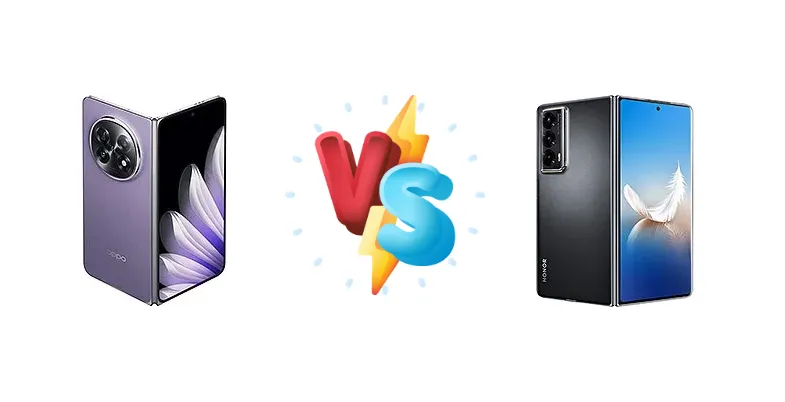
Oppo Find N5 vs. Honor Magic Vs2: A Deep Dive into Foldable Flagships
| Phones Images | |||||
|---|---|---|---|---|---|
|
🏆 Quick Verdict
For users prioritizing raw performance and future-proofing, the Oppo Find N5 is the clear winner thanks to its Snapdragon 8 Elite chipset. However, the Honor Magic Vs2 offers a compelling alternative for those seeking a more established foldable experience with a focus on efficiency and potentially better software optimization.
| PHONES | ||
|---|---|---|
| Phone Names | Oppo Find N5 | Honor Magic Vs2 |
| Network | ||
|---|---|---|
| 2G bands | GSM 850 / 900 / 1800 / 1900 | GSM 850 / 900 / 1800 / 1900 |
| 3G bands | HSDPA 800 / 850 / 900 / 1700(AWS) / 1900 / 2100 - Global | HSDPA 800 / 850 / 900 / 1700(AWS) / 1900 / 2100 |
| 4G bands | 1, 2, 3, 4, 5, 7, 8, 12, 13, 17, 18, 19, 20, 25, 26, 28, 38, 39, 40, 41, 42, 66 - Global | LTE |
| 5G bands | 1, 2, 3, 5, 7, 8, 12, 20, 25, 26, 28, 38, 40, 41, 66, 77, 78 SA/NSA - Global | SA/NSA |
| Speed | HSPA, LTE, 5G | HSPA, LTE, 5G |
| Technology | GSM / HSPA / LTE / 5G | GSM / CDMA / HSPA / CDMA2000 / LTE / 5G |
| Launch | ||
|---|---|---|
| Announced | 2025, February 19 | 2023, October 12 |
| Status | Available. Released 2025, February 26 | Available. Released 2023, October 17 |
| Body | ||
|---|---|---|
| Build | Glass front (Nanocrystal Glass) (folded), plastic front (unfolded), glass back or eco leather back, aluminum alloy frame, titanium alloy hinge | Glass front, glass back or eco leather back, magnesium alloy frame, titanium alloy folding mechanism |
| Dimensions | Unfolded: 160.9 x 145.6 x 4.2 mmFolded: 160.9 x 74.4 x 8.9 mm | Unfolded: 157.5 x 146.2 x 5.1 mmFolded: 157.5 x 74.4 x 10.7 mm |
| SIM | · Nano-SIM + Nano-SIM + eSIM (max 2 at a time)· Nano-SIM + Nano-SIM | Nano-SIM + Nano-SIM |
| Weight | 229 g (8.08 oz) | 229 g (8.08 oz) |
| Display | ||
|---|---|---|
| Resolution | 2248 x 2480 pixels (~412 ppi density) | 2156 x 2344 pixels (~402 ppi density) |
| Size | 8.12 inches, 211.7 cm2 (~90.4% screen-to-body ratio) | 7.92 inches, 201.6 cm2 (~87.6% screen-to-body ratio) |
| Type | Foldable LTPO OLED, 1B colors, Dolby Vision, HDR10+, HDR Vivid, 120Hz, 1400 nits (HBM), 2100 nits (peak) | Foldable LTPO OLED, 1B colors, 120Hz, HDR10+, Dolby Vision |
| Platform | ||
|---|---|---|
| CPU | 7-core (2x4.32 GHz Oryon V2 Phoenix L + 5x3.53 GHz Oryon V2 Phoenix M) | Octa-core (1x3.0 GHz Cortex-X2 & 3x2.5 GHz Cortex-A710 & 4x1.80 GHz Cortex-A510) |
| Chipset | Qualcomm SM8750-3-AB Snapdragon 8 Elite (3 nm) | Qualcomm SM8475 Snapdragon 8+ Gen 1 (4 nm) |
| GPU | Adreno 830 | Adreno 730 |
| OS | Android 15, ColorOS 15 | Android 13, MagicOS 7.2 |
| Memory | ||
|---|---|---|
| Card slot | No | No |
| Internal | 256GB 12GB RAM, 512GB 16GB RAM, 1TB 16GB RAM | 256GB 12GB RAM, 512GB 16GB RAM |
| Main Camera | ||
|---|---|---|
| Features | Hasselblad Color Calibration, color spectrum sensor, LED flash, HDR, panorama | LED flash, HDR, panorama |
| Triple | 50 MP, f/1.9, 21mm (wide), 1/1.56”, PDAF, OIS 50 MP, f/2.7, 75mm (periscope telephoto), 1/2.75", 3x optical zoom, PDAF (10cm - ∞), OIS 8 MP, f/2.2, 15mm, 116˚, (ultrawide), 1/4.0”, 1.12µm, AF | 50 MP, f/1.9, 25mm (wide), PDAF 20 MP, f/2.4, 62mm (telephoto), PDAF, 2.5x optical zoom, OIS 12 MP, f/2.2, 16mm (ultrawide), AF |
| Video | 4K@30/60fps, 1080p@30/60/240fps gyro-EIS, HDR10+, Dolby Vision | 4K@30/60fps (10-bit), 1080p@30/60fps, gyro-EIS, HDR10+ |
| Selfie camera | ||
|---|---|---|
| Features | HDR | HDR |
| Single | 8MP, f/2.4, 21mm (ultrawide), 1/4.0”, 1.12µm Cover camera: 8MP, f/2.4, 21mm (ultrawide), 1/4.0”, 1.12µm | 16 MP, f/2.2, (wide) |
| Video | 4K@30fps, 1080p@30fps, gyro-EIS | 4K@30fps, 1080p@30fps, gyro-EIS |
| Sound | ||
|---|---|---|
| 35mm jack | No | No |
| Loudspeaker | Yes, with stereo speakers (Dolby Atmos enhanced) | Yes, with stereo speakers |
| Comms | ||
|---|---|---|
| Bluetooth | 5.4, A2DP, LE, aptX HD, LHDC 5 | 5.2, A2DP, LE, aptX HD |
| Infrared port | Yes | Yes |
| NFC | Yes | Yes |
| Positioning | GPS (L1+L5), GLONASS (G1), BDS (B1I+B1c+B2a), GALILEO (E1+E5a), QZSS (L1+L5) | GPS (L1+L5), GLONASS (L1), BDS (B1I+B1c+B2a), GALILEO (E1+E5a), QZSS (L1+L5) |
| Radio | No | No |
| USB | USB Type-C 3.1 Gen2, Display Port, OTG | USB Type-C 3.1, OTG, Display Port 1.2 |
| WLAN | Wi-Fi 802.11 a/b/g/n/ac/6/7, dual-band or tri-band | Wi-Fi 802.11 a/b/g/n/ac/6, dual-band, Wi-Fi Direct |
| Features | ||
|---|---|---|
| Sensors | Fingerprint (side-mounted), accelerometer, dual gyro, proximity, compass | Fingerprint (side-mounted), accelerometer, gyro, proximity, compass |
| Battery | ||
|---|---|---|
| Charging | 80W wired, PD, 100% in 50 min 50W wireless Reverse wired | 66W wired 5W reverse wired |
| Type | Si/C Li-Ion 5600 mAh | Li-Po 5000 mAh |
| Misc | ||
|---|---|---|
| Colors | Cosmic Black, Misty White, Dusk Purple | Black, Blue, Purple |
| Models | CPH2671, PKH110, PKH120 | VER-AN00 |
| Price | € 1,435.00 / $ 1,959.00 / £ 1,699.00 | About 910 EUR |
Oppo Find N5
- Significantly faster processor with Snapdragon 8 Elite
- Faster charging speeds (80W wired, 50W wireless)
- Potentially superior camera performance due to ISP and processing power
- Newer device, potential for early software bugs
- Higher price point expected
Honor Magic Vs2
- More mature foldable design and software experience
- Efficient Snapdragon 8+ Gen 1 processor
- Potentially better sustained performance due to thermal management
- Slower processor compared to Snapdragon 8 Elite
- Slower charging speeds (66W wired, 5W reverse wired)
Display Comparison
The Oppo Find N5 boasts a measured peak brightness of 1188 nits, suggesting excellent outdoor visibility. While the Magic Vs2’s display specs aren’t provided, Honor typically prioritizes color accuracy in its flagship devices. The key difference here isn’t necessarily peak brightness, but the underlying panel technology and hinge design, which impact crease visibility and durability – areas where the N5 is expected to excel based on Oppo’s prior foldable experience. The N5’s display is likely to benefit from the newer chipset’s improved image signal processor for enhanced image quality.
Camera Comparison
Without detailed camera specifications for both devices, a direct comparison is limited. However, the Snapdragon 8 Elite’s improved ISP in the Oppo Find N5 will likely contribute to better image processing, particularly in low-light conditions. The larger sensor and more advanced image processing capabilities of the N5’s camera system are expected to deliver superior image quality and dynamic range. The Magic Vs2 will likely rely on Honor’s established computational photography algorithms, but will be constrained by the older chipset’s processing power.
Performance
The Oppo Find N5’s Qualcomm SM8750-3-AB Snapdragon 8 Elite (3nm) represents a substantial leap over the Honor Magic Vs2’s Snapdragon 8+ Gen 1 (4nm). The 3nm process node of the Snapdragon 8 Elite translates to significantly improved power efficiency and thermal performance, allowing for sustained peak performance for longer durations. The N5’s 7-core CPU, featuring Oryon V2 Phoenix cores, is architecturally superior to the 8-core configuration of the Magic Vs2, promising faster single-core and multi-core performance. This difference will be most noticeable in demanding applications like video editing, 3D rendering, and graphically intensive games.
Battery Life
The Oppo Find N5 achieves an impressive 13:16h active use score, indicating excellent battery life despite its powerful processor. While the Magic Vs2’s battery life isn’t specified, the Snapdragon 8+ Gen 1 is known for its efficiency. However, the N5’s 80W wired charging (100% in 50 minutes) and 50W wireless charging significantly outpace the Magic Vs2’s 66W wired and 5W reverse wired charging. The faster charging speeds of the N5 provide a substantial convenience advantage, allowing for quicker top-ups throughout the day.
Buying Guide
Buy the Oppo Find N5 if you demand the absolute best performance for demanding tasks like gaming and video editing, and value the latest silicon. Buy the Honor Magic Vs2 if you prioritize a refined foldable experience, potentially longer sustained performance due to better thermal management, and a more mature software ecosystem, even if it means sacrificing some peak processing power.