
Oppo Find N2 vs. Honor Magic V2 RSR Porsche Design: A Foldable Showdown
| Phones Images | |||||
|---|---|---|---|---|---|
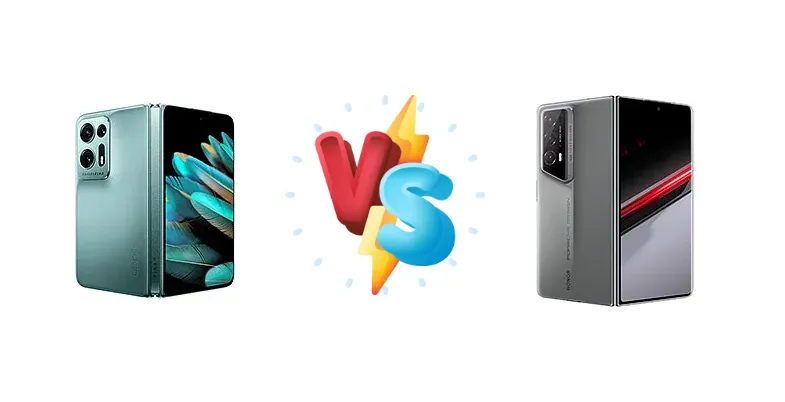
|
🏆 Quick Verdict
For most users, the Honor Magic V2 RSR Porsche Design emerges as the superior choice. Its Snapdragon 8 Gen 2 chipset delivers a noticeable performance uplift over the Find N2’s Snapdragon 8+ Gen 1, and while charging speeds are similar, the newer processor offers better long-term efficiency. However, the Find N2 remains a strong contender for those prioritizing a proven track record and potentially better software optimization.
| PHONES | ||
|---|---|---|
| Phone Names | Oppo Find N2 | Honor Magic V2 RSR Porsche Design |
| Network | ||
|---|---|---|
| 2G bands | GSM 850 / 900 / 1800 / 1900 | GSM 850 / 900 / 1800 / 1900 |
| 3G bands | HSDPA 800 / 850 / 900 / 1700(AWS) / 1900 / 2100 | HSDPA 800 / 850 / 900 / 1700(AWS) / 1900 / 2100 |
| 4G bands | 1, 2, 3, 4, 5, 7, 8, 12, 17, 18, 19, 20, 26, 28, 34, 38, 39, 40, 41, 66 | 1, 2, 3, 4, 5, 7, 8, 12, 17, 18, 19, 20, 26, 28, 34, 38, 39, 40, 41, 66 |
| 5G bands | 1, 3, 5, 7, 8, 20, 28, 38, 40, 41, 77, 78, 79 SA/NSA | 1, 3, 5, 8, 28, 38, 41, 77, 78 SA/NSA |
| Speed | HSPA, LTE, 5G | HSPA, LTE, 5G |
| Technology | GSM / CDMA / HSPA / EVDO / LTE / 5G | GSM / CDMA / HSPA / CDMA2000 / LTE / 5G |
| CDMA2000 1xEV-DO | - | |
| Launch | ||
|---|---|---|
| Announced | 2022, December 15 | 2024, January 11 |
| Status | Available. Released 2022, December 23 | Available. Released 2024, January 12 |
| Body | ||
|---|---|---|
| Build | Glass front (Gorilla Glass Victus) - folded, plastic front - unfolded, glass back (Gorilla Glass Victus) or eco leather back, aluminum frame | Glass front, glass back, magnesium alloy frame, titanium alloy folding mechanism |
| Dimensions | Unfolded: 132.2 x 140.5 x 7.4 mmFolded: 132.2 x 72.6 x 14.6 mm | Unfolded: 156.7 x 145.4 x 4.7 mm or 4.8 mmFolded: 156.7 x 74 x 9.9 mm or 10.1 mm |
| SIM | Nano-SIM + Nano-SIM | · Nano-SIM + eSIM· Nano-SIM + Nano-SIM |
| Weight | 233 g or 237 g (8.22 oz) | 234 g (8.25 oz) |
| Stylus support | - | |
| Display | ||
|---|---|---|
| Resolution | 1792 x 1920 pixels (~370 ppi density) | 2156 x 2344 pixels (~402 ppi density) |
| Size | 7.1 inches, 162.2 cm2 (~87.3% screen-to-body ratio) | 7.92 inches, 201.6 cm2 (~88.5% screen-to-body ratio) |
| Type | Foldable LTPO AMOLED, 120Hz, HDR10+, 1200 nits (HBM), 1550 nits (peak) | Foldable LTPO OLED, 1B colors, 120Hz, HDR10+, 1600 nits (peak) |
| Cover display: AMOLED, 120Hz, Corning Gorilla Glass Victus 5.54 inches, 1080 x 2120 pixels, 18:9 ratio 1000 nits (HBM), 1350 nits (peak) | - | |
| Platform | ||
|---|---|---|
| CPU | Octa-core (1x3.0 GHz Cortex-X2 & 3x2.75 GHz Cortex-A710 & 4x2.0 GHz Cortex-A510) | Octa-core (1x3.36 GHz Cortex-X3 & 2x2.8 GHz Cortex-A715 & 2x2.8 GHz Cortex-A710 & 3x2.0 GHz Cortex-A510) |
| Chipset | Qualcomm SM8475 Snapdragon 8+ Gen 1 (4 nm) | Qualcomm SM8550-AC Snapdragon 8 Gen 2 (4 nm) |
| GPU | Adreno 730 | Adreno 740 |
| OS | Android 13, ColorOS 13 | Android 13, upgradable to Android 14, MagicOS 8 |
| Memory | ||
|---|---|---|
| Card slot | No | No |
| Internal | 256GB 12GB RAM, 512GB 16GB RAM | 1TB 16GB RAM |
| UFS 3.1 | - | |
| Main Camera | ||
|---|---|---|
| Features | Hasselblad Color Calibration, color spectrum sensor, Dual-LED dual-tone flash, HDR, panorama | Multi-zone Laser AF (8x8 dToF), color spectrum sensor, LED flash, HDR, panorama |
| Single | 32 MP, f/2.4, 22mm (wide), 1/3.14" Cover camera: 32 MP, f/2.4, 22mm (wide), 1/3.14" | - |
| Triple | 50 MP, f/1.8, 24mm (wide), 1/1.56", 1.0µm, multi-directional PDAF, OIS 32 MP, f/2.0, 47mm (telephoto), 1/2.74", 0.8µm, 2x optical zoom, PDAF 48 MP, f/2.2, 14mm, 115˚ (ultrawide), 1/2", 0.8µm, AF | 50 MP, f/1.9, (wide), PDAF, OIS 20 MP, f/2.4, 62mm (telephoto), PDAF, 2.5x optical zoom, OIS 50 MP, f/2.0, 13mm (ultrawide), AF |
| Video | 4K@30/60fps, 1080p@30/60/240fps, gyro-EIS, HDR | 4K@30/60fps (10-bit), 1080p@30/60fps, gyro-EIS, HDR10+, OIS |
| Selfie camera | ||
|---|---|---|
| Features | HDR, panorama | HDR |
| Single | 32 MP, f/2.4, 22mm (wide), 1/3.14" Cover camera: 32 MP, f/2.4, 22mm (wide), 1/3.14" | 16 MP, f/2.2, (wide) |
| Video | 1080p@30fps, gyro-EIS | 4K@30fps, 1080p@30fps, gyro-EIS |
| Sound | ||
|---|---|---|
| 3.5mm jack | No | - |
| 35mm jack | No | No |
| Loudspeaker | Yes, with stereo speakers (Dolby support) | Yes, with stereo speakers |
| Comms | ||
|---|---|---|
| Bluetooth | 5.3, A2DP, LE, aptX HD | 5.3, A2DP, LE, aptX HD |
| Infrared port | - | Yes |
| NFC | Yes | Yes |
| Positioning | GPS (L1+L5), GLONASS (G1), BDS (B1I+B1c+B2a), GALILEO (E1+E5a), QZSS (L1+L5) | GPS (L1+L5), GLONASS (L1), BDS (B1I+B1c+B2a), GALILEO (E1+E5a), QZSS (L1+L5) |
| Radio | No | No |
| USB | USB Type-C 2.0, OTG | USB Type-C 3.1, OTG, Display Port 1.2 |
| WLAN | Wi-Fi 802.11 a/b/g/n/ac/6, tri-band | Wi-Fi 802.11 a/b/g/n/ac/6e/7, dual-band, Wi-Fi Direct |
| Features | ||
|---|---|---|
| Sensors | Fingerprint (side-mounted), accelerometer, dual gyro, proximity, compass | Fingerprint (side-mounted), accelerometer, gyro, proximity, compass |
| Battery | ||
|---|---|---|
| Charging | 67W wired, 37% in 10 min, 100% in 42 min 10W reverse wired | 66W wired 5W reverse wired |
| Type | Li-Po 4520 mAh | Si/C Li-Ion 5000 mAh |
| Misc | ||
|---|---|---|
| Colors | Black, Green, White | Agate Gray |
| Models | PGU110 | VER-AN10 |
| Price | About 1100 EUR | About 2700 EUR |
| Tests | ||
|---|---|---|
| Battery life | Endurance rating 83h | - |
| Camera | Photo / Video | - |
| Display | Contrast ratio: Infinite (nominal) | - |
| Loudspeaker | -27.9 LUFS (Good) | - |
| Performance | AnTuTu: 962082 (v9) GeekBench: 3670 (v5.1) GFXBench: 59fps (ES 3.1 onscreen) | - |
Oppo Find N2
- Excellent battery endurance (83h rating)
- Proven Snapdragon 8+ Gen 1 performance
- 10W reverse wired charging for accessory top-ups
- Older chipset compared to the competition
- Limited camera specification details
Honor Magic V2 RSR Porsche Design
- Cutting-edge Snapdragon 8 Gen 2 performance
- Premium Porsche Design aesthetic
- Likely superior display technology
- Battery life potentially impacted by the more powerful chipset
- Higher price point
Display Comparison
Both foldables feature large internal displays, but detailed specifications are limited. The Oppo Find N2 boasts a measured peak brightness of 1216 nits, suggesting excellent outdoor visibility. While the Honor Magic V2 RSR’s display specs aren’t provided, its positioning as a premium device suggests comparable or potentially superior brightness and color accuracy. Both likely utilize LTPO technology for adaptive refresh rates, conserving battery life. The key difference will likely be in hinge design and crease visibility, areas where Oppo has historically excelled.
Camera Comparison
Detailed camera specifications are lacking for both devices. Both are marketed as having capable photo and video capabilities, but without sensor size, aperture, or OIS details, a direct comparison is difficult. Given the Porsche Design branding, the Honor Magic V2 RSR likely prioritizes image quality and may feature more advanced image processing algorithms. However, Oppo has a strong reputation for computational photography, so the Find N2 shouldn’t be discounted. The absence of information on secondary cameras (ultrawide, telephoto) makes a comprehensive assessment impossible.
Performance
The Honor Magic V2 RSR Porsche Design holds a significant advantage in processing power. Its Snapdragon 8 Gen 2 (SM8550-AC) with a peak clock speed of 3.36 GHz on the Cortex-X3 core demonstrably outperforms the Oppo Find N2’s Snapdragon 8+ Gen 1 (SM8475) and its 3.0 GHz Cortex-X2 core. The newer architecture of the Gen 2, built on a 4nm process, also offers improved thermal efficiency, reducing the likelihood of throttling during sustained workloads. The Honor’s CPU configuration (1x3.36GHz, 2x2.8GHz, 2x2.8GHz, 3x2.0GHz) is also more balanced than the Find N2’s (1x3.0GHz, 3x2.75GHz, 4x2.0GHz).
Battery Life
The Oppo Find N2’s endurance rating of 83 hours is a strong indicator of its battery life prowess. While the Honor Magic V2 RSR’s battery capacity isn’t specified, its more power-hungry Snapdragon 8 Gen 2 chipset could offset any capacity advantage. Both devices support fast charging – 67W for the Oppo and 66W for the Honor – with similar 0-100% charge times (around 42-45 minutes). The Oppo also offers 10W reverse wired charging, while the Honor provides 5W, making the Oppo slightly more versatile for topping up accessories.
Buying Guide
Buy the Oppo Find N2 if you need a refined foldable experience with excellent battery endurance (83h rating) and a more established software ecosystem. It’s ideal for users who prioritize longevity and a balanced feature set. Buy the Honor Magic V2 RSR Porsche Design if you prefer cutting-edge performance, the latest Snapdragon 8 Gen 2 chipset, and a premium, head-turning design. This is the phone for power users and those who want the best possible foldable experience, regardless of price.