
OnePlus Open vs Oppo Find N: A Deep Dive into Foldable Flagships
| Phones Images | |||||
|---|---|---|---|---|---|
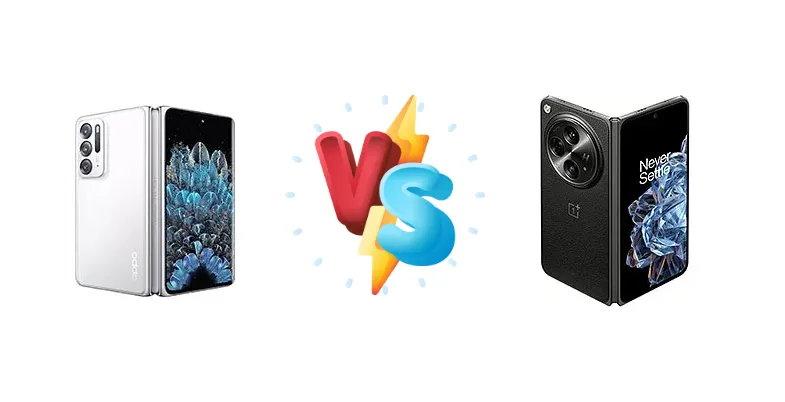
|
🏆 Quick Verdict
For most users, the OnePlus Open is the superior choice. Its Snapdragon 8 Gen 2 chipset delivers significantly improved performance and efficiency, coupled with faster 67W charging. While the Oppo Find N remains a capable device, its older processor and slower charging hold it back in a competitive landscape.
| PHONES | ||
|---|---|---|
| Phone Names | Oppo Find N | OnePlus Open |
| Network | ||
|---|---|---|
| 2G bands | GSM 850 / 900 / 1800 / 1900 | GSM 850 / 900 / 1800 / 1900 |
| 3G bands | HSDPA 800 / 850 / 900 / 1700(AWS) / 1900 / 2100 | HSDPA 800 / 850 / 900 / 1700(AWS) / 1900 / 2100 |
| 4G bands | 1, 2, 3, 4, 5, 7, 8, 12, 17, 18, 19, 20, 26, 28, 34, 38, 39, 40, 41, 66 | 1, 2, 3, 4, 5, 7, 8, 12, 13, 17, 18, 19, 20, 25, 26, 28, 30, 32, 38, 39, 40, 41, 46, 48, 66, 71 |
| 5G bands | 1, 3, 5, 7, 8, 20, 28, 38, 41, 66, 77, 78 SA/NSA | 1, 2, 3, 5, 7, 8, 12, 20, 25, 28, 30, 38, 40, 41, 66, 71, 75, 77, 78 SA/NSA |
| Speed | HSPA, LTE, 5G | HSPA, LTE, 5G |
| Technology | GSM / CDMA / HSPA / EVDO / LTE / 5G | GSM / HSPA / LTE / 5G |
| CDMA2000 1xEV-DO | - | |
| Launch | ||
|---|---|---|
| Announced | 2021, December 15 | 2023, October 19 |
| Status | Available. Released 2021, December 17 | Available. Released 2023, October 26 |
| Body | ||
|---|---|---|
| Build | Glass front (Gorilla Glass Victus) - folded, plastic front - unfolded, glass back (Gorilla Glass Victus), aluminum frame | Glass front (Ceramic Guard) (folded), plastic front (unfolded), glass back or eco leather back, aluminum frame |
| Dimensions | Unfolded: 132.6 x 140.2 x 8.0 mmFolded: 132.6 x 73 x 15.9 mm | Unfolded: 153.4 x 143.1 x 5.8 mmFolded: 153.4 x 73.3 x 11.7 mm |
| SIM | Dual SIM (Nano-SIM, dual stand-by) | Nano-SIM + Nano-SIM + eSIM (max 2 at a time) |
| Weight | 275 g (9.70 oz) | 239 g or 245 g (8.43 oz) |
| Display | ||
|---|---|---|
| Resolution | 1792 x 1920 pixels (~370 ppi density) | 2268 x 2440 pixels (~426 ppi density) |
| Size | 7.1 inches, 162.2 cm2 (~87.3% screen-to-body ratio) | 7.82 inches, 196.7 cm2 (~89.6% screen-to-body ratio) |
| Type | Foldable LTPO AMOLED, 120Hz, HDR10+, 500 nits (typ), 800 nits (HBM), 1000 nits (peak) | Foldable LTPO3 Flexi-fluid AMOLED, 1B colors, Dolby Vision, 120Hz, 2800 nits (peak) |
| Cover display: AMOLED, Corning Gorilla Glass Victus 5.49 inches, 988 x 1972 pixels, 18:9 ratio | - | |
| Platform | ||
|---|---|---|
| CPU | Octa-core (1x2.84 GHz Cortex-X1 & 3x2.42 GHz Cortex-A78 & 4x1.80 GHz Cortex-A55) | Octa-core (1x3.2 GHz Cortex-X3 & 2x2.8 GHz Cortex-A715 & 2x2.8 GHz Cortex-A710 & 3x2.0 GHz Cortex-A510) |
| Chipset | Qualcomm SM8350 Snapdragon 888 5G (5 nm) | Qualcomm SM8550-AB Snapdragon 8 Gen 2 (4 nm) |
| GPU | Adreno 660 | Adreno 740 |
| OS | Android 11, upgradable to Android 14, ColorOS 14 | Android 13, upgradable to Android 15, OxygenOS 15 |
| Memory | ||
|---|---|---|
| Card slot | No | No |
| Internal | 256GB 8GB RAM, 512GB 12GB RAM | 512GB 16GB RAM, 1TB 16GB RAM |
| UFS 3.1 | - | |
| Main Camera | ||
|---|---|---|
| Features | Color spectrum sensor, Dual-LED dual-tone flash, HDR, panorama | Hasselblad Color Calibration, LED flash, HDR, panorama |
| Single | 32 MP, f/2.4, 26mm (wide), 1/2.74", 0.8µm Cover camera: 32 MP, f/2.4, 26mm (wide), 1/2.74", 0.8µm | - |
| Triple | 50 MP, f/1.8, 24mm (wide), 1/1.56", 1.0µm, multi-directional PDAF, OIS 13 MP, f/2.4, 52mm (telephoto), 1/3.4", 1.0µm, 2x optical zoom, PDAF 16 MP, f/2.2, 14mm, 123˚ (ultrawide), 1/3.09", 1.0µm | 48 MP, f/1.7, 24mm (wide), 1/1.43", 1.12µm, multi-directional PDAF, OIS 64 MP, f/2.6, 70mm (telephoto), 1/2.0", 0.7µm, PDAF, OIS, 3x optical zoom 48 MP, f/2.2, 14mm, 114˚ (ultrawide), 1/2.0", 0.8µm, PDAF |
| Video | 4K@30/60fps, 1080p@30/60/240fps, gyro-EIS, HDR | 4K@30/60fps, 1080p@30/60/120/240/480fps gyro-EIS, HDR10+, Dolby Vision |
| Selfie camera | ||
|---|---|---|
| Features | HDR, panorama | HDR |
| Single | 32 MP, f/2.4, 26mm (wide), 1/2.74", 0.8µm Cover camera: 32 MP, f/2.4, 26mm (wide), 1/2.74", 0.8µm | 20MP, f/2.2, 20mm (ultrawide), 1/4.0", 0.7µm Cover camera: 32MP, f/2.4, 22mm (ultrawide), 1/3.14", 0.7µm |
| Video | 1080p@30fps, gyro-EIS | 4K@30fps, 1080p@30fps, gyro-EIS |
| Sound | ||
|---|---|---|
| 3.5mm jack | No | - |
| 35mm jack | No | No |
| Loudspeaker | Yes, with stereo speakers | Yes, with stereo speakers (Dolby Atmos enhanced) |
| Comms | ||
|---|---|---|
| Bluetooth | 5.2, A2DP, LE, aptX HD | 5.3, A2DP, LE, aptX HD |
| Infrared port | - | Yes |
| NFC | Yes | Yes |
| Positioning | GPS (L1+L5), GLONASS (L1), BDS (B1I+B1c+B2a), GALILEO (E1+E5a), QZSS (L1+L5) | GPS (L1+L5), GLONASS, BDS, GALILEO (E1+E5a), QZSS |
| Radio | No | No |
| USB | USB Type-C 2.0, OTG | USB Type-C 3.1, OTG |
| WLAN | Wi-Fi 802.11 a/b/g/n/ac/6, dual-band, Wi-Fi Direct | Wi-Fi 802.11 a/b/g/n/ac/6e/7, tri-band |
| Features | ||
|---|---|---|
| Sensors | Fingerprint (side-mounted), accelerometer, dual gyro, proximity, compass | Fingerprint (side-mounted), accelerometer, gyro, proximity, compass |
| Battery | ||
|---|---|---|
| Charging | 33W wired, 55% in 30 min, 100% in 70 min 15W wireless 10W reverse wired | 67W wired, PD, 100% in 42 min Reverse wired |
| Type | Li-Po 4500 mAh | Li-Po 4805 mAh |
| Misc | ||
|---|---|---|
| Colors | Black, White, Purple | Emerald Dusk, Voyager Black, Apex Edition |
| Models | PEUM00 | CPH2551 |
| Price | About 1070 EUR | $ 1,059.99 / € 926.54 |
| SAR | - | 0.98 W/kg (head) 0.76 W/kg (body) |
| Tests | ||
|---|---|---|
| Battery life | Endurance rating 90h | - |
| Camera | Photo / Video | - |
| Display | Contrast ratio: Infinite (nominal) | - |
| Loudspeaker | -28.7 LUFS (Average) | - |
| Performance | AnTuTu: 703131 (v8), 822513 (v9) GeekBench: 3478 (v5.1) GFXBench: 51fps (ES 3.1 onscreen) | - |
Oppo Find N
- Potentially lower price point
- Established foldable design
- Reverse wireless charging
- Older Snapdragon 888 processor
- Slower 33W charging
- Less efficient battery performance
OnePlus Open
- Snapdragon 8 Gen 2 for superior performance
- 67W fast charging with PD
- Brighter and more vibrant display
- Longer battery life in active use
- Higher price tag
- Newer device, potential for early software bugs
Display Comparison
The OnePlus Open boasts a significantly brighter display, reaching a measured 1238 nits peak brightness, compared to the Oppo Find N’s unspecified, but likely lower, peak brightness. Both feature foldable displays, but the Open’s higher brightness translates to better outdoor visibility. While both likely utilize LTPO technology for variable refresh rates (a common feature in this segment), the Open’s panel is demonstrably brighter. The Find N’s contrast ratio is listed as 'Infinite (nominal)', a standard marketing term, but the Open’s superior brightness provides a more vibrant and engaging viewing experience.
Camera Comparison
Both phones feature capable camera systems, but detailed sensor information is limited. Both are listed as having 'Photo / Video' capabilities. However, the OnePlus Open benefits from the newer image signal processor (ISP) within the Snapdragon 8 Gen 2, enabling improved image processing and noise reduction. While sensor size and aperture details are missing for both, the Open’s chipset provides a computational advantage. The Find N’s older processor may struggle to keep up with complex scenes and low-light conditions. Without specific sensor details, it’s difficult to declare a clear winner, but the Open’s processing power gives it an edge.
Performance
The performance gap is substantial. The OnePlus Open’s Snapdragon 8 Gen 2 (4nm) is a generational leap over the Oppo Find N’s Snapdragon 888 (5nm). The 8 Gen 2 features a Cortex-X3 prime core clocked at 3.2 GHz, compared to the Find N’s Cortex-X1 at 2.84 GHz. This, combined with the more efficient 4nm process, results in significantly faster processing speeds and improved thermal management. The Open’s CPU configuration (1x3.2GHz, 2x2.8GHz, 2x2.8GHz, 3x2.0GHz) is also more balanced than the Find N’s (1x2.84GHz, 3x2.42GHz, 4x1.80GHz). This translates to smoother multitasking, faster app loading times, and better sustained performance during demanding tasks like gaming.
Battery Life
The OnePlus Open offers a more compelling battery and charging experience. While the Oppo Find N has an endurance rating of 90 hours, the Open achieves a 96-hour rating and a more impressive 11 hours and 59 minutes of active use. Crucially, the Open’s 67W wired charging (with PD support) fully charges the device in just 42 minutes, a significant improvement over the Find N’s 70-minute charge time for a full charge at 33W. The Open also offers reverse wired charging, a feature present on the Find N at 10W, but the faster overall charging speed of the Open is a major advantage for users on the go.
Buying Guide
Buy the Oppo Find N if you prioritize a potentially lower price point and are comfortable with a less powerful processor. It's a good option for users who primarily use their phones for basic tasks and don't demand peak performance. Buy the OnePlus Open if you value cutting-edge performance, faster charging, and a brighter, more modern display. This is the foldable for power users, gamers, and those who want a future-proofed device.