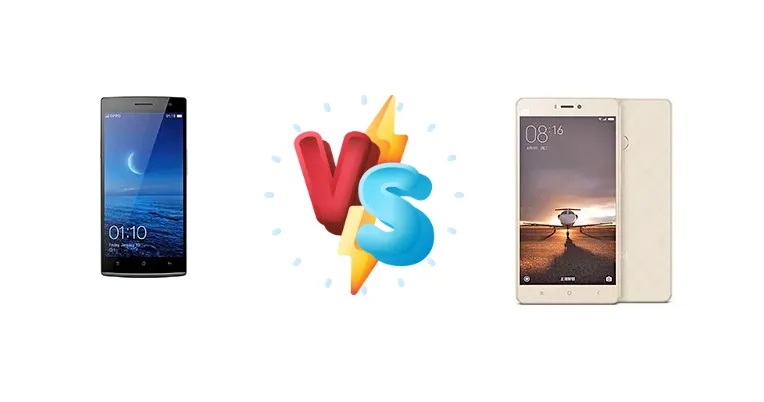
In 2014, Oppo and Xiaomi were rapidly ascending as major Android players, each offering compelling flagship experiences. The Oppo Find 7a, powered by the Snapdragon 801, and the Xiaomi Mi 4s, utilizing the Snapdragon 808, represent distinct approaches to performance and efficiency. This comparison revisits these devices, analyzing their strengths and weaknesses for those seeking a capable, affordable smartphone from a bygone era.
🏆 Quick Verdict
For the average user today, the Xiaomi Mi 4s emerges as the slightly better choice. Its Snapdragon 808, built on a 20nm process, offers improved efficiency and a more modern CPU architecture, translating to better sustained performance and a longer endurance rating of 75 hours compared to the Find 7a's 60 hours.
| Network |
|---|
| 2G bands | GSM 850 / 900 / 1800 / 1900 - all models | GSM 850 / 900 / 1800 / 1900 - SIM 1 & SIM 2 |
| 3G bands | HSDPA 850 / 900 / 1900 / 2100 - international model | HSDPA 850 / 1900 / 2100 |
| 4G bands | 1, 3, 7, 20 - International model | 1, 3, 7, 38, 39, 40, 41 |
| Speed | HSPA, LTE | HSPA, LTE Cat4 150/50 Mbps |
| Technology | GSM / HSPA / LTE | GSM / CDMA / HSPA / LTE |
| | - | TD-SCDMA |
| Launch |
|---|
| Announced | 2014, March. Released 2014, March | 2016, February. Released 2016, March |
| Status | Discontinued | Discontinued |
| Body |
|---|
| Dimensions | 152.6 x 75 x 9.2 mm (6.01 x 2.95 x 0.36 in) | 139.3 x 70.8 x 7.8 mm (5.48 x 2.79 x 0.31 in) |
| SIM | Micro-SIM | Nano-SIM + Micro-SIM |
| Weight | 170 g (6.00 oz) | 133 g (4.69 oz) |
| Display |
|---|
| Protection | Corning Gorilla Glass 3 | - |
| Resolution | 1080 x 1920 pixels, 16:9 ratio (~401 ppi density) | 1080 x 1920 pixels, 16:9 ratio (~441 ppi density) |
| Size | 5.5 inches, 83.4 cm2 (~72.9% screen-to-body ratio) | 5.0 inches, 68.9 cm2 (~69.9% screen-to-body ratio) |
| Type | IPS LCD | IPS LCD |
| Platform |
|---|
| CPU | Quad-core 2.3 GHz Krait 400 | Hexa-core (4x1.4 GHz Cortex-A53 & 2x1.8 GHz Cortex-A57) |
| Chipset | Qualcomm MSM8974AB Snapdragon 801 (28 nm) | Qualcomm MSM8992 Snapdragon 808 (20 nm) |
| GPU | Adreno 330 | Adreno 418 |
| OS | Android 4.3 (Jelly Bean), ColorOS | Android 5.1 (Lollipop), upgradable to 7.0 (Nougat), MIUI 10 |
| Memory |
|---|
| Card slot | microSDXC (dedicated slot) | microSDXC (uses shared SIM slot) |
| Internal | 16GB 2GB RAM | 64GB 3GB RAM |
| | - | eMMC 5.0 |
| Main Camera |
|---|
| Features | Dual-LED flash, panorama, HDR | Dual-LED dual-tone flash, panorama, HDR |
| Single | 13 MP, f/2.0, 1/3.0", AF | 13 MP, f/2.0, PDAF |
| Video | 4K@30fps, 1080p@60fps, 720p@120fps | 1080p@30fps, 720p@120fps |
| Selfie camera |
|---|
| Single | 5 MP, f/2.0 | 5 MP, f/2.0 |
| Video | 1080p@30fps | 1080p@30fps |
| Sound |
|---|
| 3.5mm jack | - | Yes |
| 35mm jack | Yes | Yes |
| Loudspeaker | Yes | Yes |
| Comms |
|---|
| Bluetooth | 4.0, A2DP | 4.1, A2DP |
| Infrared port | - | Yes |
| NFC | Yes | No |
| Positioning | GPS | GPS, GLONASS, BDS |
| Radio | No | No |
| USB | microUSB 2.0, OTG | USB Type-C |
| WLAN | Wi-Fi 802.11 a/b/g/n/ac, dual-band, Wi-Fi Direct, hotspot | Wi-Fi 802.11 a/b/g/n/ac, dual-band, Wi-Fi Direct, hotspot |
| Features |
|---|
| Sensors | Accelerometer, gyro, proximity, compass | Fingerprint (rear-mounted), accelerometer, gyro, proximity, compass |
| Battery |
|---|
| Charging | 20W wired, 75% in 30 min | 18W wired, QC2, 40% in 60 min |
| Type | Li-Po 2800 mAh, removable | Li-Ion 3260 mAh, non-removable |
| Misc |
|---|
| Colors | White, Black | Black, White, Gold, Pink |
| Models | X9006 | - |
| Price | About 370 EUR | About 220 EUR |
| Tests |
|---|
| Audio quality | - |
Noise -94.9dB / Crosstalk -82.6dB |
| Battery life | - |
Endurance rating 75h
|
| Camera | - |
Photo / Video |
| Display | - |
Contrast ratio: 975:1 (nominal), 2.095 (sunlight) |
| Loudspeaker | - |
Voice 73dB / Noise 68dB / Ring 82dB
|
| Performance | - |
Basemark OS II 2.0: 1545Basemark X: 12990 |
Oppo Find 7a (2014)
- Faster charging speed (20W, 75% in 30 min)
- Competitive performance for its time
- Reputable brand with established software support (in 2014)
- Lower battery endurance (60h)
- Less efficient Snapdragon 801 (28nm)
- Older CPU architecture
Xiaomi Mi 4s
- Superior battery life (75h)
- More efficient Snapdragon 808 (20nm)
- Hexa-core CPU with Cortex-A57 cores
- Slightly better display contrast
- Slower charging speed (18W, 40% in 60 min)
- May be harder to find in good condition
- Software support likely ended
Display Comparison
Both the Oppo Find 7a and Xiaomi Mi 4s offer comparable display experiences, with sunlight contrast ratios around 2.1. However, the Mi 4s boasts a slightly higher nominal contrast ratio of 975:1 versus the Find 7a’s 852:1, suggesting deeper blacks and a more vibrant image. While neither display is likely to match modern standards for color accuracy or refresh rate, the Mi 4s’ marginally superior contrast provides a subtle visual edge. The lack of information on panel type (IPS, AMOLED) prevents a deeper analysis of color reproduction.
Camera Comparison
Both devices feature capable cameras for their era, but detailed specifications beyond 'Photo / Video' are lacking. Given the market positioning, it’s reasonable to assume both phones offered similar image quality in good lighting conditions. The Mi 4s likely benefits from the more advanced image signal processor (ISP) within the Snapdragon 808, potentially leading to better noise reduction and dynamic range. Without sensor size or aperture data, a definitive camera comparison is impossible, but the Mi 4s’ chipset advantage suggests a slight edge in image processing capabilities.
Performance
The core difference lies in the chipsets. The Oppo Find 7a’s Snapdragon 801, while powerful for its time with a quad-core 2.3 GHz Krait 400 CPU, is built on a 28nm process. The Xiaomi Mi 4s’ Snapdragon 808, conversely, utilizes a 20nm process and a hexa-core configuration (4x1.4 GHz Cortex-A53 & 2x1.8 GHz Cortex-A57). This architectural shift and process node shrink translate to improved power efficiency and better sustained performance under load. The Mi 4s’ CPU benefits from the inclusion of Cortex-A57 cores, offering a performance boost over the Find 7a’s homogenous Krait 400 setup. While both phones would struggle with modern demanding tasks, the Mi 4s will exhibit less thermal throttling during prolonged use.
Battery Life
The Xiaomi Mi 4s clearly wins in battery endurance, achieving a rating of 75 hours compared to the Oppo Find 7a’s 60 hours. This is largely attributable to the Snapdragon 808’s superior power efficiency. While the Find 7a compensates with faster 20W charging (75% in 30 minutes), the Mi 4s’ longer runtime is more valuable for users who prioritize all-day usability. The Mi 4s’ 18W charging with Quick Charge 2.0 takes longer to reach a comparable charge level (40% in 60 minutes), highlighting a trade-off between charging speed and overall battery life.
Buying Guide
Buy the Oppo Find 7a (2014) if you prioritize fast charging – its 20W charging can get you to 75% in just 30 minutes, a feature relatively uncommon in 2014. Buy the Xiaomi Mi 4s if you value battery life and a more efficient processor; the Snapdragon 808’s 20nm fabrication process and hexa-core CPU provide a noticeable advantage in longevity and sustained performance, making it better suited for moderate multitasking and light gaming.
Frequently Asked Questions
❓ Is the Snapdragon 801 in the Oppo Find 7a still capable of running modern apps?
While the Snapdragon 801 was a flagship processor in 2014, it will struggle with many modern applications and games. Expect significant lag and performance issues with demanding tasks. It's best suited for basic communication, web browsing, and older apps.
❓ Does the Xiaomi Mi 4s support expandable storage via microSD card?
No, the Xiaomi Mi 4s does not offer microSD card expansion. Users are limited to the internal storage capacity of the device, so choosing a model with sufficient storage is crucial.
❓ What is the typical battery life I can expect from the Xiaomi Mi 4s with moderate usage?
With moderate usage (calls, texting, social media, some web browsing), the Xiaomi Mi 4s should comfortably last a full day on a single charge. The 75-hour endurance rating suggests it can handle up to 2-3 days of light use.
❓ Are replacement batteries readily available for either the Oppo Find 7a or Xiaomi Mi 4s?
Finding replacement batteries for these older devices can be challenging. Availability is limited, and quality can vary significantly. It's important to source batteries from reputable suppliers to avoid potential safety issues.