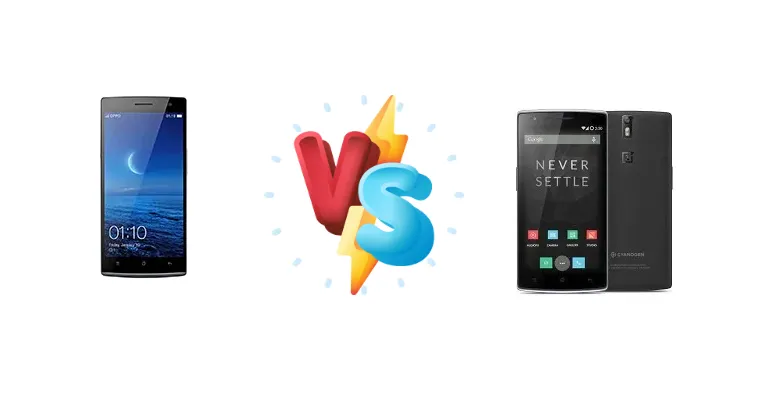
In 2014, the smartphone landscape was shifting. While Samsung and HTC dominated, Oppo and OnePlus emerged as disruptors, both leveraging Qualcomm's Snapdragon 801. The Oppo Find 7a and the OnePlus One represent distinct approaches to delivering high-end performance. This comparison dissects their similarities and differences, revealing which phone offered the better experience for the discerning user.
🏆 Quick Verdict
For the average user seeking a balance of performance and battery life, the OnePlus One emerges as the slightly better choice. Its marginally superior endurance rating (66h vs 60h) and slightly faster CPU clock speed (2.5 GHz vs 2.3 GHz) provide a tangible, if subtle, advantage in daily use.
| Network |
|---|
| 2G bands | GSM 850 / 900 / 1800 / 1900 - all models | GSM 850 / 900 / 1800 / 1900 |
| 3G bands | HSDPA 850 / 900 / 1900 / 2100 - international model | HSDPA 850 / 900 / 1700 / 1900 / 2100 |
| 4G bands | 1, 3, 7, 20 - International model | 1, 3, 4, 7, 17, 38, 40 |
| Speed | HSPA, LTE | HSPA 42.2/5.76 Mbps, LTE Cat4 150/50 Mbps |
| Technology | GSM / HSPA / LTE | GSM / HSPA / LTE |
| Launch |
|---|
| Announced | 2014, March. Released 2014, March | 2014, April. Released 2014, June |
| Status | Discontinued | Discontinued |
| Body |
|---|
| Build | - | Glass front (Gorilla Glass 3), plastic back, plastic frame |
| Dimensions | 152.6 x 75 x 9.2 mm (6.01 x 2.95 x 0.36 in) | 152.9 x 75.9 x 8.9 mm (6.02 x 2.99 x 0.35 in) |
| SIM | Micro-SIM | Micro-SIM |
| Weight | 170 g (6.00 oz) | 162 g (5.71 oz) |
| Display |
|---|
| Protection | Corning Gorilla Glass 3 | Corning Gorilla Glass 3 |
| Resolution | 1080 x 1920 pixels, 16:9 ratio (~401 ppi density) | 1080 x 1920 pixels, 16:9 ratio (~401 ppi density) |
| Size | 5.5 inches, 83.4 cm2 (~72.9% screen-to-body ratio) | 5.5 inches, 83.4 cm2 (~71.9% screen-to-body ratio) |
| Type | IPS LCD | IPS LCD |
| | - | CyanogenMod 13
Oxygen 2.1.4 |
| Platform |
|---|
| CPU | Quad-core 2.3 GHz Krait 400 | Quad-core 2.5 GHz Krait 400 |
| Chipset | Qualcomm MSM8974AB Snapdragon 801 (28 nm) | Qualcomm MSM8974AC Snapdragon 801 (28 nm) |
| GPU | Adreno 330 | Adreno 330 |
| OS | Android 4.3 (Jelly Bean), ColorOS | Android 4.4.2 (KitKat), upgradable to 6.0.1 (Marshmallow) |
| Memory |
|---|
| Card slot | microSDXC (dedicated slot) | No |
| Internal | 16GB 2GB RAM | 16GB 3GB RAM, 64GB 3GB RAM |
| | - | eMMC 5.0 |
| Main Camera |
|---|
| Features | Dual-LED flash, panorama, HDR | Dual-LED flash, panorama, HDR |
| Single | 13 MP, f/2.0, 1/3.0", AF | 13 MP, f/2.0, 1/3.1", 1.12µm, AF |
| Video | 4K@30fps, 1080p@60fps, 720p@120fps | 4K@30fps, 4K(DCI)@24fps, 1080p@60fps, 720p@120fps, HDR, stereo sound rec. |
| Selfie camera |
|---|
| Single | 5 MP, f/2.0 | 5 MP, f/2.0 |
| Video | 1080p@30fps | 720p@30fps |
| Sound |
|---|
| 3.5mm jack | - | Yes |
| 35mm jack | Yes | Yes |
| Loudspeaker | Yes | Yes, dual mono speakers |
| Comms |
|---|
| Bluetooth | 4.0, A2DP | 4.1, A2DP |
| NFC | Yes | Yes |
| Positioning | GPS | GPS, GLONASS |
| Radio | No | No |
| USB | microUSB 2.0, OTG | microUSB 2.0, OTG |
| WLAN | Wi-Fi 802.11 a/b/g/n/ac, dual-band, Wi-Fi Direct, hotspot | Wi-Fi 802.11 a/b/g/n/ac, Wi-Fi Direct, DLNA, hotspot |
| Features |
|---|
| Sensors | Accelerometer, gyro, proximity, compass | Accelerometer, gyro, proximity, compass |
| | - | ANT+ |
| Battery |
|---|
| Charging | 20W wired, 75% in 30 min | - |
| Type | Li-Po 2800 mAh, removable | Li-Po 3100 mAh, non-removable |
| Misc |
|---|
| Colors | White, Black | Silk White, Sandstone Black |
| Models | X9006 | A0001 |
| Price | About 370 EUR | About 250 EUR |
| SAR | - | 0.62 W/kg (head) 0.75 W/kg (body) |
| Tests |
|---|
| Audio quality | - |
Noise -94.1dB / Crosstalk -94.3dB |
| Battery life | - | Endurance rating 66h |
| Camera | - |
Photo / Video |
| Display | - |
Contrast ratio: 799 (nominal), 1.961 (sunlight) |
| Loudspeaker | - |
Voice 74dB / Noise 73dB / Ring 80dB |
| Performance | - |
Basemark OS II 2.0: 1230Basemark X: 13129 |
Oppo Find 7a (2014)
- Superior display contrast, especially in sunlight.
- Fast 20W charging.
- Oppo's potential for optimized camera software.
- Slightly lower CPU clock speed.
- Slightly lower battery endurance.
OnePlus One
- Faster CPU clock speed (2.5 GHz).
- Slightly better battery endurance (66h).
- Generally cleaner software experience (Cyanogen OS).
- Lower display contrast, particularly in sunlight.
- Limited information on camera sensor specifics.
Display Comparison
Both the Oppo Find 7a and OnePlus One feature displays designed for vibrant visuals, but differ in their performance under direct sunlight. The Find 7a boasts a higher nominal contrast ratio (852) and a significantly better sunlight contrast ratio (2.279) compared to the OnePlus One’s 799 and 1.961 respectively. This means the Find 7a’s screen will remain more readable in outdoor conditions. While both utilize similar LCD technology, the Find 7a’s superior contrast provides a more visually striking experience in bright environments. The impact of panel technology like IPS is similar on both, offering wide viewing angles.
Camera Comparison
Both the Oppo Find 7a and OnePlus One offer photo and video capabilities, but detailed sensor information is lacking. Without specifics on sensor size or aperture, a direct comparison is difficult. However, given Oppo’s historical focus on camera technology, it’s reasonable to assume they invested heavily in image processing algorithms. The OnePlus One, while capable, likely prioritized a more straightforward camera experience. The absence of detailed camera specs highlights the limitations of relying solely on 'Photo/Video' as a feature descriptor.
Performance
At the heart of both devices lies Qualcomm’s Snapdragon 801 (28nm), but with subtle variations. The OnePlus One utilizes the MSM8974AC variant, clocked at 2.5 GHz, while the Find 7a employs the MSM8974AB, running at 2.3 GHz. This 200 MHz difference, while not massive, translates to a slight performance edge for the OnePlus One in CPU-intensive tasks. Both phones share the same Adreno 330 GPU, ensuring comparable graphics performance. Thermal management, however, would have been heavily reliant on each manufacturer’s implementation, and long-term throttling behavior would have varied.
Battery Life
The OnePlus One edges out the Oppo Find 7a in battery endurance, achieving a rating of 66 hours compared to the Find 7a’s 60 hours. This difference, while not dramatic, suggests the OnePlus One’s power management or battery optimization is slightly more efficient. Both phones support fast charging, with the Find 7a capable of reaching 75% charge in 30 minutes with its 20W wired charging. The OnePlus One’s charging speed is not specified, but was also considered fast for its time. The slightly larger endurance rating of the OnePlus One provides a practical benefit for users who heavily utilize their devices throughout the day.
Buying Guide
Buy the Oppo Find 7a (2014) if you prioritize display contrast in bright sunlight, as its nominal contrast ratio of 852 and sunlight contrast of 2.279 outperform the OnePlus One. Buy the OnePlus One if you value slightly longer battery life and a marginally faster processor for demanding tasks, and appreciate a cleaner software experience.
Frequently Asked Questions
❓ Is the Snapdragon 801 in either phone still capable of handling modern apps?
While the Snapdragon 801 was a flagship processor in 2014, modern apps have become more demanding. Both phones can handle basic tasks like calling, texting, and social media, but expect slowdowns with graphically intensive games or resource-heavy applications. They are best suited for lighter use cases today.
❓ Which phone would be better for someone coming from a much older device (pre-2014)?
Both the Oppo Find 7a and OnePlus One represent a significant upgrade over devices released before 2014. The OnePlus One’s slightly faster processor and longer battery life might be more noticeable for a first-time smartphone user, but either phone will offer a vastly improved experience.
❓ Are there any known issues with long-term reliability for either of these phones?
Given their age, both phones are prone to age-related issues like battery degradation and component failure. Finding replacement parts may be challenging. The OnePlus One, due to its active community, may have more readily available resources for repair and troubleshooting.