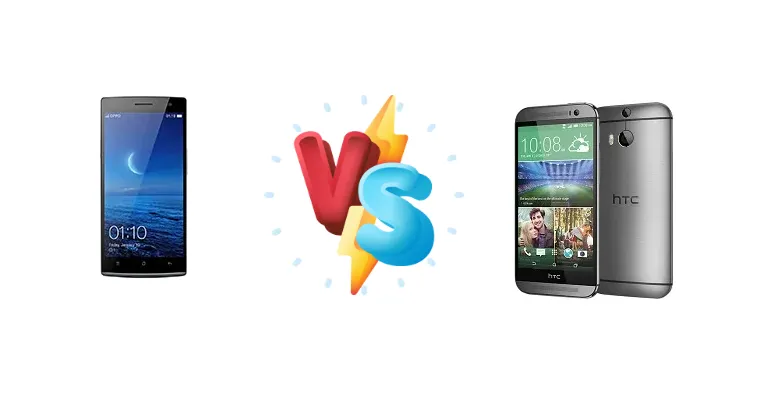
The Oppo Find 7a and HTC One M8s represent a fascinating point in Android history – the transition from bleeding-edge specs to more refined, cost-effective designs. Both launched in 2014, but targeted different performance tiers. This comparison revisits these devices, analyzing how their core hardware choices hold up today and who would benefit most from each.
🏆 Quick Verdict
For the average user seeking a functional, albeit aging, smartphone experience, the Oppo Find 7a emerges as the stronger choice. Its Snapdragon 801 chipset delivers significantly more processing power than the HTC One M8s’ Snapdragon 615, making it better suited for demanding tasks and future-proofing, despite the similar manufacturing process.
| Network |
|---|
| 2G bands | GSM 850 / 900 / 1800 / 1900 - all models | GSM 850 / 900 / 1800 / 1900 |
| 3G bands | HSDPA 850 / 900 / 1900 / 2100 - international model | HSDPA 850 / 900 / 1900 / 2100 - EMEA |
| 4G bands | 1, 3, 7, 20 - International model | 3, 5, 7, 8, 20 - EMEA |
| Speed | HSPA, LTE | HSPA 42.2/5.76 Mbps, LTE Cat4 150/50 Mbps |
| Technology | GSM / HSPA / LTE | GSM / HSPA / LTE |
| | - | HSDPA 850 / 900 / 2100 - Germany |
| Launch |
|---|
| Announced | 2014, March. Released 2014, March | 2015, April. Released 2015, May |
| Status | Discontinued | Discontinued |
| Body |
|---|
| Dimensions | 152.6 x 75 x 9.2 mm (6.01 x 2.95 x 0.36 in) | 146.4 x 70.6 x 9.6 mm (5.76 x 2.78 x 0.38 in) |
| SIM | Micro-SIM | Nano-SIM |
| Weight | 170 g (6.00 oz) | 160 g (5.64 oz) |
| Display |
|---|
| Protection | Corning Gorilla Glass 3 | To be confirmed |
| Resolution | 1080 x 1920 pixels, 16:9 ratio (~401 ppi density) | 1080 x 1920 pixels, 16:9 ratio (~441 ppi density) |
| Size | 5.5 inches, 83.4 cm2 (~72.9% screen-to-body ratio) | 5.0 inches, 68.9 cm2 (~66.7% screen-to-body ratio) |
| Type | IPS LCD | Super LCD3 |
| Platform |
|---|
| CPU | Quad-core 2.3 GHz Krait 400 | Octa-core (4x1.7 GHz Cortex-A53 & 4x1.0 GHz Cortex-A53) |
| Chipset | Qualcomm MSM8974AB Snapdragon 801 (28 nm) | Qualcomm MSM8939 Snapdragon 615 (28 nm) |
| GPU | Adreno 330 | Adreno 405 |
| OS | Android 4.3 (Jelly Bean), ColorOS | Android 5 (Lollipop), Sense UI 7 |
| Memory |
|---|
| Card slot | microSDXC (dedicated slot) | microSDXC (dedicated slot) |
| Internal | 16GB 2GB RAM | 16GB 2GB RAM, 32GB 2GB RAM |
| | - | eMMC 4.5 |
| Main Camera |
|---|
| Dual | - | 13 MP, f/2.0, 28mm (wide), AF
Auxiliary lens |
| Features | Dual-LED flash, panorama, HDR | Dual-LED dual-tone flash, HDR, panorama |
| Single | 13 MP, f/2.0, 1/3.0", AF | 8 MP, 1/4.0" |
| Video | 4K@30fps, 1080p@60fps, 720p@120fps | 1080p@60fps, 720p@120fps, HDR, stereo sound rec. |
| Selfie camera |
|---|
| Features | - | HDR |
| Single | 5 MP, f/2.0 | 5 MP, f/2.8, 34mm (standard) |
| Video | 1080p@30fps | 1080p@30fps |
| Sound |
|---|
| 3.5mm jack | - | Yes |
| 35mm jack | Yes | Yes |
| Loudspeaker | Yes | Yes, with stereo speakers |
| Comms |
|---|
| Bluetooth | 4.0, A2DP | 4.1, A2DP, aptX |
| NFC | Yes | Yes (market/operator dependent) |
| Positioning | GPS | GPS, GLONASS |
| Radio | No | Stereo FM radio, RDS |
| USB | microUSB 2.0, OTG | microUSB 2.0 (MHL TV-out), OTG |
| WLAN | Wi-Fi 802.11 a/b/g/n/ac, dual-band, Wi-Fi Direct, hotspot | Wi-Fi 802.11 a/b/g/n/ac, dual-band, Wi-Fi Direct, DLNA, hotspot |
| Features |
|---|
| Sensors | Accelerometer, gyro, proximity, compass | Accelerometer, gyro, proximity, compass, barometer |
| Battery |
|---|
| Charging | 20W wired, 75% in 30 min | - |
| Stand-by | - | Up to 753 h (3G) |
| Talk time | - | Up to 20 h (3G) |
| Type | Li-Po 2800 mAh, removable | Li-Po 2840 mAh, non-removable |
| Misc |
|---|
| Colors | White, Black | Gunmetal Gray, Glacial Silver, Amber Gold |
| Models | X9006 | One M8s |
| Price | About 370 EUR | About 330 EUR |
Oppo Find 7a (2014)
- Significantly faster processor (Snapdragon 801)
- Superior display contrast for better visibility
- Faster charging (20W, 75% in 30min)
- Potentially shorter battery life due to more powerful processor
- Limited information on camera specifications
HTC One M8s
- More power-efficient processor (Snapdragon 615)
- Potentially longer standby time
- Likely more affordable on the used market
- Noticeably slower processor for demanding tasks
- Limited information on display and camera quality
Display Comparison
The Oppo Find 7a boasts a contrast ratio of 852 (nominal) and a significantly improved 2.279 under sunlight, suggesting superior outdoor visibility compared to the HTC One M8s, though specific sunlight contrast data for the M8s is unavailable. While both likely utilized LCD panels common in 2014, the Find 7a’s higher contrast ratio indicates a more vibrant and readable display, particularly in challenging lighting conditions. Bezels were comparable for the era, and color accuracy data is absent for both, making a definitive judgment impossible.
Camera Comparison
Both devices featured capable cameras for their time, but detailed specifications are limited. The Oppo Find 7a is listed as having photo/video capabilities, but sensor size and aperture are unknown. The HTC One M8s’ camera specs are similarly sparse. Without concrete data, it’s difficult to assess image quality differences. It’s safe to assume both relied on software processing to enhance images, a common practice in 2014. The presence of any OIS (Optical Image Stabilization) is unknown for both.
Performance
The core difference lies in the chipsets. The Oppo Find 7a’s Qualcomm Snapdragon 801 (MSM8974AB) with its quad-core 2.3 GHz Krait 400 CPU represents a flagship-level processor for 2014. In contrast, the HTC One M8s utilizes the Snapdragon 615 (MSM8939), an octa-core processor (4x1.7 GHz Cortex-A53 & 4x1.0 GHz Cortex-A53) designed for the mid-range. While the 615’s octa-core configuration might seem appealing, the Krait 400 cores in the 801 offer significantly higher single-core performance, crucial for responsiveness and app loading times. The 28nm manufacturing process is shared, meaning thermal efficiency differences will be driven primarily by architecture and workload.
Battery Life
The Oppo Find 7a claims an endurance rating of 60 hours, while specific battery capacity is not provided. Its 20W wired charging capability, achieving 75% charge in 30 minutes, was relatively fast for 2014. The HTC One M8s’ battery capacity and charging speed are not specified. The Snapdragon 615’s lower power consumption *could* translate to longer standby times, but the Find 7a’s faster charging mitigates this advantage. Real-world battery life will depend heavily on usage patterns.
Buying Guide
Buy the Oppo Find 7a (2014) if you prioritize performance for tasks like older games or running multiple apps simultaneously, and are willing to accept potentially shorter battery life. Buy the HTC One M8s if you value a more balanced approach, prioritizing efficiency and potentially longer standby times, even if it means sacrificing raw processing speed. Both are best suited for users on a very tight budget or those seeking a retro Android experience.
Frequently Asked Questions
❓ Will the Oppo Find 7a handle modern Android apps smoothly?
While the Snapdragon 801 was a flagship processor in 2014, modern Android versions and apps are more demanding. Expect some lag and slowdowns with newer applications, especially graphically intensive games. It will likely run lighter apps and older games adequately.
❓ Is the Snapdragon 615 in the HTC One M8s sufficient for basic tasks like calling and texting?
Yes, the Snapdragon 615 is perfectly capable of handling basic tasks like calling, texting, web browsing, and social media. It’s not a powerhouse, but it’s sufficient for everyday communication and light usage.
❓ Can either of these phones be upgraded to a newer version of Android?
Highly unlikely. Both devices are well past their software support lifecycle. Any attempts to install custom ROMs would require advanced technical knowledge and carry inherent risks.
❓ What kind of storage options did these phones offer, and are they expandable?
Storage details are not provided in the context data. However, many 2014 flagships offered microSD card slots for expandable storage. Checking specific model variations is crucial to confirm storage capacity and expansion capabilities.