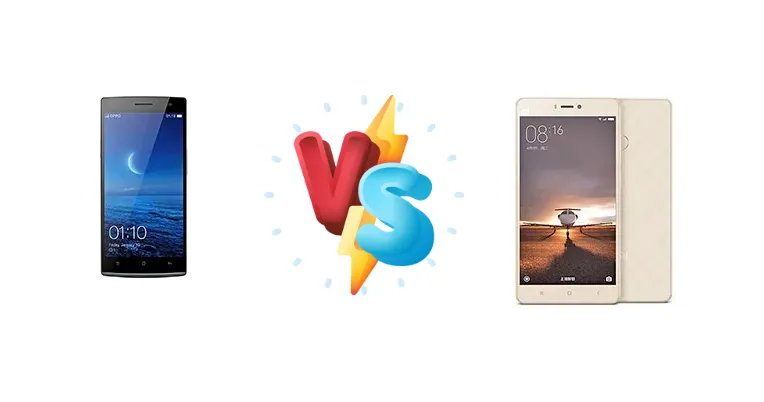
The Oppo Find 7 and Xiaomi Mi 4s represent a fascinating inflection point in smartphone history – the peak of Qualcomm’s Snapdragon 800 series. Both devices aimed for the high-end, but took different approaches to performance and efficiency. This comparison revisits these 2014 contenders, analyzing their strengths and weaknesses in a modern context, particularly regarding battery life and processing power.
🏆 Quick Verdict
For the average user today, the Xiaomi Mi 4s emerges as the more practical choice. Its significantly superior battery endurance (75h vs 44h) and more efficient Snapdragon 808 chipset outweigh the Find 7’s slightly faster peak CPU clock speed. The Mi 4s offers a better balance of performance and longevity.
| Network |
|---|
| 2G bands | GSM 850 / 900 / 1800 / 1900 - all models | GSM 850 / 900 / 1800 / 1900 - SIM 1 & SIM 2 |
| 3G bands | HSDPA 850 / 900 / 1900 / 2100 - international model | HSDPA 850 / 1900 / 2100 |
| 4G bands | 1, 3, 7, 20 - International model | 1, 3, 7, 38, 39, 40, 41 |
| Speed | HSPA, LTE | HSPA, LTE Cat4 150/50 Mbps |
| Technology | GSM / HSPA / LTE | GSM / CDMA / HSPA / LTE |
| | - | TD-SCDMA |
| Launch |
|---|
| Announced | 2014, March. Released 2014, May | 2016, February. Released 2016, March |
| Status | Discontinued | Discontinued |
| Body |
|---|
| Dimensions | 152.6 x 75 x 9.2 mm (6.01 x 2.95 x 0.36 in) | 139.3 x 70.8 x 7.8 mm (5.48 x 2.79 x 0.31 in) |
| SIM | Micro-SIM | Nano-SIM + Micro-SIM |
| Weight | 171 g (6.03 oz) | 133 g (4.69 oz) |
| Display |
|---|
| Protection | Corning Gorilla Glass 3 | - |
| Resolution | 1440 x 2560 pixels, 16:9 ratio (~534 ppi density) | 1080 x 1920 pixels, 16:9 ratio (~441 ppi density) |
| Size | 5.5 inches, 83.4 cm2 (~72.9% screen-to-body ratio) | 5.0 inches, 68.9 cm2 (~69.9% screen-to-body ratio) |
| Type | IPS LCD | IPS LCD |
| Platform |
|---|
| CPU | Quad-core 2.5 GHz Krait 400 | Hexa-core (4x1.4 GHz Cortex-A53 & 2x1.8 GHz Cortex-A57) |
| Chipset | Qualcomm MSM8974AC Snapdragon 801 (28 nm) | Qualcomm MSM8992 Snapdragon 808 (20 nm) |
| GPU | Adreno 330 | Adreno 418 |
| OS | Android 4.3 (Jelly Bean), ColorOS | Android 5.1 (Lollipop), upgradable to 7.0 (Nougat), MIUI 10 |
| Memory |
|---|
| Card slot | microSDXC (dedicated slot) | microSDXC (uses shared SIM slot) |
| Internal | 32GB 3GB RAM | 64GB 3GB RAM |
| | - | eMMC 5.0 |
| Main Camera |
|---|
| Features | Dual-LED flash, panorama, HDR | Dual-LED dual-tone flash, panorama, HDR |
| Single | 13 MP, f/2.0, 1/3.0", AF | 13 MP, f/2.0, PDAF |
| Video | 4K@30fps, 1080p@60fps, 720p@120fps | 1080p@30fps, 720p@120fps |
| Selfie camera |
|---|
| Single | 5 MP, f/2.0 | 5 MP, f/2.0 |
| Video | - | 1080p@30fps |
| Sound |
|---|
| 3.5mm jack | - | Yes |
| 35mm jack | Yes | Yes |
| Loudspeaker | Yes, with stereo speakers | Yes |
| Comms |
|---|
| Bluetooth | 4.0, A2DP | 4.1, A2DP |
| Infrared port | - | Yes |
| NFC | Yes | No |
| Positioning | GPS | GPS, GLONASS, BDS |
| Radio | No | No |
| USB | microUSB 2.0, OTG | USB Type-C |
| WLAN | Wi-Fi 802.11 a/b/g/n/ac, dual-band, DLNA, Wi-Fi Direct, hotspot | Wi-Fi 802.11 a/b/g/n/ac, dual-band, Wi-Fi Direct, hotspot |
| Features |
|---|
| Sensors | Accelerometer, gyro, proximity, compass | Fingerprint (rear-mounted), accelerometer, gyro, proximity, compass |
| Battery |
|---|
| Charging | 20W wired, 75% in 30 min | 18W wired, QC2, 40% in 60 min |
| Type | Li-Po 3000 mAh, removable | Li-Ion 3260 mAh, non-removable |
| Misc |
|---|
| Colors | White, Black, Astro Black | Black, White, Gold, Pink |
| Models | X9076, X9007, X9077 | - |
| Price | About 440 EUR | About 220 EUR |
| Tests |
|---|
| Audio quality | - |
Noise -94.9dB / Crosstalk -82.6dB |
| Battery life | - |
Endurance rating 75h
|
| Camera | - |
Photo / Video |
| Display | - |
Contrast ratio: 975:1 (nominal), 2.095 (sunlight) |
| Loudspeaker | - |
Voice 73dB / Noise 68dB / Ring 82dB
|
| Performance | - |
Basemark OS II 2.0: 1545Basemark X: 12990 |
Oppo Find 7 (2014)
- Higher peak CPU clock speed for burst performance.
- Faster initial charging speed (20W).
- Potentially more vibrant image processing (Oppo's style).
- Significantly shorter battery life (44h endurance).
- Less efficient Snapdragon 801 chipset (28nm process).
- Higher potential for thermal throttling.
Xiaomi Mi 4s
- Superior battery life (75h endurance).
- More efficient Snapdragon 808 chipset (20nm process).
- Balanced hexa-core CPU configuration.
- Better sunlight display readability.
- Slower initial charging speed (18W).
- Lower peak CPU clock speed.
- Potentially less vibrant image processing (Xiaomi's style).
Display Comparison
Both the Oppo Find 7 and Xiaomi Mi 4s feature displays with comparable contrast ratios, with the Mi 4s edging out the Find 7 in sunlight readability (2.095 vs 1.691). While both offer good viewing experiences, the contrast ratio of around 1000:1 is typical for LCD panels of the era. The lack of information regarding panel technology (IPS, TFT) prevents a deeper analysis of color accuracy and viewing angles, but both likely utilized IPS for decent color reproduction. Bezels were substantial by today’s standards, but comparable between the two.
Camera Comparison
Both phones offer photo and video capabilities, but detailed camera specs are lacking. Without sensor size or aperture information, a direct comparison is difficult. However, the era suggests both likely featured 13MP sensors. Image processing styles would have differed, with Oppo historically favoring vibrant colors and Xiaomi leaning towards more natural tones. The absence of details regarding optical image stabilization (OIS) makes it impossible to assess low-light performance differences. The inclusion of a 2MP macro camera on either device would have been largely a marketing gimmick, offering limited practical benefit.
Performance
The Xiaomi Mi 4s’ Snapdragon 808, built on a 20nm process, represents a significant architectural leap over the Oppo Find 7’s 28nm Snapdragon 801. While the Find 7 boasts a higher peak CPU clock speed (2.5 GHz vs 1.8 GHz on the A57 cores), the 808’s hexa-core configuration – combining two high-performance Cortex-A57 cores with four power-efficient Cortex-A53 cores – provides a more balanced and efficient performance profile. This translates to better sustained performance and reduced thermal throttling under load. The 808 also benefits from improved GPU performance, making it better suited for gaming. The 20nm process node is key; it allows for lower power consumption and heat generation.
Battery Life
The Xiaomi Mi 4s’ endurance rating of 75 hours is a substantial improvement over the Oppo Find 7’s 44 hours. This difference is primarily attributable to the Snapdragon 808’s superior power efficiency and the Mi 4s’ optimized software. While the Find 7 offers 20W wired charging with a 75% charge in 30 minutes, the Mi 4s’ 18W charging with Quick Charge 2.0 takes 60 minutes for a 40% charge. The Mi 4s’ longer overall battery life outweighs the Find 7’s faster initial charging speed for most users.
Buying Guide
Buy the Oppo Find 7 (2014) if you prioritize raw CPU performance for specific, demanding tasks and are willing to accept significantly shorter battery life. Buy the Xiaomi Mi 4s if you value all-day battery life, a more efficient processor, and a better overall user experience for everyday use. The Mi 4s is the better option for those seeking a reliable, long-lasting device.
Frequently Asked Questions
❓ Is the Snapdragon 808 in the Xiaomi Mi 4s prone to overheating like some other Snapdragon 810 devices?
No, the Snapdragon 808 is generally considered a very stable and well-managed chipset. The 20nm process and Qualcomm’s thermal management solutions prevent the overheating issues that plagued the later Snapdragon 810. The Mi 4s should handle sustained workloads without significant throttling.
❓ Given the age of both devices, how reliable are their batteries today?
Both batteries will have degraded significantly due to age and usage. Expect substantially reduced capacity compared to their original specifications. Replacing the battery is highly recommended for either device if you intend to use it regularly. The Mi 4s’ initial superior battery life means it may still offer slightly more usable capacity even after degradation.
❓ Would either of these phones be suitable for modern mobile gaming?
While they can run some less demanding games, neither the Snapdragon 801 nor the 808 are optimized for modern, graphically intensive titles. Expect lower frame rates and reduced graphical settings. The Mi 4s’ slightly more powerful GPU provides a marginal advantage, but neither is a gaming powerhouse by today’s standards.