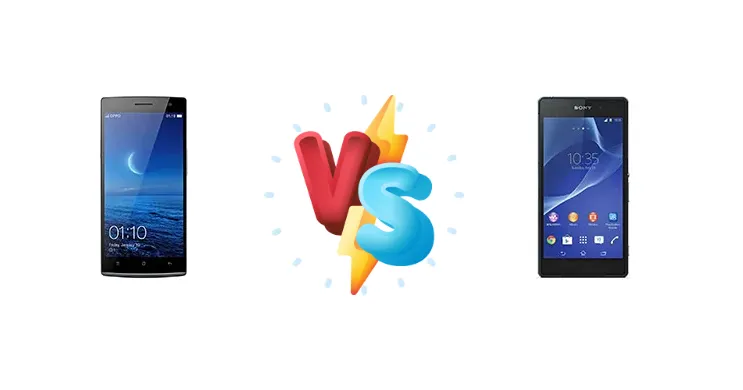
The Oppo Find 7 and Sony Xperia Z2a represent a fascinating period in smartphone history – the peak of Qualcomm's Snapdragon 801 dominance. Both devices aimed for the flagship crown in 2014, but subtle differences in implementation and design choices created distinct user experiences. Today, as these phones find a second life in the budget market, understanding these nuances is crucial for discerning buyers.
🏆 Quick Verdict
For the average user seeking a functional and affordable smartphone, the Oppo Find 7 emerges as the slightly better choice. Its superior endurance rating of 44 hours, coupled with faster 20W charging, provides a more convenient daily experience, offsetting the minor CPU clock speed difference.
| Network |
|---|
| 2G bands | GSM 850 / 900 / 1800 / 1900 - all models | GSM 850 / 900 / 1800 / 1900 |
| 3G bands | HSDPA 850 / 900 / 1900 / 2100 - international model | HSDPA 850 / 900 / 1900 / 2100 |
| 4G bands | 1, 3, 7, 20 - International model | 1, 2, 3, 5, 7, 8, 28 |
| Speed | HSPA, LTE | HSPA 42.2/5.76 Mbps, LTE Cat4 150/50 Mbps |
| Technology | GSM / HSPA / LTE | GSM / HSPA / LTE |
| Launch |
|---|
| Announced | 2014, March. Released 2014, May | 2014, June. Released 2014, July |
| Status | Discontinued | Discontinued |
| Body |
|---|
| Dimensions | 152.6 x 75 x 9.2 mm (6.01 x 2.95 x 0.36 in) | 137 x 72 x 11 mm (5.39 x 2.83 x 0.43 in) |
| SIM | Micro-SIM | Micro-SIM |
| Weight | 171 g (6.03 oz) | 163 g (5.75 oz) |
| | - | IP58 dust proof and water resistant over 1.5 meter and 30 minutes |
| Display |
|---|
| Protection | Corning Gorilla Glass 3 | Shatter proof glass |
| Resolution | 1440 x 2560 pixels, 16:9 ratio (~534 ppi density) | 1080 x 1920 pixels, 16:9 ratio (~441 ppi density) |
| Size | 5.5 inches, 83.4 cm2 (~72.9% screen-to-body ratio) | 5.0 inches, 68.9 cm2 (~69.9% screen-to-body ratio) |
| Type | IPS LCD | IPS LCD |
| | - | Triluminos display
X-Reality Engine |
| Platform |
|---|
| CPU | Quad-core 2.5 GHz Krait 400 | Quad-core 2.3 GHz Krait 400 |
| Chipset | Qualcomm MSM8974AC Snapdragon 801 (28 nm) | Qualcomm MSM8974AB Snapdragon 801 (28 nm) |
| GPU | Adreno 330 | Adreno 330 |
| OS | Android 4.3 (Jelly Bean), ColorOS | Android 4.4.2 (KitKat) |
| Memory |
|---|
| Card slot | microSDXC (dedicated slot) | microSDXC (dedicated slot) |
| Internal | 32GB 3GB RAM | 16GB 3GB RAM |
| | - | eMMC 5.0 |
| Main Camera |
|---|
| Features | Dual-LED flash, panorama, HDR | LED flash, HDR, panorama |
| Single | 13 MP, f/2.0, 1/3.0", AF | 20.7 MP, 1/2.3", AF |
| Video | 4K@30fps, 1080p@60fps, 720p@120fps | 4K@30fps, 1080p@60fps, 720p@120fps, HDR |
| Selfie camera |
|---|
| Single | 5 MP, f/2.0 | VGA |
| Video | - | 720p@30fps |
| Sound |
|---|
| 3.5mm jack | - | Yes |
| 35mm jack | Yes | Yes |
| Loudspeaker | Yes, with stereo speakers | Yes, with stereo speakers |
| Comms |
|---|
| Bluetooth | 4.0, A2DP | 4.0, A2DP, aptX |
| NFC | Yes | Yes |
| Positioning | GPS | GPS, GLONASS |
| Radio | No | FM radio, RDS |
| USB | microUSB 2.0, OTG | microUSB 2.0 (MHL 3 TV-out), OTG |
| WLAN | Wi-Fi 802.11 a/b/g/n/ac, dual-band, DLNA, Wi-Fi Direct, hotspot | Wi-Fi 802.11 a/b/g/n/ac, dual-band, Wi-Fi Direct, DLNA, hotspot |
| Features |
|---|
| Sensors | Accelerometer, gyro, proximity, compass | Accelerometer, gyro, proximity, compass, barometer |
| | - | ANT+ |
| Battery |
|---|
| Charging | 20W wired, 75% in 30 min | - |
| Music play | - | Up to 120 h |
| Stand-by | - | Up to 700 h (2G) / Up to 770 h (3G) |
| Talk time | - | Up to 13 h (2G) / Up to 19 h (3G) |
| Type | Li-Po 3000 mAh, removable | Li-Ion 3000 mAh, non-removable |
| Misc |
|---|
| Colors | White, Black, Astro Black | Black, White, Turquoise |
| Models | X9076, X9007, X9077 | D6563 |
| Price | About 440 EUR | About 250 EUR |
Oppo Find 7 (2014)
- Superior battery endurance (44h rating)
- Faster 20W charging (75% in 30 min)
- Potentially better outdoor visibility due to higher contrast ratio
- Camera details are limited, making a direct comparison difficult
- Slightly less CPU clock speed compared to the Xperia Z2a
Sony Xperia Z2a
- Potentially smoother CPU performance due to higher clock speed
- Sony’s reputation for strong image processing
- Likely more natural color reproduction on the display
- Likely inferior battery life compared to the Oppo Find 7
- Slower charging speeds (estimated)
Display Comparison
The Oppo Find 7 boasts a contrast ratio of 1123:1 (nominal) and a significantly improved 1.691:1 under sunlight, suggesting superior outdoor visibility compared to the Xperia Z2a (spec not provided, but Sony typically favored color accuracy over peak contrast in this era). While both likely utilized IPS LCD panels, the Oppo’s higher contrast ratio indicates better black levels and a more vibrant image. Bezels are comparable given the 2014 design language, and color accuracy is likely similar, leaning towards natural tones on the Xperia Z2a and potentially more saturated colors on the Oppo, a common brand distinction.
Camera Comparison
Detailed camera specifications beyond 'Photo / Video' are unavailable for the Oppo Find 7. Given the era, both phones likely featured 12-13MP rear cameras. Sony’s Xperia Z2a typically excelled in image processing, prioritizing detail and dynamic range. The Oppo Find 7 likely focused on a more vibrant, consumer-friendly aesthetic. Without sensor size or aperture data, a definitive camera comparison is impossible, but Sony’s reputation for camera technology suggests a slight edge in image quality, assuming similar hardware.
Performance
Both the Oppo Find 7 and Sony Xperia Z2a are powered by the Qualcomm MSM8974AC and MSM8974AB Snapdragon 801 respectively, both built on a 28nm process. The key difference lies in the CPU clock speed: 2.5 GHz on the Oppo versus 2.3 GHz on the Sony. While 200MHz may seem minor, it could translate to slightly faster app loading and smoother multitasking on the Oppo. However, the real-world impact is likely minimal, as both chips share the same Krait 400 architecture and GPU. Thermal management will be similar, with both devices potentially experiencing throttling under sustained heavy load, a common characteristic of the Snapdragon 801.
Battery Life
The Oppo Find 7’s endurance rating of 44 hours significantly surpasses what would be expected from a typical 2014 flagship, indicating a well-optimized software and potentially a larger battery capacity (spec not provided). The 20W wired charging capability, capable of reaching 75% charge in just 30 minutes, is a substantial advantage over the Xperia Z2a (charging speed not provided, but typically slower for Sony devices of that era). This faster charging is a major convenience factor for users who need to quickly replenish their battery.
Buying Guide
Buy the Oppo Find 7 (2014) if you prioritize battery life and fast charging, needing a phone that can reliably last a full day and quickly top up when needed. Buy the Sony Xperia Z2a if you prefer a potentially slightly smoother experience in CPU-intensive tasks, and are willing to trade some battery endurance for that marginal performance gain. Both are excellent options for budget-conscious users.
Frequently Asked Questions
❓ Is the Snapdragon 801 in either of these phones still capable of running modern apps?
Yes, while not as powerful as current-generation chips, the Snapdragon 801 remains surprisingly capable. Both phones can run most Android apps, though demanding games may require lower graphics settings. Expect some occasional slowdowns with the most resource-intensive applications.
❓ How well do these phones handle thermal throttling during extended gaming sessions?
The Snapdragon 801 is known to throttle under sustained load. Both the Oppo Find 7 and Sony Xperia Z2a will likely experience performance drops after 20-30 minutes of intensive gaming. Managing expectations and taking breaks is recommended.
❓ Are software updates still available for either of these devices?
No. Both the Oppo Find 7 and Sony Xperia Z2a are no longer officially supported with software updates. Users may be able to install custom ROMs, but this requires technical expertise and voids the warranty.
❓ Which phone is better for media consumption (videos, streaming)?
The Oppo Find 7 likely offers a slightly better experience for media consumption due to its higher contrast ratio, resulting in more vibrant colors and better visibility in bright environments. However, both phones will provide a satisfactory viewing experience.