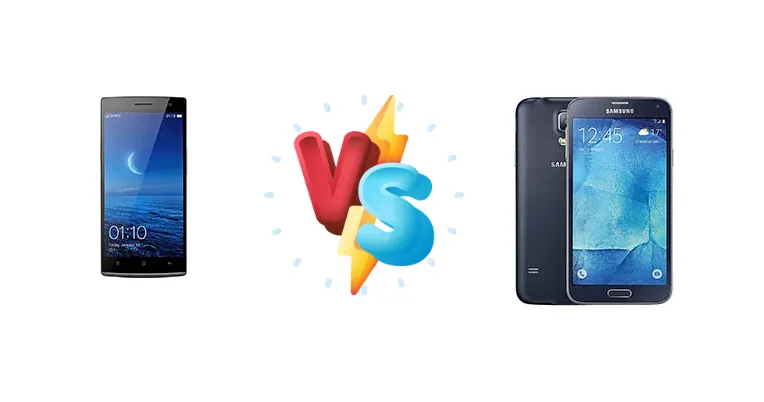
The Oppo Find 7 and Samsung Galaxy S5 Neo represent a fascinating point in smartphone history – the tail end of the early flagship wars. Both devices aimed for the top tier in 2014, but took drastically different approaches to achieving it. Today, we revisit these phones to determine which holds up better, considering their original strengths and how they translate to modern usage.
🏆 Quick Verdict
For the average user seeking a functional and surprisingly capable device from this era, the Oppo Find 7 emerges as the stronger contender. Its Snapdragon 801 chipset delivers superior processing power, and the faster 20W charging is a significant advantage, offsetting the slightly lower endurance rating compared to the S5 Neo.
| Network |
|---|
| 2G bands | GSM 850 / 900 / 1800 / 1900 - all models | GSM 850 / 900 / 1800 / 1900 |
| 3G bands | HSDPA 850 / 900 / 1900 / 2100 - international model | HSDPA 850 / 900 / 1900 / 2100 - G903F |
| 4G bands | 1, 3, 7, 20 - International model | 1, 3, 5, 7, 8, 20 - G903F |
| Speed | HSPA, LTE | HSPA 42.2/5.76 Mbps, LTE Cat6 300/50 Mbps |
| Technology | GSM / HSPA / LTE | GSM / HSPA / LTE |
| | - | 1, 2, 3, 4, 5, 7, 12, 13, 17, 20, 29 - G903W |
| Launch |
|---|
| Announced | 2014, March. Released 2014, May | 2015, August. Released 2015, August |
| Status | Discontinued | Discontinued |
| Body |
|---|
| Dimensions | 152.6 x 75 x 9.2 mm (6.01 x 2.95 x 0.36 in) | 142 x 72.5 x 8.1 mm (5.59 x 2.85 x 0.32 in) |
| SIM | Micro-SIM | Micro-SIM |
| Weight | 171 g (6.03 oz) | 145 g (5.11 oz) |
| | - | IP67 dust/water resistant (up to 1m for 30 min) |
| Display |
|---|
| Protection | Corning Gorilla Glass 3 | - |
| Resolution | 1440 x 2560 pixels, 16:9 ratio (~534 ppi density) | 1080 x 1920 pixels, 16:9 ratio (~432 ppi density) |
| Size | 5.5 inches, 83.4 cm2 (~72.9% screen-to-body ratio) | 5.1 inches, 71.7 cm2 (~69.6% screen-to-body ratio) |
| Type | IPS LCD | Super AMOLED |
| Platform |
|---|
| CPU | Quad-core 2.5 GHz Krait 400 | Octa-core 1.6 GHz Cortex-A53 |
| Chipset | Qualcomm MSM8974AC Snapdragon 801 (28 nm) | Exynos 7580 Octa (28 nm) |
| GPU | Adreno 330 | Mali-T720MP2 |
| OS | Android 4.3 (Jelly Bean), ColorOS | Android 5.1.1 (Lollipop), upgradable to 7.0 (Nougat) |
| Memory |
|---|
| Card slot | microSDXC (dedicated slot) | microSDXC (dedicated slot) |
| Internal | 32GB 3GB RAM | 16GB 2GB RAM |
| | - | eMMC 5.0 |
| Main Camera |
|---|
| Features | Dual-LED flash, panorama, HDR | LED flash, panorama, HDR |
| Single | 13 MP, f/2.0, 1/3.0", AF | 16 MP, f/1.9, 31mm (standard), AF |
| Video | 4K@30fps, 1080p@60fps, 720p@120fps | 1080p@30fps |
| Selfie camera |
|---|
| Single | 5 MP, f/2.0 | 5 MP, f/1.9, 23mm (wide) |
| Video | - | 1080p@30fps |
| Sound |
|---|
| 3.5mm jack | - | Yes |
| 35mm jack | Yes | Yes |
| Loudspeaker | Yes, with stereo speakers | Yes |
| Comms |
|---|
| Bluetooth | 4.0, A2DP | 4.1, A2DP, EDR, LE |
| NFC | Yes | Yes |
| Positioning | GPS | GPS, GLONASS |
| Radio | No | FM radio |
| USB | microUSB 2.0, OTG | microUSB 2.0, OTG |
| WLAN | Wi-Fi 802.11 a/b/g/n/ac, dual-band, DLNA, Wi-Fi Direct, hotspot | Wi-Fi 802.11 a/b/g/n/ac, dual-band, Wi-Fi Direct, hotspot |
| Features |
|---|
| Sensors | Accelerometer, gyro, proximity, compass | Accelerometer, gyro, proximity, compass, heart rate |
| | - | ANT+
S-Voice |
| Battery |
|---|
| Charging | 20W wired, 75% in 30 min | - |
| Music play | - | Up to 73 h |
| Talk time | - | Up to 15 h (3G) |
| Type | Li-Po 3000 mAh, removable | Li-Ion 2800 mAh, removable |
| Misc |
|---|
| Colors | White, Black, Astro Black | Black, Gray, Gold |
| Models | X9076, X9007, X9077 | SM-G903F, SM-G903W, SM-G903M, SM-S903VL |
| Price | About 440 EUR | About 300 EUR |
| SAR | - | 1.03 W/kg (head) 1.27 W/kg (body) |
| SAR EU | - | 0.46 W/kg (head) 0.58 W/kg (body) |
Oppo Find 7 (2014)
- Faster Snapdragon 801 processor for better performance
- 20W fast charging significantly reduces charging time
- Higher display contrast ratio for improved visibility
- Older software may lack security updates
- Battery endurance rating slightly lower than potential S5 Neo performance
Samsung Galaxy S5 Neo
- Potentially more efficient Exynos 7580 chipset for longer standby
- Samsung’s image processing may offer better photo quality
- Likely more readily available replacement parts
- Slower processor compared to Snapdragon 801
- Lack of fast charging support
- Limited display information suggests a less impressive screen
Display Comparison
The Oppo Find 7 boasts a contrast ratio of 1123:1 (nominal) and a significantly improved 1.691:1 in sunlight, suggesting superior outdoor visibility compared to the Galaxy S5 Neo, for which display specs are unavailable. While neither phone will match modern OLED displays, the Find 7’s higher contrast ratio indicates a more vibrant and readable image, particularly in bright conditions. The lack of detailed display information for the S5 Neo suggests it wasn't a key selling point, likely utilizing a standard LCD panel.
Camera Comparison
Both devices feature photo and video capabilities, but detailed camera specifications are limited. Without sensor size or aperture information, a direct comparison is difficult. However, given Samsung’s historical emphasis on camera technology, the S5 Neo likely benefits from more refined image processing algorithms. The Find 7’s camera performance will likely be more reliant on the raw processing power of the Snapdragon 801. The presence of a 2MP macro camera on the S5 Neo is unlikely to provide significant benefit due to its low resolution.
Performance
The core difference lies in the chipsets: the Oppo Find 7 utilizes the Qualcomm MSM8974AC Snapdragon 801 with a quad-core 2.5 GHz Krait 400 CPU, while the Samsung Galaxy S5 Neo features the Exynos 7580 Octa with an octa-core 1.6 GHz Cortex-A53 CPU. Architecturally, the Snapdragon 801’s Krait cores are more powerful per clock cycle than the Cortex-A53 cores in the Exynos 7580. While the Exynos has more cores, the Snapdragon 801’s superior single-core performance translates to snappier responsiveness in most applications. Both are built on a 28nm process, but the Snapdragon 801 was designed for higher performance, making it the better choice for demanding tasks.
Battery Life
The Oppo Find 7 has an endurance rating of 44 hours, while the Galaxy S5 Neo’s battery life is not specified. However, the Find 7’s 20W wired charging, capable of reaching 75% charge in just 30 minutes, is a substantial advantage. This rapid charging capability mitigates any potential disadvantage from a slightly lower overall endurance rating. The Exynos 7580’s efficiency *could* lead to longer standby times, but the Find 7’s fast charging provides a more tangible benefit for active users.
Buying Guide
Buy the Oppo Find 7 (2014) if you prioritize raw performance for tasks like older games or demanding apps, and value faster charging speeds. Buy the Samsung Galaxy S5 Neo if you prefer a potentially more efficient chipset for basic tasks and longer standby times, and are less concerned with peak performance. Both are best suited for users comfortable with the limitations of older software and hardware.
Frequently Asked Questions
❓ Does the Exynos 7580 in the Galaxy S5 Neo tend to overheat during prolonged use?
The Exynos 7580 is generally a thermally efficient chip, designed for mid-range devices. While it *can* heat up under sustained load, it's less prone to significant throttling compared to the Snapdragon 801, which was known to get warm. However, the Find 7’s superior cooling design may mitigate this issue.
❓ Is the 2MP macro camera on the Samsung Galaxy S5 Neo actually useful for taking detailed close-up photos?
Unfortunately, a 2MP macro camera on a phone from 2014 is unlikely to produce high-quality, detailed close-up photos. The low resolution and small sensor size result in images that are often soft and lack detail. It's more of a novelty feature than a genuinely useful camera component.
❓ Can the Oppo Find 7 still handle modern mobile games, even with its older Snapdragon 801 chipset?
The Oppo Find 7 can run many older mobile games reasonably well, but demanding titles released in recent years will likely struggle. The Snapdragon 801’s GPU is showing its age, and newer games are optimized for more powerful hardware. Expect lower graphics settings and potential frame rate drops.