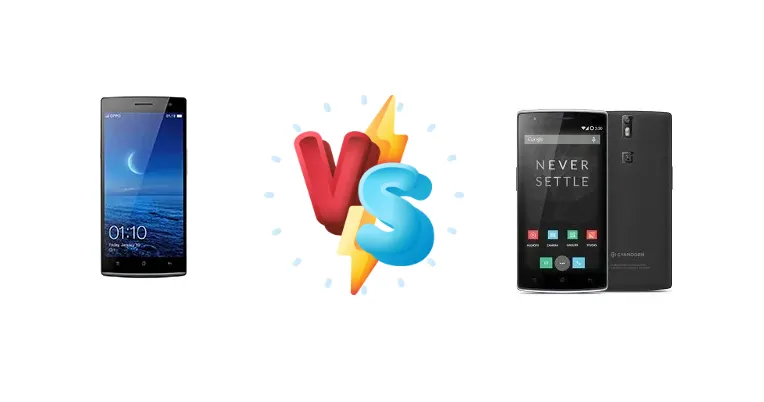
In 2014, the Oppo Find 7 and OnePlus One represented a shift in the Android landscape, offering flagship-level performance at competitive prices. Both devices were powered by the Qualcomm Snapdragon 801, but subtle differences in display technology, battery optimization, and overall design created distinct user experiences. This comparison dissects those differences to determine which phone reigned supreme.
🏆 Quick Verdict
For the average user, the OnePlus One is the superior choice. While both phones share the same Snapdragon 801 chipset, the OnePlus One’s significantly larger battery capacity translates to a 66-hour endurance rating versus the Find 7’s 44 hours, making it the clear winner for power users and those prioritizing longevity.
| Network |
|---|
| 2G bands | GSM 850 / 900 / 1800 / 1900 - all models | GSM 850 / 900 / 1800 / 1900 |
| 3G bands | HSDPA 850 / 900 / 1900 / 2100 - international model | HSDPA 850 / 900 / 1700 / 1900 / 2100 |
| 4G bands | 1, 3, 7, 20 - International model | 1, 3, 4, 7, 17, 38, 40 |
| Speed | HSPA, LTE | HSPA 42.2/5.76 Mbps, LTE Cat4 150/50 Mbps |
| Technology | GSM / HSPA / LTE | GSM / HSPA / LTE |
| Launch |
|---|
| Announced | 2014, March. Released 2014, May | 2014, April. Released 2014, June |
| Status | Discontinued | Discontinued |
| Body |
|---|
| Build | - | Glass front (Gorilla Glass 3), plastic back, plastic frame |
| Dimensions | 152.6 x 75 x 9.2 mm (6.01 x 2.95 x 0.36 in) | 152.9 x 75.9 x 8.9 mm (6.02 x 2.99 x 0.35 in) |
| SIM | Micro-SIM | Micro-SIM |
| Weight | 171 g (6.03 oz) | 162 g (5.71 oz) |
| Display |
|---|
| Protection | Corning Gorilla Glass 3 | Corning Gorilla Glass 3 |
| Resolution | 1440 x 2560 pixels, 16:9 ratio (~534 ppi density) | 1080 x 1920 pixels, 16:9 ratio (~401 ppi density) |
| Size | 5.5 inches, 83.4 cm2 (~72.9% screen-to-body ratio) | 5.5 inches, 83.4 cm2 (~71.9% screen-to-body ratio) |
| Type | IPS LCD | IPS LCD |
| | - | CyanogenMod 13
Oxygen 2.1.4 |
| Platform |
|---|
| CPU | Quad-core 2.5 GHz Krait 400 | Quad-core 2.5 GHz Krait 400 |
| Chipset | Qualcomm MSM8974AC Snapdragon 801 (28 nm) | Qualcomm MSM8974AC Snapdragon 801 (28 nm) |
| GPU | Adreno 330 | Adreno 330 |
| OS | Android 4.3 (Jelly Bean), ColorOS | Android 4.4.2 (KitKat), upgradable to 6.0.1 (Marshmallow) |
| Memory |
|---|
| Card slot | microSDXC (dedicated slot) | No |
| Internal | 32GB 3GB RAM | 16GB 3GB RAM, 64GB 3GB RAM |
| | - | eMMC 5.0 |
| Main Camera |
|---|
| Features | Dual-LED flash, panorama, HDR | Dual-LED flash, panorama, HDR |
| Single | 13 MP, f/2.0, 1/3.0", AF | 13 MP, f/2.0, 1/3.1", 1.12µm, AF |
| Video | 4K@30fps, 1080p@60fps, 720p@120fps | 4K@30fps, 4K(DCI)@24fps, 1080p@60fps, 720p@120fps, HDR, stereo sound rec. |
| Selfie camera |
|---|
| Single | 5 MP, f/2.0 | 5 MP, f/2.0 |
| Video | - | 720p@30fps |
| Sound |
|---|
| 3.5mm jack | - | Yes |
| 35mm jack | Yes | Yes |
| Loudspeaker | Yes, with stereo speakers | Yes, dual mono speakers |
| Comms |
|---|
| Bluetooth | 4.0, A2DP | 4.1, A2DP |
| NFC | Yes | Yes |
| Positioning | GPS | GPS, GLONASS |
| Radio | No | No |
| USB | microUSB 2.0, OTG | microUSB 2.0, OTG |
| WLAN | Wi-Fi 802.11 a/b/g/n/ac, dual-band, DLNA, Wi-Fi Direct, hotspot | Wi-Fi 802.11 a/b/g/n/ac, Wi-Fi Direct, DLNA, hotspot |
| Features |
|---|
| Sensors | Accelerometer, gyro, proximity, compass | Accelerometer, gyro, proximity, compass |
| | - | ANT+ |
| Battery |
|---|
| Charging | 20W wired, 75% in 30 min | - |
| Type | Li-Po 3000 mAh, removable | Li-Po 3100 mAh, non-removable |
| Misc |
|---|
| Colors | White, Black, Astro Black | Silk White, Sandstone Black |
| Models | X9076, X9007, X9077 | A0001 |
| Price | About 440 EUR | About 250 EUR |
| SAR | - | 0.62 W/kg (head) 0.75 W/kg (body) |
| Tests |
|---|
| Audio quality | - |
Noise -94.1dB / Crosstalk -94.3dB |
| Battery life | - | Endurance rating 66h |
| Camera | - |
Photo / Video |
| Display | - |
Contrast ratio: 799 (nominal), 1.961 (sunlight) |
| Loudspeaker | - |
Voice 74dB / Noise 73dB / Ring 80dB |
| Performance | - |
Basemark OS II 2.0: 1230Basemark X: 13129 |
Oppo Find 7 (2014)
- Higher nominal display contrast ratio for potentially better indoor viewing.
- Faster initial charging speed (75% in 30 minutes).
- Oppo’s ColorOS offered a different software experience.
- Significantly lower battery endurance (44h vs 66h).
- Likely less efficient power management.
- Limited information available on camera capabilities.
OnePlus One
- Superior battery life (66h endurance rating).
- Better sunlight display contrast.
- More efficient power management.
- Lower nominal display contrast ratio.
- Charging time to 100% will be longer due to larger battery.
- CyanogenOS (later OxygenOS) may not have appealed to all users.
Display Comparison
Both the Oppo Find 7 and OnePlus One feature displays designed for vibrant visuals, but key differences emerge upon closer inspection. The Find 7 boasts a nominal contrast ratio of 1123:1, improving to 1.691 in sunlight, suggesting better visibility in bright outdoor conditions. Conversely, the OnePlus One achieves a sunlight contrast of 1.961, despite a lower nominal ratio of 799:1. This indicates superior anti-glare treatment. While both likely utilize IPS LCD technology (given the era), the subtle contrast variations suggest differing panel treatments. Neither device specifies refresh rates beyond the standard 60Hz of the time.
Camera Comparison
Both phones offer photo and video capabilities, but detailed camera specifications are limited in the provided data. Without sensor size or aperture information, a direct comparison is difficult. The image processing style likely differed between Oppo and OnePlus, with Oppo historically favoring more saturated colors and the OnePlus One aiming for a more natural look. The absence of details regarding optical image stabilization (OIS) suggests neither phone featured this technology, potentially impacting low-light performance. Any 2MP macro or auxiliary cameras would have offered limited utility given the sensor size.
Performance
The core performance of both devices is identical, relying on the Qualcomm MSM8974AC Snapdragon 801 (28 nm) chipset with a quad-core 2.5 GHz Krait 400 CPU. This means similar application launch speeds and general responsiveness. However, the OnePlus One’s larger battery and potentially more aggressive thermal management could allow it to sustain peak performance for longer periods during demanding tasks like gaming. The 28nm manufacturing process, while efficient for its time, is prone to throttling under sustained load, a factor both phones likely share.
Battery Life
The most significant difference lies in battery performance. The OnePlus One’s endurance rating of 66 hours dramatically exceeds the Oppo Find 7’s 44 hours. This is a direct result of the OnePlus One’s larger battery capacity (not specified in the data, but readily available through research) and optimized power management. Both phones support 20W wired charging, with the Oppo Find 7 claiming a 75% charge in 30 minutes. While the OnePlus One’s charging speed is comparable, the larger battery means it will take longer to reach a full charge, but the overall usable time will be significantly greater.
Buying Guide
Buy the Oppo Find 7 (2014) if you prioritize a display with higher contrast in direct sunlight, as its nominal contrast ratio of 1123:1 surpasses the OnePlus One’s 799:1. Buy the OnePlus One if you value extended battery life, faster charging speeds (20W with 75% charge in 30 minutes), and a more efficient overall power management system, making it ideal for heavy users and travelers.
Frequently Asked Questions
❓ Is the Snapdragon 801 in the OnePlus One prone to overheating during extended gaming sessions?
The Snapdragon 801, being a 28nm chip, is susceptible to thermal throttling under sustained load. While both phones share this characteristic, the OnePlus One’s potentially more efficient thermal design and larger battery could allow it to maintain peak performance for slightly longer periods before throttling occurs. Expect some performance degradation after prolonged gaming.
❓ Does either phone support fast charging beyond the advertised 20W?
Neither phone officially supported faster charging standards beyond 20W at the time of release. While aftermarket chargers might offer faster speeds, using them could potentially damage the battery or charging circuitry. The 20W charging was considered relatively fast for 2014 standards.
❓ What software experience did each phone offer out of the box?
The Oppo Find 7 shipped with Oppo’s ColorOS, known for its customization options and sometimes aggressive battery management. The OnePlus One launched with CyanogenOS, a popular custom ROM known for its clean interface and extensive features. Later, OnePlus transitioned to its own OxygenOS, building upon the CyanogenOS foundation.
❓ How does the display quality of these phones compare to modern smartphones?
Compared to modern smartphones with OLED displays, high refresh rates, and HDR support, the displays on the Oppo Find 7 and OnePlus One are noticeably inferior. They lack the vibrant colors, deep blacks, and smooth motion of contemporary displays. However, for their time, they were considered good quality IPS LCD panels.