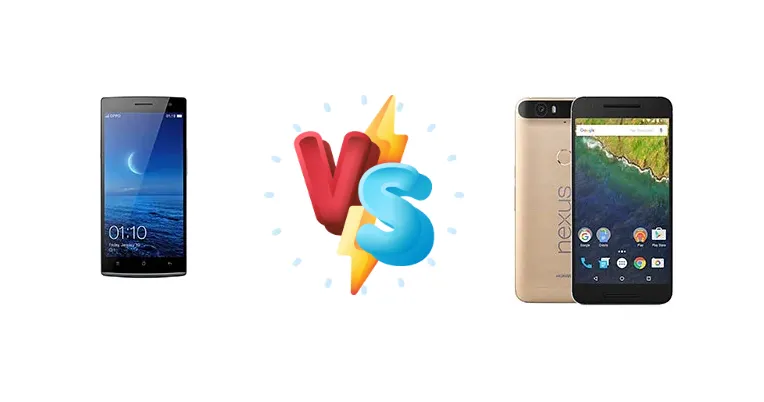
The Oppo Find 7 and Huawei Nexus 6P represent distinct approaches to the 2014 flagship smartphone landscape. The Find 7 prioritized rapid charging and a high-contrast display, while the Nexus 6P, built in collaboration with Google, focused on a clean Android experience and extended battery life. Today, we revisit these devices to determine which holds up better for users seeking a capable, affordable smartphone.
🏆 Quick Verdict
For the average user in 2024, the Huawei Nexus 6P is the superior choice. Its significantly longer battery life (74h endurance vs 44h) and more efficient Snapdragon 810 chipset outweigh the Find 7’s faster 20W charging. While both offer capable cameras, the Nexus 6P’s software support and overall refinement provide a better user experience.
| Network |
|---|
| 2G bands | GSM 850 / 900 / 1800 / 1900 - all models | GSM 850 / 900 / 1800 / 1900 - all models |
| 3G bands | HSDPA 850 / 900 / 1900 / 2100 - international model | HSDPA 800 / 850 / 900 / 1700 / 1800 / 1900 / 2100 - Global model |
| 4G bands | 1, 3, 7, 20 - International model | 1, 2, 3, 4, 5, 7, 8, 9, 17, 19, 20, 28, 38, 39, 40, 41 - Global model |
| Speed | HSPA, LTE | HSPA 42.2/5.76 Mbps, LTE (2CA) Cat6 300/50 Mbps |
| Technology | GSM / HSPA / LTE | GSM / CDMA / HSPA / LTE |
| | - | 2, 3, 4, 5, 7, 12, 13, 17, 25, 26, 29, 30, 41 - American model |
| Launch |
|---|
| Announced | 2014, March. Released 2014, May | 2015, September. Released 2015, September |
| Status | Discontinued | Discontinued |
| Body |
|---|
| Build | - | Glass front (Gorilla Glass 4), aluminum back, aluminum frame |
| Dimensions | 152.6 x 75 x 9.2 mm (6.01 x 2.95 x 0.36 in) | 159.3 x 77.8 x 7.3 mm (6.27 x 3.06 x 0.29 in) |
| SIM | Micro-SIM | Nano-SIM |
| Weight | 171 g (6.03 oz) | 178 g (6.28 oz) |
| Display |
|---|
| Protection | Corning Gorilla Glass 3 | Corning Gorilla Glass 4, oleophobic coating |
| Resolution | 1440 x 2560 pixels, 16:9 ratio (~534 ppi density) | 1440 x 2560 pixels, 16:9 ratio (~518 ppi density) |
| Size | 5.5 inches, 83.4 cm2 (~72.9% screen-to-body ratio) | 5.7 inches, 88.5 cm2 (~71.4% screen-to-body ratio) |
| Type | IPS LCD | OLED |
| Platform |
|---|
| CPU | Quad-core 2.5 GHz Krait 400 | Octa-core (4x1.55 GHz Cortex-A53 & 4x2.0 GHz Cortex-A57) |
| Chipset | Qualcomm MSM8974AC Snapdragon 801 (28 nm) | Qualcomm MSM8994 Snapdragon 810 (20 nm) |
| GPU | Adreno 330 | Adreno 430 |
| OS | Android 4.3 (Jelly Bean), ColorOS | Android 6.0 (Marshmallow), upgradable to Android 8.0 (Oreo) |
| Memory |
|---|
| Card slot | microSDXC (dedicated slot) | No |
| Internal | 32GB 3GB RAM | 32GB 3GB RAM, 64GB 3GB RAM, 128GB 3GB RAM |
| | - | eMMC 5.0 |
| Main Camera |
|---|
| Features | Dual-LED flash, panorama, HDR | Laser AF, Dual-LED dual-tone flash, HDR, panorama |
| Single | 13 MP, f/2.0, 1/3.0", AF | 12.3 MP, f/2.0, 1/2.3", 1.55µm |
| Video | 4K@30fps, 1080p@60fps, 720p@120fps | 4K@30fps, 720p@240fps |
| Selfie camera |
|---|
| Single | 5 MP, f/2.0 | 8 MP, f/2.4 |
| Video | - | 1080p@30fps |
| Sound |
|---|
| 3.5mm jack | - | Yes |
| 35mm jack | Yes | Yes |
| Loudspeaker | Yes, with stereo speakers | Yes, with front stereo speakers |
| | - | 24-bit/96kHz
|
| Comms |
|---|
| Bluetooth | 4.0, A2DP | 4.2, A2DP, LE |
| NFC | Yes | Yes |
| Positioning | GPS | GPS, GLONASS |
| Radio | No | No |
| USB | microUSB 2.0, OTG | USB Type-C 2.0 |
| WLAN | Wi-Fi 802.11 a/b/g/n/ac, dual-band, DLNA, Wi-Fi Direct, hotspot | Wi-Fi 802.11 a/b/g/n/ac, dual-band, Wi-Fi Direct, DLNA |
| Features |
|---|
| Sensors | Accelerometer, gyro, proximity, compass | Fingerprint (rear-mounted), accelerometer, gyro, proximity, compass, barometer |
| Battery |
|---|
| Charging | 20W wired, 75% in 30 min | 15W wired |
| Music play | - | Up to 100 h |
| Stand-by | - | Up to 440 h (3G) |
| Talk time | - | Up to 23 h (3G) |
| Type | Li-Po 3000 mAh, removable | Li-Po 3450 mAh, non-removable |
| Misc |
|---|
| Colors | White, Black, Astro Black | Aluminium, Graphite, Frost |
| Models | X9076, X9007, X9077 | H1511, H1512 |
| Price | About 440 EUR | About 300 EUR |
| SAR | - | 1.49 W/kg (head) 0.81 W/kg (body) |
| SAR EU | - | 1.17 W/kg (head) 0.54 W/kg (body) |
| Tests |
|---|
| Battery life | - |
Endurance rating 74h
|
| Camera | - |
Photo / Video |
| Performance | - |
Basemark OS II 2.0: 1374Basemark X: 22825 |
Oppo Find 7 (2014)
- Faster 20W charging
- High display contrast ratio (especially in sunlight)
- Potentially lower price point in the used market
- Significantly shorter battery life
- Older Snapdragon 801 chipset
- Less efficient 28nm process
Huawei Nexus 6P
- Superior battery life (74h endurance)
- More efficient Snapdragon 810 chipset
- Clean Android experience with potential for custom ROMs
- Slower 15W charging
- Snapdragon 810 known for potential throttling
- Software support has ended
Display Comparison
The Oppo Find 7 boasts a contrast ratio of 1123:1 (nominal) and a remarkable 1.691:1 in sunlight, suggesting excellent outdoor visibility. However, the Nexus 6P, while lacking specific contrast ratio data, benefits from a larger display and likely utilizes more advanced color calibration techniques. The Find 7’s focus on contrast is a clear strength for users who spend significant time outdoors, but the Nexus 6P’s larger screen real estate offers a more immersive viewing experience. Neither phone features modern display technologies like LTPO or high refresh rates, common in today’s smartphones.
Camera Comparison
Both devices offer photo and video capabilities, but detailed sensor specifications are absent. Given the Nexus 6P’s collaboration with Google, it likely benefits from superior image processing algorithms and software optimization. The Nexus 6P’s camera was generally well-regarded for its low-light performance and accurate color reproduction. The Find 7, while capable, likely relies more heavily on hardware limitations. Without specific sensor size or aperture data, it’s difficult to definitively declare a winner, but the Nexus 6P’s software advantage is a strong indicator of superior image quality.
Performance
The Huawei Nexus 6P’s Snapdragon 810, built on a 20nm process, represents a significant architectural leap over the Oppo Find 7’s Snapdragon 801 (28nm). The 810’s octa-core configuration (4x1.55 GHz Cortex-A53 & 4x2.0 GHz Cortex-A57) allows for more efficient task handling compared to the Find 7’s quad-core 2.5 GHz Krait 400. While the Find 7’s higher clock speed might offer a slight edge in single-core tasks, the 810’s superior architecture and process node translate to better sustained performance and thermal management. The Snapdragon 810 was known for some throttling issues, but the Nexus 6P’s larger chassis likely mitigated this to some extent.
Battery Life
The most significant difference lies in battery endurance. The Nexus 6P achieves a remarkable 74-hour endurance rating, compared to the Find 7’s 44 hours. This substantial difference is attributable to the Snapdragon 810’s improved power efficiency and the Nexus 6P’s larger battery capacity (though the exact mAh is not provided). While the Find 7 offers faster 20W wired charging (75% in 30 minutes), the Nexus 6P’s longer battery life reduces the need for frequent charging. The Nexus 6P’s 15W charging is slower, but the overall benefit of extended runtime is more valuable for most users.
Buying Guide
Buy the Oppo Find 7 (2014) if you absolutely prioritize the fastest possible charging speeds and a display with exceptional contrast in direct sunlight. This phone is best suited for users who frequently find themselves needing a quick power boost and value a vibrant screen. Buy the Huawei Nexus 6P if you prefer a cleaner Android experience, significantly longer battery life, and a more modern chipset architecture, making it ideal for users who prioritize all-day usability and software updates (though support has ended).
Frequently Asked Questions
❓ Is the Snapdragon 810 in the Nexus 6P prone to overheating during extended gaming sessions?
The Snapdragon 810 was known to experience thermal throttling under sustained load. However, the Nexus 6P’s larger chassis and Google’s software optimizations likely mitigated this issue to some extent. While it may not perform at peak speeds for prolonged periods, it should be capable of handling most mobile games without significant issues.
❓ Given the age of both devices, is software security a concern?
Yes, software security is a significant concern. The Oppo Find 7 is unlikely to receive any further security updates. The Nexus 6P has also reached its end-of-life for official updates, making it vulnerable to potential exploits. Users should exercise caution when using these devices for sensitive tasks and consider using a custom ROM with ongoing security support if possible.
❓ Does the Oppo Find 7's VOOC charging require a special charger?
Yes, the Oppo Find 7 utilizes VOOC (now SuperVOOC) fast charging technology, which requires a compatible charger to achieve the advertised 20W charging speeds. Using a standard USB charger will result in significantly slower charging times.
❓ Can I still find replacement batteries for either of these phones?
Replacement batteries are becoming increasingly difficult to find for both the Oppo Find 7 and the Nexus 6P. Availability varies depending on your region and the specific model. Expect to pay a premium for any available replacements.