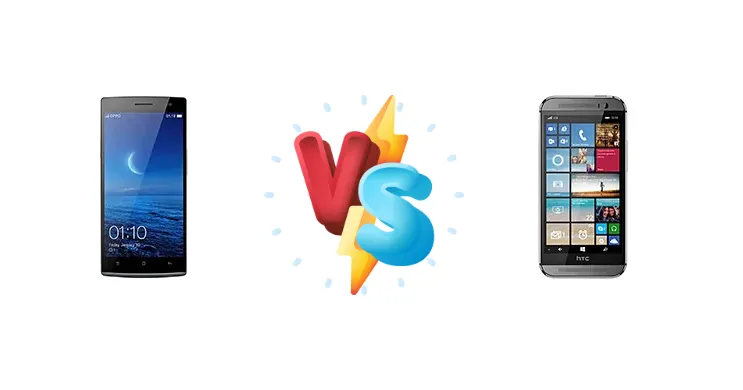
In 2014, both the Oppo Find 7 and the HTC One (M8) for Windows represented the pinnacle of Android and Windows Phone hardware. While the HTC One (M8) offered a unique Windows Phone experience, the Oppo Find 7 aimed for raw performance and display quality. Today, we revisit these devices to determine which holds up better, considering their original strengths and the passage of time.
🏆 Quick Verdict
For the average user seeking a functional piece of 2014 tech, the Oppo Find 7 emerges as the slightly better choice. Its superior endurance rating of 44 hours, coupled with faster 20W charging, provides a more practical experience than the HTC One (M8) for Windows, despite the latter's premium build quality.
| Network |
|---|
| 2G bands | GSM 850 / 900 / 1800 / 1900 - all models | GSM 850 / 900 / 1800 / 1900 |
| 3G bands | HSDPA 850 / 900 / 1900 / 2100 - international model | - |
| 4G bands | 1, 3, 7, 20 - International model | - |
| EDGE | - | Yes |
| GPRS | - | Yes |
| Speed | HSPA, LTE | HSPA, LTE Cat4 150/50 Mbps, EV-DO Rev.A 3.1 Mbps |
| Technology | GSM / HSPA / LTE | GSM / CDMA / HSPA / EVDO |
| | - | 3, 4, 7, 13 - Verizon |
| Launch |
|---|
| Announced | 2014, March. Released 2014, May | 2014, August. Released 2014, September |
| Status | Discontinued | Discontinued |
| Body |
|---|
| Dimensions | 152.6 x 75 x 9.2 mm (6.01 x 2.95 x 0.36 in) | 146.4 x 70.6 x 9.4 mm (5.76 x 2.78 x 0.37 in) |
| SIM | Micro-SIM | Nano-SIM |
| Weight | 171 g (6.03 oz) | 160 g (5.64 oz) |
| Display |
|---|
| Protection | Corning Gorilla Glass 3 | To be confirmed |
| Resolution | 1440 x 2560 pixels, 16:9 ratio (~534 ppi density) | 1080 x 1920 pixels, 16:9 ratio (~441 ppi density) |
| Size | 5.5 inches, 83.4 cm2 (~72.9% screen-to-body ratio) | 5.0 inches, 68.9 cm2 (~66.7% screen-to-body ratio) |
| Type | IPS LCD | Super LCD3 |
| Platform |
|---|
| CPU | Quad-core 2.5 GHz Krait 400 | Quad-core 2.3 GHz Krait 400 |
| Chipset | Qualcomm MSM8974AC Snapdragon 801 (28 nm) | Qualcomm MSM8974AB Snapdragon 801 (28 nm) |
| GPU | Adreno 330 | Adreno 330 |
| OS | Android 4.3 (Jelly Bean), ColorOS | Microsoft Windows Phone 8.1.1 |
| Memory |
|---|
| Card slot | microSDXC (dedicated slot) | microSDXC (dedicated slot) |
| Internal | 32GB 3GB RAM | 32GB 2GB RAM |
| | - | eMMC 5.0 |
| Main Camera |
|---|
| Features | Dual-LED flash, panorama, HDR | Dual-LED dual-tone flash, panorama, HDR |
| Single | 13 MP, f/2.0, 1/3.0", AF | 4 MP, f/2.0, 27mm (wide), 1/3.0", 2µm, AF
Auxiliary lens |
| Video | 4K@30fps, 1080p@60fps, 720p@120fps | 1080p@60fps, 720p@60fps, HDR, stereo sound rec. |
| Selfie camera |
|---|
| Features | - | HDR |
| Single | 5 MP, f/2.0 | 5 MP |
| Video | - | 1080p@30fps |
| Sound |
|---|
| 3.5mm jack | - | Yes |
| 35mm jack | Yes | Yes |
| Loudspeaker | Yes, with stereo speakers | Yes, with stereo speakers |
| Comms |
|---|
| Bluetooth | 4.0, A2DP | 4.0, A2DP, aptX |
| Infrared port | - | Yes |
| NFC | Yes | Yes |
| Positioning | GPS | GPS, GLONASS |
| Radio | No | Stereo FM radio, RDS |
| USB | microUSB 2.0, OTG | microUSB 2.0 |
| WLAN | Wi-Fi 802.11 a/b/g/n/ac, dual-band, DLNA, Wi-Fi Direct, hotspot | Wi-Fi 802.11 a/b/g/n/ac, dual-band, Wi-Fi Direct, DLNA, hotspot |
| Features |
|---|
| Sensors | Accelerometer, gyro, proximity, compass | Accelerometer, gyro, proximity, compass, barometer |
| Battery |
|---|
| Charging | 20W wired, 75% in 30 min | - |
| Stand-by | - | Up to 387 h |
| Talk time | - | Up to 24 h |
| Type | Li-Po 3000 mAh, removable | Li-Ion 2600 mAh, non-removable |
| Misc |
|---|
| Colors | White, Black, Astro Black | Gunmetal Gray |
| Models | X9076, X9007, X9077 | - |
| Price | About 440 EUR | About 300 EUR |
Oppo Find 7 (2014)
- Superior battery endurance (44h rating)
- Faster 20W charging
- Higher display contrast ratio for better visibility
- Android OS may be outdated
- Specific battery capacity unknown
HTC One (M8) for Windows (CDMA)
- Unique Windows Phone experience
- Premium metal build quality
- BoomSound stereo speakers
- No software support
- Lower battery endurance compared to Oppo Find 7
Display Comparison
Both devices utilize similar display technology for the era, but the Oppo Find 7 boasts a significantly higher contrast ratio – 1123:1 nominally, and an impressive 1691:1 in sunlight. This suggests superior outdoor visibility and richer colors compared to the HTC One (M8). While neither device specifies peak brightness in nits, the higher contrast ratio indicates the Oppo Find 7 likely delivers a more vibrant image. Bezels were comparable for the time, and color accuracy data is unavailable, making contrast the key differentiator.
Camera Comparison
Detailed camera analysis is hampered by a lack of specific sensor information. Both phones offered 'Photo / Video' capabilities, but the Oppo Find 7 likely prioritized image processing for a more vibrant, consumer-friendly look, typical of Oppo’s approach. The HTC One (M8) was known for its UltraPixel camera, focusing on low-light performance, but often criticized for its lack of detail in bright conditions. Without sensor size or aperture data, it’s difficult to definitively declare a winner, but the Oppo’s marketing suggests a broader range of shooting scenarios.
Performance
Both the Oppo Find 7 and HTC One (M8) for Windows are powered by the Qualcomm MSM8974AC/AB Snapdragon 801 (28nm). However, the Oppo Find 7 features a slightly higher clocked CPU at 2.5 GHz compared to the HTC’s 2.3 GHz Krait 400 cores. While this 0.2 GHz difference isn’t massive, it could translate to marginally faster application loading and multitasking. Both utilize the same 28nm process, meaning thermal throttling under sustained load would be a similar concern for both devices. The impact of the Windows Phone OS versus Android on resource management is a significant, but unquantifiable, factor.
Battery Life
The Oppo Find 7’s endurance rating of 44 hours significantly surpasses what was typical for flagship phones in 2014. This suggests a combination of efficient software optimization and a larger battery capacity (specific mAh is unavailable). The HTC One (M8) for Windows, while offering a respectable battery life, likely fell short of the Find 7’s longevity. Furthermore, the Oppo Find 7’s 20W wired charging, capable of reaching 75% charge in just 30 minutes, provides a substantial convenience advantage over the HTC One (M8)'s slower charging speeds.
Buying Guide
Buy the Oppo Find 7 (2014) if you prioritize battery life and fast charging, and are comfortable with the Android ecosystem. It’s ideal for users who want a functional, albeit older, smartphone for basic tasks. Buy the HTC One (M8) for Windows (CDMA) if you’re a collector of Windows Phone devices or specifically need CDMA compatibility, and appreciate the unique design and BoomSound speakers, understanding that software support is non-existent.
Frequently Asked Questions
❓ Is the CDMA support on the HTC One (M8) for Windows still relevant today?
CDMA networks are largely phased out in most regions. Unless you specifically require compatibility with a remaining CDMA carrier, the CDMA support on the HTC One (M8) for Windows offers little practical benefit. Most modern networks operate on GSM/LTE.
❓ Can I update the Oppo Find 7 to a newer version of Android?
The Oppo Find 7 likely runs an older version of Android (likely KitKat or Lollipop). Official updates are no longer available. While custom ROMs may exist, installing them carries risks and requires technical expertise. Expect a dated software experience.
❓ Will the Snapdragon 801 in either phone struggle with modern apps?
Yes, both phones will struggle with demanding modern applications and games. The Snapdragon 801 was a powerful chip in 2014, but it lacks the processing power and memory bandwidth to handle current software efficiently. Expect slowdowns and compatibility issues.
❓ Is the Windows Phone ecosystem on the HTC One (M8) still functional?
Microsoft has officially ended support for Windows Phone. While some core functionality may still work, app availability is extremely limited, and security updates are no longer provided. The HTC One (M8) for Windows is essentially a collector's item at this point.