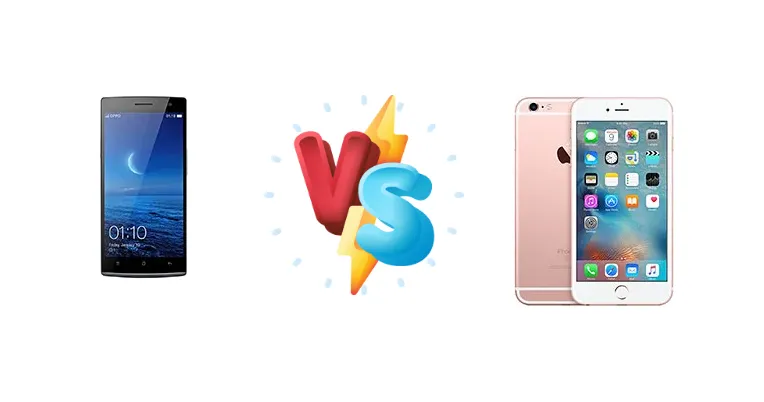
In 2014, the Oppo Find 7 and Apple iPhone 6s Plus represented the pinnacle of Android and iOS smartphone technology, respectively. While both aimed for premium experiences, they took drastically different approaches to achieving them. This comparison revisits these devices, analyzing their strengths and weaknesses in a modern context, particularly focusing on battery endurance, display technology, and processing power.
🏆 Quick Verdict
For the average user in 2024, the Apple iPhone 6s Plus is the superior choice. Its significantly longer battery life (85h endurance vs. 44h) and superior display contrast (1382:1 vs 1123:1) outweigh the Oppo Find 7’s faster 20W charging. The A9 chip also demonstrates better long-term efficiency.
| Network |
|---|
| 2G bands | GSM 850 / 900 / 1800 / 1900 - all models | GSM 850 / 900 / 1800 / 1900 |
| 3G bands | HSDPA 850 / 900 / 1900 / 2100 - international model | HSDPA 850 / 900 / 1700 / 1900 / 2100 |
| 4G bands | 1, 3, 7, 20 - International model | 1, 2, 3, 4, 5, 7, 8, 12, 13, 17, 18, 19, 20, 25, 26, 28, 29, 30 - A1633 |
| Speed | HSPA, LTE | HSPA 42.2/5.76 Mbps, LTE (2CA) Cat6 300/50 Mbps, EV-DO Rev.A 3.1 Mbps |
| Technology | GSM / HSPA / LTE | GSM / CDMA / HSPA / EVDO / LTE |
| | - | 1, 2, 3, 4, 5, 7, 8, 12, 13, 17, 18, 19, 20, 25, 26, 28, 29, 30, 38, 39, 40, 41 - A1634 |
| Launch |
|---|
| Announced | 2014, March. Released 2014, May | 2015, September 09. Released 2015, September 25 |
| Status | Discontinued | Discontinued |
| Body |
|---|
| Build | - | Glass front (Corning-made glass), aluminum back, aluminum frame |
| Dimensions | 152.6 x 75 x 9.2 mm (6.01 x 2.95 x 0.36 in) | 158.2 x 77.9 x 7.3 mm (6.23 x 3.07 x 0.29 in) |
| SIM | Micro-SIM | Nano-SIM |
| Weight | 171 g (6.03 oz) | 192 g (6.77 oz) |
| | - | Apple Pay (Visa, MasterCard, AMEX certified) |
| Display |
|---|
| Protection | Corning Gorilla Glass 3 | Ion-strengthened glass, oleophobic coating |
| Resolution | 1440 x 2560 pixels, 16:9 ratio (~534 ppi density) | 1080 x 1920 pixels, 16:9 ratio (~401 ppi density) |
| Size | 5.5 inches, 83.4 cm2 (~72.9% screen-to-body ratio) | 5.5 inches, 83.4 cm2 (~67.7% screen-to-body ratio) |
| Type | IPS LCD | IPS LCD |
| | - | 3D Touch display |
| Platform |
|---|
| CPU | Quad-core 2.5 GHz Krait 400 | Dual-core 1.84 GHz Twister |
| Chipset | Qualcomm MSM8974AC Snapdragon 801 (28 nm) | Apple A9 (14/16 nm - maker dependant) |
| GPU | Adreno 330 | PowerVR GT7600 (six-core graphics) |
| OS | Android 4.3 (Jelly Bean), ColorOS | iOS 9, upgradable to iOS 15.8.5 |
| Memory |
|---|
| Card slot | microSDXC (dedicated slot) | No |
| Internal | 32GB 3GB RAM | 16GB 2GB RAM, 32GB 2GB RAM, 64GB 2GB RAM, 128GB 2GB RAM |
| | - | NVMe |
| Main Camera |
|---|
| Features | Dual-LED flash, panorama, HDR | Dual-LED dual-tone flash, HDR |
| Single | 13 MP, f/2.0, 1/3.0", AF | 12 MP, f/2.2, 29mm (standard), 1/3.0", 1.22µm, PDAF, OIS |
| Video | 4K@30fps, 1080p@60fps, 720p@120fps | 4K@30fps, 1080p@60fps, 1080p@120fps, 720p@240fps |
| Selfie camera |
|---|
| Features | - | Face detection, HDR, panorama |
| Single | 5 MP, f/2.0 | 5 MP, f/2.2, 31mm (standard) |
| Video | - | 720p@30fps |
| Sound |
|---|
| 3.5mm jack | - | Yes |
| 35mm jack | Yes | Yes |
| Loudspeaker | Yes, with stereo speakers | Yes |
| | - | 16-bit/44.1kHz audio
|
| Comms |
|---|
| Bluetooth | 4.0, A2DP | 4.2, A2DP, LE |
| NFC | Yes | Yes (Apple Pay only) |
| Positioning | GPS | GPS, GLONASS, GALILEO, QZSS |
| Radio | No | No |
| USB | microUSB 2.0, OTG | Lightning, USB 2.0 |
| WLAN | Wi-Fi 802.11 a/b/g/n/ac, dual-band, DLNA, Wi-Fi Direct, hotspot | Wi-Fi 802.11 a/b/g/n/ac, dual-band, hotspot |
| Features |
|---|
| Sensors | Accelerometer, gyro, proximity, compass | Fingerprint (front-mounted), accelerometer, gyro, proximity, compass, barometer |
| Battery |
|---|
| Charging | 20W wired, 75% in 30 min | - |
| Stand-by | - | Up to 384 h (3G) |
| Talk time | - | Up to 24 h (3G) |
| Type | Li-Po 3000 mAh, removable | Li-Ion 2750 mAh, non-removable (10.45 Wh) |
| Misc |
|---|
| Colors | White, Black, Astro Black | Space Gray, Silver, Gold, Rose Gold |
| Models | X9076, X9007, X9077 | A1634, A1687, A1690, A1699, iPhone8,2 |
| Price | About 440 EUR | About 240 EUR |
| SAR | - | 1.12 W/kg (head) 1.14 W/kg (body) |
| SAR EU | - | 0.93 W/kg (head) 0.98 W/kg (body) |
| Tests |
|---|
| Audio quality | - |
Noise -93.4dB / Crosstalk -71.1dB |
| Battery life | - |
Endurance rating 85h
|
| Camera | - |
Photo / Video |
| Display | - |
Contrast ratio: 1382:1 (nominal), 3.530 (sunlight) |
| Loudspeaker | - |
Voice 65dB / Noise 65dB / Ring 64dB
|
| Performance | - |
Basemark OS II 2.0: 2261 |
Oppo Find 7 (2014)
- Faster 20W charging capability.
- Android customization options (for the time).
- Potentially lower initial cost (in 2014).
- Significantly shorter battery life.
- Lower display contrast and outdoor visibility.
- Less efficient Snapdragon 801 chipset.
Apple iPhone 6s Plus
- Exceptional battery life (85h endurance).
- Superior display contrast and brightness.
- More power-efficient Apple A9 chipset.
- Slower charging speed compared to Oppo Find 7.
- Less customization compared to Android.
- iOS ecosystem lock-in.
Display Comparison
The iPhone 6s Plus boasts a significantly superior display experience. While both phones offer photo/video capabilities, the contrast ratio of 1382:1 (nominal) and 3.530 (sunlight) on the iPhone 6s Plus dramatically outperforms the Oppo Find 7’s 1123:1 (nominal) and 1.691 (sunlight). This translates to deeper blacks, more vibrant colors, and better visibility in bright outdoor conditions. While neither phone specifies panel technology, the iPhone’s superior contrast suggests a more advanced IPS implementation. Bezels were comparable for the time, but the overall visual impact favors Apple.
Camera Comparison
Both devices offer photo and video capabilities, but detailed sensor information is lacking. Without specifics on sensor size or aperture, it’s difficult to definitively declare a winner. However, Apple’s image processing pipeline was, and remains, highly regarded for its natural color reproduction and dynamic range. The Oppo Find 7 likely relied more heavily on software enhancements to compensate for potential hardware limitations. The absence of detailed camera specs necessitates a cautious assessment; both phones were capable of producing acceptable images for their time, but the iPhone likely held an edge in overall image quality.
Performance
The chipset architecture represents a key difference. The Oppo Find 7 utilizes a Qualcomm MSM8974AC Snapdragon 801 with a quad-core 2.5 GHz Krait 400 CPU, built on a 28nm process. The iPhone 6s Plus, however, features the Apple A9, fabricated on a smaller 14/16nm node (depending on the manufacturer). This process node advantage is critical; the A9 is inherently more power-efficient, contributing significantly to the iPhone’s longer battery life. While the Snapdragon 801’s higher clock speed might suggest raw processing power, the A9’s optimized architecture and efficient design deliver a smoother, more sustained performance experience. The A9’s dual-core configuration doesn’t necessarily equate to lower performance, as Apple’s core design is highly performant.
Battery Life
Battery life is where the iPhone 6s Plus truly shines. With an endurance rating of 85 hours, it nearly doubles the Oppo Find 7’s 44-hour rating. This difference is a direct result of the A9’s superior power efficiency and the iPhone’s optimized software. While the Oppo Find 7 offers a faster 20W wired charging solution, achieving 75% charge in 30 minutes, this speed advantage is overshadowed by the iPhone’s significantly longer runtime between charges. The iPhone’s endurance rating suggests a more practical, real-world battery experience.
Buying Guide
Buy the Oppo Find 7 (2014) if you prioritize rapid charging and are comfortable with the Android ecosystem of that era, potentially for nostalgic purposes or as a secondary device. Buy the Apple iPhone 6s Plus if you value exceptional battery life, a brighter and higher-contrast display, and the continued (though limited) software support and ecosystem integration of iOS.
Frequently Asked Questions
❓ Is the Snapdragon 801 in the Oppo Find 7 still capable of running modern apps?
While the Snapdragon 801 was a flagship processor in 2014, it will struggle with many modern, resource-intensive applications. Expect significant slowdowns and compatibility issues with newer games and apps. The A9 in the iPhone 6s Plus will fare slightly better due to Apple’s software optimization, but both are showing their age.
❓ Does the iPhone 6s Plus still receive software updates?
No, Apple officially ended software support for the iPhone 6s Plus. However, the jailbreaking community continues to provide updates and security patches, though this comes with inherent risks. The Oppo Find 7 is unlikely to receive any further software updates.
❓ How does the 20W charging on the Oppo Find 7 compare to modern fast charging standards?
20W charging was considered fast in 2014, but it’s relatively slow by today’s standards. Modern smartphones often support 65W or even 120W charging, allowing for a full charge in under 30 minutes. While the Find 7’s charging speed is a benefit over the iPhone 6s Plus, it’s not competitive with current technology.