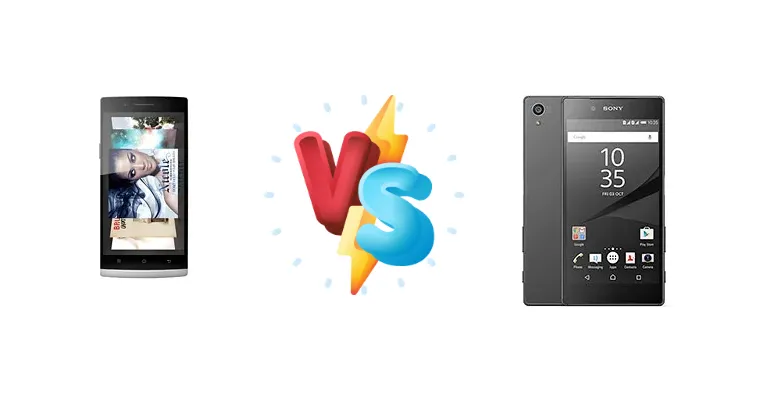
The Oppo Find 5 and Sony Xperia Z5 represent distinct approaches to the 2014 flagship smartphone market. The Find 5 aimed to deliver high-end specs at a competitive price, while the Xperia Z5 focused on a premium build and advanced camera technology. This comparison dissects their key differences, focusing on performance, display quality, and battery life to determine which device holds up better today.
🏆 Quick Verdict
For the average user seeking a balance of performance and longevity, the Sony Xperia Z5 emerges as the better choice. Its Snapdragon 810 chipset, despite potential thermal concerns, offers significantly more processing power than the Find 5’s Snapdragon S4 Pro, and its slightly superior battery endurance and faster charging provide a more modern user experience.
| Network |
|---|
| 2G bands | GSM 850 / 900 / 1800 / 1900 | GSM 850 / 900 / 1800 / 1900 |
| 3G bands | HSDPA 850 / 1900 / 2100 | HSDPA 850 / 900 / 1900 / 2100 - E6603, E6653 |
| 4G bands | - | 1, 2, 3, 4, 5, 7, 8, 12, 17, 20, 28, 38, 40 - E6603, E6653 |
| Speed | HSPA | HSPA 42.2/5.76 Mbps, LTE Cat4 150/50 Mbps (E6603), LTE Cat6 300/50 Mbps (E6653) |
| Technology | GSM / HSPA | GSM / HSPA / LTE |
| Launch |
|---|
| Announced | 2012, December. Released 2013, February | 2015, September 02. Released 2015, October 02 |
| Status | Discontinued | Discontinued |
| Body |
|---|
| Build | - | Glass front, glass back, aluminum frame |
| Dimensions | 141.8 x 68.8 x 8.9 mm (5.58 x 2.71 x 0.35 in) | 146 x 72 x 7.3 mm (5.75 x 2.83 x 0.29 in) |
| SIM | Micro-SIM | Nano-SIM |
| Weight | 165 g (5.82 oz) | 154 g (5.43 oz) |
| | - | IP68 dust/water resistant (up to 1.5m for 30 mins) |
| Display |
|---|
| Protection | Corning Gorilla Glass 2 | Scratch-resistant glass, oleophobic coating |
| Resolution | 1080 x 1920 pixels, 16:9 ratio (~441 ppi density) | 1080 x 1920 pixels, 16:9 ratio (~428 ppi density) |
| Size | 5.0 inches, 68.9 cm2 (~70.6% screen-to-body ratio) | 5.2 inches, 73.2 cm2 (~69.6% screen-to-body ratio) |
| Type | IPS LCD | IPS LCD |
| | - | Triluminos display
X-Reality Engine |
| Platform |
|---|
| CPU | Quad-core 1.5 GHz Krait | Octa-core (4x1.5 GHz Cortex-A53 & 4x2.0 GHz Cortex-A57) |
| Chipset | Qualcomm APQ8064 Snapdragon S4 Pro | Qualcomm MSM8994 Snapdragon 810 (20 nm) |
| GPU | Adreno 320 | Adreno 430 |
| OS | Android 4.1 (Jelly Bean) | Android 5.1.1 (Lollipop), upgradable to 7.1.1 (Nougat) |
| Memory |
|---|
| Card slot | No | microSDXC (dedicated slot) |
| Internal | 16GB 2GB RAM, 32GB 2GB RAM | 32GB 3GB RAM |
| | - | eMMC 5.0 |
| Main Camera |
|---|
| Features | LED flash, panorama, HDR | LED flash, HDR, panorama |
| Single | 13 MP, AF | 23 MP, f/2.0, 24mm (wide), 1/2.3", PDAF |
| Video | 1080p@30fps, HDR | 4K@30fps, 1080p@60fps, 720p@120fps, HDR |
| Selfie camera |
|---|
| Features | - | HDR |
| Single | 1.9 MP | 5.1 MP, f/2.4 |
| Video | - | 1080p@30fps |
| Sound |
|---|
| 3.5mm jack | - | Yes |
| 35mm jack | Yes | Yes |
| Loudspeaker | Yes | Yes, with stereo speakers |
| | - | 24-bit/192kHz audio
|
| Comms |
|---|
| Bluetooth | 4.0, A2DP | 4.1, A2DP, aptX |
| NFC | Yes | Yes |
| Positioning | GPS | GPS, GLONASS/ BDS (market dependant) |
| Radio | No | FM radio, RDS |
| USB | microUSB 2.0 | microUSB 2.0 (MHL 3 TV-out), OTG |
| WLAN | Wi-Fi 802.11 a/b/g/n, dual-band, Wi-Fi Direct, DLNA, hotspot | Wi-Fi 802.11 a/b/g/n/ac, dual-band, Wi-Fi Direct, DLNA, hotspot |
| Features |
|---|
| Sensors | Accelerometer, gyro, proximity, compass | Fingerprint (side-mounted; EU model only), accelerometer, gyro, proximity, compass, barometer |
| | - | ANT+ |
| Battery |
|---|
| Charging | - | 18W wired, QC2 |
| Music play | - | Up to 87 h |
| Stand-by | - | Up to 520 h (2G) / Up to 540 h (3G) |
| Talk time | - | Up to 13 h 10 min (2G) / Up to 17 h (3G) |
| Type | Li-Ion 2500 mAh, non-removable | Li-Ion 2900 mAh, non-removable |
| Misc |
|---|
| Colors | White, Black | White, Graphite Black, Gold, Green, Pink |
| Models | - | E6653, SO-01H, SOV32, E6603, 501SO |
| Price | About 540 EUR | About 150 EUR |
| SAR | - | 0.55 W/kg (head) 0.64 W/kg (body) |
| SAR EU | - | 0.75 W/kg (head) 0.78 W/kg (body) |
| Tests |
|---|
| Audio quality | - |
Noise -95.5dB / Crosstalk -94.8dB |
| Battery life | - |
Endurance rating 48h
|
| Camera | - |
Photo / Video |
| Display | - |
Contrast ratio: 986 (nominal), 2.88(sunlight) |
| Loudspeaker | - |
Voice 65dB / Noise 62dB / Ring 66dB
|
| Performance | - |
Basemark OS II 2.0: 1580Basemark X: 24941 |
Oppo Find 5
- More affordable price point (at launch)
- Lower risk of thermal throttling
- High nominal display contrast ratio
- Significantly less powerful processor
- Slower charging speeds
- Shorter battery life
Sony Xperia Z5
- More powerful Snapdragon 810 processor
- Faster 18W Quick Charge 2.0 charging
- Better sunlight display readability
- Potentially superior camera performance
- Potential for thermal throttling under heavy load
- Higher price point (at launch)
- Slightly lower nominal display contrast ratio
Display Comparison
Both the Oppo Find 5 and Sony Xperia Z5 feature displays with respectable contrast ratios, but differ in their nominal and sunlight readability. The Find 5 boasts a nominal contrast ratio of 1107, significantly higher than the Z5’s 986. However, the Xperia Z5 excels in sunlight readability with a contrast ratio of 2.88:1 compared to the Find 5’s 2.088:1. This suggests the Z5’s display is better optimized for outdoor viewing. While neither specification details panel technology (IPS, AMOLED), the Z5’s superior sunlight performance indicates potentially better polarization or anti-reflective coating.
Camera Comparison
Both phones offer photo and video capabilities, but detailed sensor information is lacking. The Xperia Z5 likely benefits from Sony’s expertise in image sensor technology, potentially featuring a larger sensor and more advanced image processing algorithms. While both phones likely offer similar feature sets (HDR, panorama, etc.), the Z5’s processor allows for faster image processing and potentially better low-light performance. Without specific sensor size or aperture data, it’s difficult to definitively declare a camera winner, but Sony’s brand reputation and the 810’s processing power give the Z5 an edge.
Performance
The performance gap between these two devices is substantial. The Oppo Find 5 utilizes the Qualcomm APQ8064 Snapdragon S4 Pro with a quad-core 1.5 GHz Krait CPU, a capable chip for its time, but significantly outmatched by the Sony Xperia Z5’s Qualcomm MSM8994 Snapdragon 810. The Z5’s octa-core CPU (4x1.5 GHz Cortex-A53 & 4x2.0 GHz Cortex-A57) offers a considerable performance uplift, particularly in multi-threaded tasks. The Snapdragon 810, built on a 20nm process, also benefits from architectural improvements over the S4 Pro. However, the 810 was known for potential thermal throttling under sustained load, a concern the S4 Pro largely avoided due to its lower power draw. The Z5’s performance advantage is most noticeable in gaming and demanding applications.
Battery Life
The Sony Xperia Z5 edges out the Oppo Find 5 in battery endurance, achieving a rating of 48 hours compared to the Find 5’s 43 hours. This difference, while not massive, is coupled with the Z5’s 18W wired charging with Quick Charge 2.0 support, a significant advantage over the Find 5’s unspecified charging capabilities. The faster charging allows the Z5 to replenish its battery much quicker, reducing downtime. The Z5’s more efficient processor also contributes to its slightly longer battery life, despite potentially higher power consumption under load.
Buying Guide
Buy the Oppo Find 5 if you prioritize a more affordable entry point into the flagship experience and are comfortable with a less powerful processor. It’s ideal for users who primarily browse, use social media, and perform basic tasks. Buy the Sony Xperia Z5 if you demand more processing power for demanding applications, gaming, or photography, and value faster charging and a slightly longer battery life. It’s geared towards power users and multimedia enthusiasts.
Frequently Asked Questions
❓ Is the Snapdragon 810 in the Xperia Z5 prone to overheating during extended gaming sessions?
The Snapdragon 810 was known to experience thermal throttling under sustained heavy load, particularly in poorly cooled devices. However, the Xperia Z5’s design and Sony’s thermal management likely mitigated this issue to some extent. While you may experience some performance reduction during prolonged gaming, it shouldn’t be a crippling issue for most users.
❓ Does the Oppo Find 5 still receive software updates or security patches?
No, the Oppo Find 5 is no longer officially supported with software updates or security patches. Using this device today carries inherent security risks, and it’s advisable to exercise caution when handling sensitive information.
❓ How does the difference in CPU architecture (Krait vs. Cortex-A53/A57) impact real-world performance?
The Cortex-A53/A57 architecture in the Snapdragon 810 represents a significant leap forward in CPU design compared to the Krait cores in the Snapdragon S4 Pro. The 810’s big.LITTLE configuration allows for efficient power management, while the A57 cores provide substantial performance gains in demanding tasks. This translates to faster app loading times, smoother multitasking, and improved gaming performance on the Xperia Z5.