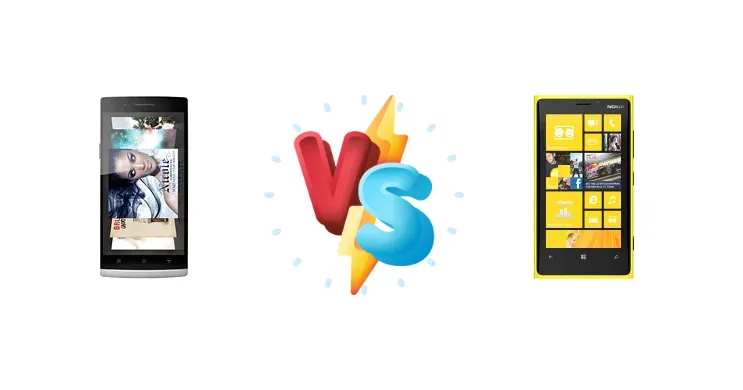
The Oppo Find 5 and Nokia Lumia 920 represented distinct approaches to the high-end smartphone market in 2013. The Find 5 aimed for a competitive Android experience with a focus on display quality and processing power, while the Lumia 920 championed Windows Phone 8 with its innovative camera and wireless charging capabilities. This comparison revisits these devices to determine which holds up better today.
🏆 Quick Verdict
For the average user seeking a functional and potentially repairable smartphone from this era, the Nokia Lumia 920 edges out the Oppo Find 5. Its wireless charging and slightly better battery endurance, combined with a comparable display, offer a more convenient experience, despite the Find 5's more powerful processor.
| Network |
|---|
| 2G bands | GSM 850 / 900 / 1800 / 1900 | GSM 850 / 900 / 1800 / 1900 - RM-821, RM-820 |
| 3G bands | HSDPA 850 / 1900 / 2100 | HSDPA 850 / 900 / 1900 / 2100 - RM-821, RM-820 |
| 4G bands | - | 1, 3, 7, 8, 20 - RM-821 |
| EDGE | - | No |
| GPRS | - | No |
| Speed | HSPA | HSPA 42.2/5.76 Mbps, LTE Cat3 100/50 Mbps |
| Technology | GSM / HSPA | GSM / HSPA / LTE |
| | - | 4, 17 - RM-820 (AT&T) |
| Launch |
|---|
| Announced | 2012, December. Released 2013, February | 2012, September. Released 2012, November |
| Status | Discontinued | Discontinued |
| Body |
|---|
| Dimensions | 141.8 x 68.8 x 8.9 mm (5.58 x 2.71 x 0.35 in) | 130.3 x 70.8 x 10.7 mm, 99 cc (5.13 x 2.79 x 0.42 in) |
| SIM | Micro-SIM | Micro-SIM |
| Weight | 165 g (5.82 oz) | 185 g (6.53 oz) |
| Display |
|---|
| Protection | Corning Gorilla Glass 2 | Corning Gorilla Glass 2 |
| Resolution | 1080 x 1920 pixels, 16:9 ratio (~441 ppi density) | 768 x 1280 pixels, 5:3 ratio (~332 ppi density) |
| Size | 5.0 inches, 68.9 cm2 (~70.6% screen-to-body ratio) | 4.5 inches, 57.6 cm2 (~62.5% screen-to-body ratio) |
| Type | IPS LCD | IPS LCD |
| | - | PureMotion HD+ ClearBlack display |
| Platform |
|---|
| CPU | Quad-core 1.5 GHz Krait | Dual-core 1.5 GHz Krait |
| Chipset | Qualcomm APQ8064 Snapdragon S4 Pro | Qualcomm MSM8960 Snapdragon S4 Plus |
| GPU | Adreno 320 | Adreno 225 |
| OS | Android 4.1 (Jelly Bean) | Microsoft Windows Phone 8, upgradable to 8.1 |
| Memory |
|---|
| Call records | - | Yes |
| Card slot | No | No |
| Internal | 16GB 2GB RAM, 32GB 2GB RAM | 32GB 1GB RAM |
| Phonebook | - | Yes |
| Main Camera |
|---|
| Features | LED flash, panorama, HDR | Carl Zeiss optics, dual-LED flash |
| Single | 13 MP, AF | 8 MP, f/2.0, 26mm (wide), 1/3.0", AF, OIS |
| Video | 1080p@30fps, HDR | 1080p@30fps |
| Selfie camera |
|---|
| Single | 1.9 MP | 1.3 MP |
| Video | - | 720p@30fps |
| Sound |
|---|
| 3.5mm jack | - | Yes |
| 35mm jack | Yes | Yes |
| Loudspeaker | Yes | Yes |
| Comms |
|---|
| Bluetooth | 4.0, A2DP | 4.0, A2DP, EDR, LE/ aptX after WP8 Denim update |
| NFC | Yes | Yes |
| Positioning | GPS | GPS, A-GPS, GLONASS |
| Radio | No | FM radio |
| USB | microUSB 2.0 | microUSB 2.0 |
| WLAN | Wi-Fi 802.11 a/b/g/n, dual-band, Wi-Fi Direct, DLNA, hotspot | Wi-Fi 802.11 a/b/g/n, dual-band, DLNA, hotspot |
| Features |
|---|
| Browser | - | No |
| Games | - | No |
| Java | - | No |
| Messaging | - | SMS |
| Sensors | Accelerometer, gyro, proximity, compass | Accelerometer, gyro, proximity, compass |
| Battery |
|---|
| Charging | - | Wireless (Qi) |
| Music play | - | Up to 67 h |
| Stand-by | - | Up to 400 h (2G) / Up to 400 h (3G) |
| Talk time | - | Up to 17 h (2G) / Up to 10 h (3G) |
| Type | Li-Ion 2500 mAh, non-removable | Non-removable Li-Ion 2000 mAh battery (BP-4GW) |
| Misc |
|---|
| Colors | White, Black | Black, Gray, Red, Yellow, White |
| Price | About 540 EUR | About 210 EUR |
| SAR | - | 1.08 W/kg (head) 0.91 W/kg (body) |
| SAR EU | - | 0.70 W/kg (head) |
| Tests |
|---|
| Audio quality | - |
Noise -78.9dB / Crosstalk -75.0dB |
| Battery life | - |
Endurance rating 44h
|
| Camera | - |
Photo / Video |
| Display | - |
Contrast ratio: 1065:1 (nominal) / 2.107:1 (sunlight) |
| Loudspeaker | - |
Voice 61dB / Noise 64dB / Ring 65dB
|
Oppo Find 5
- More powerful processor (Snapdragon S4 Pro)
- Slightly higher display contrast ratio
- Potentially more open software ecosystem (Android)
- Lacks wireless charging
- Android updates likely ceased long ago
- Potentially harder to find replacement parts
Nokia Lumia 920
- Wireless charging (Qi)
- Excellent low-light camera performance
- Unique Windows Phone 8 experience
- Less powerful processor (Snapdragon S4 Plus)
- Windows Phone 8 ecosystem limitations
- App availability limited compared to Android
Display Comparison
Both the Oppo Find 5 and Nokia Lumia 920 feature displays with similar contrast ratios – 1107:1 and 1065:1 nominal, respectively, and 2.088:1 and 2.107:1 in sunlight. This suggests comparable visibility in bright conditions. However, the Find 5’s slightly higher nominal contrast ratio may translate to marginally deeper blacks indoors. Neither device boasts the high refresh rates or advanced panel technologies found in modern smartphones, but they were competitive for their time. The Lumia 920’s display benefits from Nokia’s ClearType technology, aiming for improved readability, while the Find 5 focused on color accuracy.
Camera Comparison
Both phones were marketed heavily on their camera capabilities. While both capture photo and video, detailed sensor information is lacking. The Lumia 920 gained significant praise for its low-light performance, attributed to its large sensor and optical image stabilization (OIS). The Find 5 likely relied more on software processing to enhance image quality. Without specific sensor size data, it’s difficult to definitively declare a winner, but the Lumia 920’s OIS and software optimizations likely provided a more consistent and reliable camera experience, particularly in challenging lighting conditions.
Performance
The Oppo Find 5’s Qualcomm APQ8064 Snapdragon S4 Pro, with its quad-core 1.5 GHz Krait CPU, offers a theoretical performance advantage over the Nokia Lumia 920’s dual-core 1.5 GHz Krait CPU based on the MSM8960 Snapdragon S4 Plus. However, the real-world difference in performance for typical 2013 tasks would have been minimal. The S4 Pro’s advantage would be most noticeable in multi-threaded applications. The Lumia 920’s S4 Plus included optimizations for camera processing, potentially offsetting the CPU core count difference in photo and video tasks. Both devices likely shipped with 2GB of RAM, a standard for the time, limiting multitasking capabilities by today’s standards.
Battery Life
Both the Oppo Find 5 and Nokia Lumia 920 achieve an endurance rating of approximately 44 hours, indicating similar battery life. The Lumia 920’s inclusion of wireless charging (Qi standard) provides a significant convenience factor, allowing for easy top-ups without the need for cables. While the Find 5 lacks wireless charging, its battery performance is comparable, suggesting efficient power management. Neither device offers fast charging capabilities by modern standards, with full charges likely taking several hours.
Buying Guide
Buy the Oppo Find 5 if you prioritize raw processing power for older Android applications and value a slightly higher contrast ratio in display performance. Buy the Nokia Lumia 920 if you prefer the Windows Phone 8 ecosystem, appreciate the convenience of wireless charging, and prioritize camera performance in low-light conditions. Both devices are likely best suited for collectors or those seeking a retro smartphone experience.
Frequently Asked Questions
❓ Is the Snapdragon S4 Plus in the Lumia 920 a significant bottleneck compared to the S4 Pro in the Find 5 for modern app usage?
While the S4 Pro is technically more powerful, the S4 Plus is unlikely to be a major bottleneck for the types of applications these phones would realistically run today. Both processors are aging and will struggle with demanding modern apps. The limitations of the operating system and available RAM will likely be more significant constraints.
❓ Does the Nokia Lumia 920 still receive software updates, and are there any security concerns with running an outdated version of Windows Phone 8?
No, the Nokia Lumia 920 no longer receives official software updates from Microsoft. Running an outdated operating system poses significant security risks, as known vulnerabilities remain unpatched. Using this device for sensitive tasks is strongly discouraged.
❓ How reliable is the wireless charging on the Nokia Lumia 920 after years of use?
The reliability of the wireless charging on a used Lumia 920 can vary. Over time, the charging coil or internal components may degrade, leading to slower charging speeds or intermittent connectivity. It's a potential point of failure to consider.