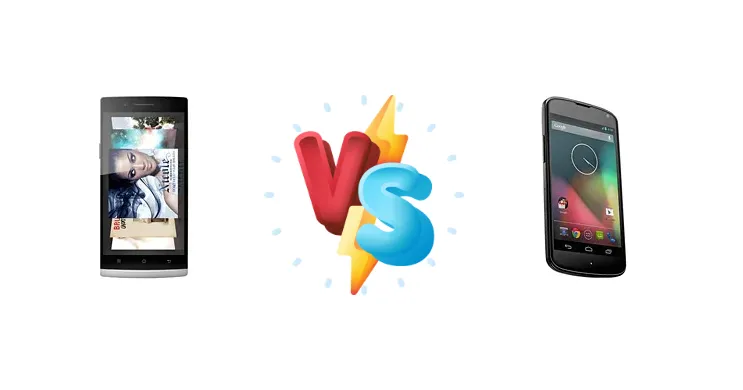
Released within months of each other in 2013, the Oppo Find 5 and LG Nexus 4 represented compelling alternatives to the established smartphone giants. Both leveraged Qualcomm’s Snapdragon S4 Pro, but diverged significantly in their approach to battery life, display technology, and user experience. This comparison dissects these differences to determine which phone holds up better under scrutiny.
🏆 Quick Verdict
For the average user prioritizing longevity, the Oppo Find 5 emerges as the stronger choice. Its 43-hour endurance rating significantly surpasses the Nexus 4’s 32 hours. While the Nexus 4 offers the convenience of wireless charging, the Find 5’s superior battery performance provides a more tangible benefit in daily use.
| Network |
|---|
| 2G bands | GSM 850 / 900 / 1800 / 1900 | GSM 850 / 900 / 1800 / 1900 |
| 3G bands | HSDPA 850 / 1900 / 2100 | HSDPA 850 / 900 / 1700 / 1900 / 2100 |
| Speed | HSPA | HSPA 42.2/5.76 Mbps |
| Technology | GSM / HSPA | GSM / HSPA |
| | - | HSDPA 900 / 2100 |
| Launch |
|---|
| Announced | 2012, December. Released 2013, February | 2012, October. Released 2012, November |
| Status | Discontinued | Discontinued |
| Body |
|---|
| Dimensions | 141.8 x 68.8 x 8.9 mm (5.58 x 2.71 x 0.35 in) | 133.9 x 68.7 x 9.1 mm (5.27 x 2.70 x 0.36 in) |
| SIM | Micro-SIM | Micro-SIM |
| Weight | 165 g (5.82 oz) | 139 g (4.90 oz) |
| Display |
|---|
| Protection | Corning Gorilla Glass 2 | Corning Gorilla Glass 2 |
| Resolution | 1080 x 1920 pixels, 16:9 ratio (~441 ppi density) | 768 x 1280 pixels, 5:3 ratio (~318 ppi density) |
| Size | 5.0 inches, 68.9 cm2 (~70.6% screen-to-body ratio) | 4.7 inches, 62.9 cm2 (~68.3% screen-to-body ratio) |
| Type | IPS LCD | True HD IPS Plus |
| Platform |
|---|
| CPU | Quad-core 1.5 GHz Krait | Quad-core 1.5 GHz Krait |
| Chipset | Qualcomm APQ8064 Snapdragon S4 Pro | Qualcomm APQ8064 Snapdragon S4 Pro |
| GPU | Adreno 320 | Adreno 320 |
| OS | Android 4.1 (Jelly Bean) | Android 4.2 (Jelly Bean), upgradable to 5.1 (Lollipop) |
| Memory |
|---|
| Card slot | No | No |
| Internal | 16GB 2GB RAM, 32GB 2GB RAM | 8GB 2GB RAM, 16GB 2GB RAM |
| Main Camera |
|---|
| Features | LED flash, panorama, HDR | LED flash |
| Single | 13 MP, AF | 8 MP, 1/4.0", AF |
| Video | 1080p@30fps, HDR | 1080p@30fps |
| Selfie camera |
|---|
| Single | 1.9 MP | 1.3 MP |
| Sound |
|---|
| 3.5mm jack | - | Yes |
| 35mm jack | Yes | Yes |
| Loudspeaker | Yes | Yes |
| Comms |
|---|
| Bluetooth | 4.0, A2DP | 4.0, A2DP |
| NFC | Yes | Yes |
| Positioning | GPS | GPS, GLONASS |
| Radio | No | No |
| USB | microUSB 2.0 | microUSB 2.0 (SlimPort) |
| WLAN | Wi-Fi 802.11 a/b/g/n, dual-band, Wi-Fi Direct, DLNA, hotspot | Wi-Fi 802.11 a/b/g/n, dual-band, DLNA, hotspot |
| Features |
|---|
| Sensors | Accelerometer, gyro, proximity, compass | Accelerometer, gyro, proximity, compass, barometer |
| Battery |
|---|
| Charging | - | Wireless (Qi) |
| Stand-by | - | Up to 390 h (3G) |
| Talk time | - | Up to 15 h (3G) |
| Type | Li-Ion 2500 mAh, non-removable | Li-Po 2100 mAh, non-removable |
| Misc |
|---|
| Colors | White, Black | Black, White |
| Models | - | Nexus 4 |
| Price | About 540 EUR | About 250 EUR |
| SAR | - | 0.55 W/kg (head) 1.27 W/kg (body) |
| SAR EU | - | 0.41 W/kg (head) 0.48 W/kg (body) |
| Tests |
|---|
| Audio quality | - |
Noise -82.3dB / Crosstalk -82.0dB |
| Battery life | - |
Endurance rating 32h
|
| Camera | - |
Photo / Video |
| Display | - |
Contrast ratio: 1341 (nominal) / 1.926:1 (sunlight) |
| Loudspeaker | - |
Voice 71dB / Noise 66dB / Ring 78dB
|
| Performance | - |
Basemark X: 6639 |
Oppo Find 5
- Significantly longer battery life (43h endurance)
- Superior sunlight contrast ratio for better outdoor visibility
- Potentially better camera hardware (based on Oppo's brand focus)
- Lacks wireless charging convenience
- Software experience may not be as streamlined as stock Android
LG Nexus 4 E960
- Convenient Qi wireless charging support
- Clean, stock Android experience with faster updates
- Slightly higher nominal contrast ratio
- Significantly shorter battery life (32h endurance)
- May require more frequent charging
Display Comparison
Both the Oppo Find 5 and LG Nexus 4 feature displays with a 1080p resolution, but differ in contrast. The Nexus 4 boasts a nominal contrast ratio of 1341, slightly higher than the Find 5’s 1107. However, under direct sunlight, the Find 5’s contrast ratio jumps to 2.088:1, significantly outperforming the Nexus 4’s 1.926:1. This suggests better outdoor readability for the Find 5. While neither phone specifies panel technology (IPS or AMOLED), the contrast figures suggest high-quality IPS panels in both cases, prioritizing color accuracy over extreme blacks.
Camera Comparison
Both phones offer photo and video capabilities, but detailed camera specifications are absent. Without sensor size, aperture, or image processing details, a direct comparison is difficult. However, given the Nexus 4’s history of strong computational photography, it’s reasonable to assume LG focused on software enhancements. The Find 5, being a flagship from a camera-focused manufacturer, likely prioritized hardware quality. The absence of any mention of advanced features like optical image stabilization (OIS) suggests neither phone excels in low-light photography by modern standards.
Performance
Both devices are powered by the Qualcomm APQ8064 Snapdragon S4 Pro with a quad-core 1.5 GHz Krait CPU. This means raw processing power is virtually identical. Real-world performance differences would likely stem from software optimization and RAM management, areas where the Nexus 4’s stock Android experience typically excels. However, the lack of detailed RAM specifications prevents a definitive statement on memory bandwidth or speed. Thermal throttling, while not explicitly mentioned, would be a potential concern under sustained load for both devices given the S4 Pro’s limitations compared to later Snapdragon generations.
Battery Life
The most significant difference lies in battery endurance. The Oppo Find 5 achieves a 43-hour endurance rating, a substantial improvement over the Nexus 4’s 32 hours. This translates to a full day of heavier usage on the Find 5 versus potentially needing a midday charge on the Nexus 4. The Nexus 4 compensates with Qi wireless charging, a convenience feature absent on the Find 5. However, wireless charging is generally slower than wired charging, and the Nexus 4’s smaller battery capacity means it’s often starting from a lower baseline.
Buying Guide
Buy the Oppo Find 5 if you need maximum battery life and a slightly higher contrast display for outdoor visibility. This phone is ideal for users who frequently travel or heavily utilize their smartphones throughout the day. Buy the LG Nexus 4 E960 if you prioritize a clean Android experience, the convenience of Qi wireless charging, and a slightly better contrast ratio in nominal conditions, and are willing to compromise on battery endurance.
Frequently Asked Questions
❓ Does the Snapdragon S4 Pro in either phone struggle with modern app demands?
Yes, the Snapdragon S4 Pro is a relatively old chipset. While capable of handling basic tasks, it will likely struggle with demanding modern apps and games. Expect slowdowns and potential compatibility issues with newer software.
❓ Is the wireless charging on the Nexus 4 significantly slower than wired charging?
Yes, Qi wireless charging on the Nexus 4 is considerably slower than wired charging. Expect a full charge to take several hours longer via wireless charging, making it more suitable for overnight charging rather than quick top-ups.
❓ Given the age of these phones, what is the biggest concern regarding long-term usability?
The biggest concern is battery degradation. Lithium-ion batteries degrade over time, and after over a decade, both phones will likely exhibit significantly reduced battery capacity, even if they haven't been heavily used. Finding replacement batteries may also be challenging.
❓ Would either of these phones be suitable for someone looking for a secondary or backup device?
The Oppo Find 5, due to its superior battery life, is the more practical choice as a secondary device. The Nexus 4's shorter battery life makes it less convenient for infrequent use.