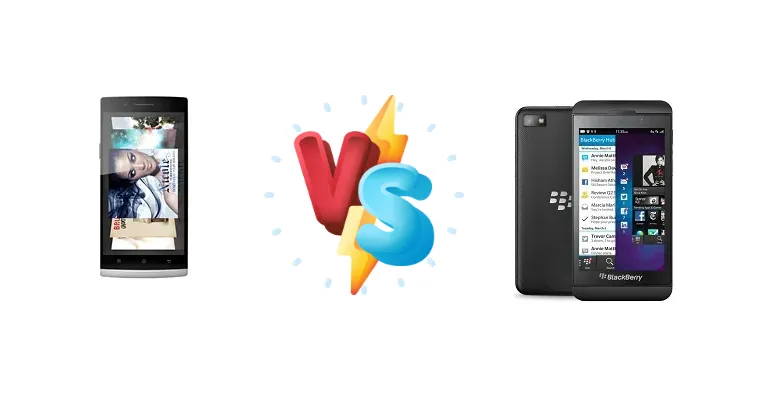
The Oppo Find 5 and BlackBerry Z10 represent divergent approaches to the flagship smartphone in 2013. The Find 5 aimed to deliver high-end Android specs at a competitive price, while the Z10 marked BlackBerry’s bold transition to a completely new, gesture-based OS. Both devices leveraged Qualcomm’s Snapdragon S4 platform, but with key differences in core count and software implementation. This comparison dissects those differences to determine which phone holds up better today.
🏆 Quick Verdict
For the average user seeking a functional and capable smartphone from this era, the Oppo Find 5 emerges as the slightly better choice. Its quad-core processor provides a performance edge, and the Android ecosystem offers broader app compatibility and continued support compared to the now-defunct BlackBerry 10 OS.
| Network |
|---|
| 2G bands | GSM 850 / 900 / 1800 / 1900 | GSM 850 / 900 / 1800 / 1900 - all versions |
| 3G bands | HSDPA 850 / 1900 / 2100 | HSDPA 850 / 900 / 1900 / 2100 - STL100-1 |
| 4G bands | - | 3, 7, 8, 20 - STL100-2 |
| Speed | HSPA | HSPA 21.1/5.76 Mbps, LTE, EV-DO Rev.A 3.1 Mbps |
| Technology | GSM / HSPA | GSM / CDMA / HSPA / LTE |
| | - | 13 - STL100-4 |
| Launch |
|---|
| Announced | 2012, December. Released 2013, February | 2013, January. Released 2013, January |
| Status | Discontinued | Discontinued |
| Body |
|---|
| Build | - | Glass front, plastic back, plastic frame |
| Dimensions | 141.8 x 68.8 x 8.9 mm (5.58 x 2.71 x 0.35 in) | 130 x 65.6 x 9 mm (5.12 x 2.58 x 0.35 in) |
| SIM | Micro-SIM | Micro-SIM |
| Weight | 165 g (5.82 oz) | 137.5 g (4.83 oz) |
| Display |
|---|
| Protection | Corning Gorilla Glass 2 | - |
| Resolution | 1080 x 1920 pixels, 16:9 ratio (~441 ppi density) | 768 x 1280 pixels, 5:3 ratio (~355 ppi density) |
| Size | 5.0 inches, 68.9 cm2 (~70.6% screen-to-body ratio) | 4.2 inches, 50.2 cm2 (~58.9% screen-to-body ratio) |
| Type | IPS LCD | TFT |
| Platform |
|---|
| CPU | Quad-core 1.5 GHz Krait | Dual-core 1.5 GHz Krait |
| Chipset | Qualcomm APQ8064 Snapdragon S4 Pro | Qualcomm MSM8960 Snapdragon S4 Plus |
| GPU | Adreno 320 | Adreno 225 |
| OS | Android 4.1 (Jelly Bean) | BlackBerry OS 10, upgradable to 10.3.1 |
| Memory |
|---|
| Card slot | No | microSDXC (dedicated slot) |
| Internal | 16GB 2GB RAM, 32GB 2GB RAM | 16GB 2GB RAM |
| Main Camera |
|---|
| Features | LED flash, panorama, HDR | LED flash, HDR, panorama |
| Single | 13 MP, AF | 8 MP, f/2.2, 31mm (standard), AF |
| Video | 1080p@30fps, HDR | 1080p@30fps |
| Selfie camera |
|---|
| Single | 1.9 MP | 2 MP |
| Video | - | 720p@30fps |
| Sound |
|---|
| 3.5mm jack | - | Yes |
| 35mm jack | Yes | Yes |
| Loudspeaker | Yes | Yes |
| Comms |
|---|
| Bluetooth | 4.0, A2DP | 4.0, A2DP, LE |
| NFC | Yes | Yes |
| Positioning | GPS | GPS |
| Radio | No | No |
| USB | microUSB 2.0 | microUSB 2.0 |
| WLAN | Wi-Fi 802.11 a/b/g/n, dual-band, Wi-Fi Direct, DLNA, hotspot | Wi-Fi 802.11 a/b/g/n, dual-band, DLNA, hotspot |
| Features |
|---|
| Sensors | Accelerometer, gyro, proximity, compass | Accelerometer, gyro, proximity, compass |
| | - | HDMI port |
| Battery |
|---|
| Stand-by | - | Up to 312 h |
| Talk time | - | Up to 10 h |
| Type | Li-Ion 2500 mAh, non-removable | Li-Ion 1800 mAh, removable |
| Misc |
|---|
| Colors | White, Black | Black, White |
| Price | About 540 EUR | About 120 EUR |
| SAR | - | 1.07 W/kg (head) 1.07 W/kg (body) |
| SAR EU | - | 0.87 W/kg (head) 0.99 W/kg (body) |
| Tests |
|---|
| Audio quality | - |
Noise -82.8dB / Crosstalk -80.5dB |
| Battery life | - |
Endurance rating 46h
|
| Camera | - |
Photo / Video |
| Display | - |
Contrast ratio: 1532 (nominal) / 2.051:1 (sunlight) |
| Loudspeaker | - |
Voice 70dB / Noise 67dB / Ring 73dB
|
Oppo Find 5
- Quad-core processor offers better performance.
- Android ecosystem provides wider app compatibility.
- Competitive price point at launch.
- Slightly lower battery endurance than the Z10.
- Lower nominal display contrast ratio.
BlackBerry Z10
- Higher nominal display contrast ratio for potentially better visuals.
- Slightly better battery endurance.
- Unique BlackBerry 10 gesture-based OS (for collectors).
- Dual-core processor is less powerful than the Find 5.
- BlackBerry 10 OS is no longer supported and has limited app availability.
Display Comparison
Both the Oppo Find 5 and BlackBerry Z10 feature displays with a sunlight contrast ratio of approximately 2.05:1, suggesting similar outdoor visibility. However, the Z10 boasts a higher nominal contrast ratio of 1532 compared to the Find 5’s 1107. This indicates deeper blacks and potentially more vibrant colors on the Z10, though real-world differences may be subtle. Neither device specifies panel technology (IPS, AMOLED), but given the era, IPS is highly probable for both. Bezels were relatively substantial on both devices, typical for 2013 designs, and color accuracy data is unavailable, making a definitive judgment on display quality challenging.
Camera Comparison
Both devices feature photo and video capabilities, but detailed camera specifications are lacking. Without sensor size, aperture, or image processing details, a direct comparison is difficult. The era suggests both likely employed 8-12MP sensors. The BlackBerry Z10’s camera was often criticized for its image quality, while the Oppo Find 5 was considered competitive for its time. Without further data, it’s reasonable to assume the Find 5 offered a slightly more refined camera experience, but this remains speculative.
Performance
The core performance difference lies in the CPU configuration. The Oppo Find 5 utilizes a Qualcomm APQ8064 Snapdragon S4 Pro with a quad-core 1.5 GHz Krait processor, while the BlackBerry Z10 employs the MSM8960 Snapdragon S4 Plus with a dual-core 1.5 GHz Krait processor. While both are Krait cores, the quad-core configuration of the Find 5 should offer superior multi-tasking and responsiveness, particularly in applications optimized for multiple threads. The S4 Plus in the Z10 focused on efficiency, but the Find 5’s extra cores provide a noticeable advantage in raw processing power. RAM specifications are not provided, but both likely featured 2GB, standard for the time.
Battery Life
The BlackBerry Z10 edges out the Oppo Find 5 in endurance, boasting a 46-hour rating versus the Find 5’s 43-hour rating. This suggests slightly better power efficiency, potentially due to the dual-core processor and BlackBerry 10’s OS optimizations. However, the difference is marginal. Neither device supports modern fast-charging standards, and 0-100% charge times would have been in the 2-3 hour range, typical for 2013 flagships. The Z10’s slightly better endurance is likely more noticeable in standby time than in heavy usage.
Buying Guide
Buy the Oppo Find 5 if you prioritize performance for basic tasks, value a larger app ecosystem, and appreciate a more conventional Android experience. Buy the BlackBerry Z10 if you are a collector interested in experiencing a unique, gesture-driven OS and a physical keyboard-less BlackBerry design, understanding that software support is non-existent and app availability is severely limited.
Frequently Asked Questions
❓ Is the BlackBerry 10 OS still usable in 2024, and can I install apps?
No, BlackBerry 10 is effectively defunct. BlackBerry officially ended support for the OS in January 2022. While some legacy apps may still function, the app store is no longer maintained, and new app installations are extremely limited. Security updates are also unavailable, making the device vulnerable.
❓ Will the Oppo Find 5 receive any software updates or security patches?
No. The Oppo Find 5 is a very old device and no longer receives any official software updates or security patches from Oppo. While custom ROMs may be available from the Android developer community, installing them carries risks and is not officially supported.
❓ How does the Snapdragon S4 Plus in the Z10 compare to the S4 Pro in the Find 5 for everyday tasks like browsing and social media?
For basic tasks like web browsing, social media, and email, both processors are adequate. However, the quad-core S4 Pro in the Find 5 will provide a smoother and more responsive experience, especially when multitasking or loading complex web pages. The S4 Plus prioritizes efficiency, but the extra cores of the S4 Pro offer a noticeable performance boost.