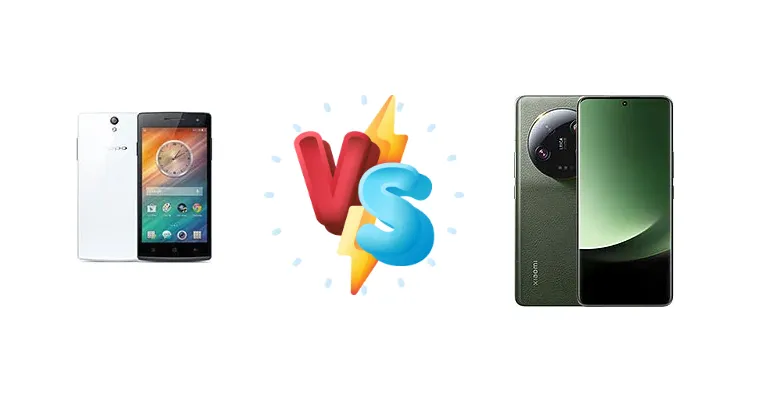
The Oppo Find 5 Mini represents a bygone era of budget smartphones, while the Xiaomi 13 Ultra embodies modern flagship technology. This comparison explores the vast differences between these two devices, examining their strengths and weaknesses to help you decide which is right for you.
🏆 Quick Verdict
The Xiaomi 13 Ultra utterly dominates the Oppo Find 5 Mini across nearly every metric. Its superior chipset, camera, display, and battery life make it the clear winner, though the Find 5 Mini might appeal to users seeking a very basic, ultra-budget device.
| Network |
|---|
| 2G bands | GSM 850 / 900 / 1800 / 1900 - SIM 1 & SIM 2 | GSM 850 / 900 / 1800 / 1900 |
| 3G bands | HSDPA 2100 | HSDPA 800 / 850 / 900 / 1700(AWS) / 1900 / 2100 |
| 4G bands | - | 1, 2, 3, 4, 5, 7, 8, 18, 19, 20, 26, 28, 38, 40, 41, 66 - International |
| 5G bands | - | 1, 3, 5, 7, 8, 20, 28, 38, 40, 41, 77, 78, 79 SA/NSA - International |
| Speed | HSPA 42.2/11.5 Mbps | HSPA, LTE, 5G |
| Technology | GSM / HSPA | GSM / CDMA / HSPA / EVDO / LTE / 5G |
| | - | CDMA2000 1xEV-DO |
| Launch |
|---|
| Announced | 2014, January. Released 2014, January | 2023, April 18 |
| Status | Discontinued | Available. Released 2023, April 21 |
| Body |
|---|
| Build | - | Glass front (Gorilla Glass Victus), eco leather back, aluminum frame |
| Dimensions | 137 x 68 x 7.7 mm (5.39 x 2.68 x 0.30 in) | 163.2 x 74.6 x 9.1 mm (6.43 x 2.94 x 0.36 in) |
| SIM | Dual SIM (Mini-SIM/ Micro-SIM, dual stand-by) | Nano-SIM + Nano-SIM |
| Weight | 128 g (4.52 oz) | 227 g (8.01 oz) |
| | - | IP68 dust/water resistant (up to 1.5m for 30 min) |
| Display |
|---|
| Protection | - | Corning Gorilla Glass Victus |
| Resolution | 540 x 960 pixels, 16:9 ratio (~234 ppi density) | 1440 x 3200 pixels, 20:9 ratio (~522 ppi density) |
| Size | 4.7 inches, 60.9 cm2 (~65.4% screen-to-body ratio) | 6.73 inches, 108.9 cm2 (~89.5% screen-to-body ratio) |
| Type | IPS LCD | LTPO AMOLED, 68B colors, 120Hz, Dolby Vision, HDR10+, 1300 nits (HBM), 2600 nits (peak) |
| Platform |
|---|
| CPU | Quad-core 1.3 GHz Cortex-A7 | Octa-core (1x3.2 GHz Cortex-X3 & 2x2.8 GHz Cortex-A715 & 2x2.8 GHz Cortex-A710 & 3x2.0 GHz Cortex-A510) |
| Chipset | Mediatek MT6582M (28 nm) | Qualcomm SM8550-AB Snapdragon 8 Gen 2 (4 nm) |
| GPU | Mali-400MP2 | Adreno 740 |
| OS | Android 4.2.2 (Jelly Bean) | Android 13, upgradable to Android 14, HyperOS |
| Memory |
|---|
| Card slot | microSDHC (dedicated slot) | No |
| Internal | 4GB 1GB RAM | 256GB 12GB RAM, 512GB 12GB RAM, 512GB 16GB RAM, 1TB 16GB RAM |
| | - | UFS 4.0 |
| Main Camera |
|---|
| Features | LED flash | Laser AF, color spectrum sensor, Leica lenses, Dual-LED flash, HDR, panorama, 67mm filter ring holder (optional) |
| Quad | - | 50 MP, f/1.9 or f/4.0, 23mm (wide), 1.0"-type, 1.6µm, dual pixel PDAF, OIS
50 MP, f/1.8, 75mm (telephoto), 1/2.51", 0.7µm, dual pixel PDAF, OIS, 3.2x optical zoom
50 MP, f/3.0, 120mm (periscope telephoto), 1/2.51", 0.7µm, dual pixel PDAF, OIS, 5x optical zoom
50 MP, f/1.8, 12mm, 122˚ (ultrawide), 1/2.51", 0.7µm, dual pixel PDAF
TOF 3D, (depth) |
| Single | 8 MP, AF | - |
| Video | 720p@30fps | 8K@24fps, 4K@24/30/60fps, 1080p@30/60/120/240/480/960/1920fps, gyro-EIS, Dolby Vision HDR 10-bit rec. (4K@60fps, 1080p) |
| Selfie camera |
|---|
| Features | - | HDR, panorama |
| Single | 2 MP | 32 MP, f/2.0, 22mm (wide), 1/3.14", 0.7µm |
| Video | - | 1080p@30/60fps, gyro-EIS |
| Sound |
|---|
| 3.5mm jack | Yes | No |
| 35mm jack | Yes | No |
| Loudspeaker | Yes | Yes, with stereo speakers |
| | - | 24-bit/192kHz audio |
| Comms |
|---|
| Bluetooth | 4.0, A2DP, LE | 5.3, A2DP, LE, aptX HD, aptX Adaptive |
| Infrared port | - | Yes |
| NFC | No | Yes |
| Positioning | GPS | GPS (L1+L5), GLONASS (L1), BDS (B1I+B1c+B2a), GALILEO (E1+E5a), QZSS (L1+L5), NavIC (L5) |
| Radio | FM radio | No |
| USB | microUSB 2.0 | USB Type-C 3.2, DisplayPort, OTG |
| WLAN | Wi-Fi 802.11 b/g/n, Wi-Fi Direct, hotspot | Wi-Fi 802.11 a/b/g/n/ac/6e/7, tri-band, Wi-Fi Direct |
| Features |
|---|
| Sensors | Accelerometer, proximity, compass | Fingerprint (under display, optical), accelerometer, proximity, gyro, compass, barometer |
| | - | Virtual proximity sensing |
| Battery |
|---|
| Charging | - | 90W wired, PD3.0, QC4, 100% in 35 min
50W wireless, 100% in 49 min
10W reverse wireless |
| Type | Li-Po 2000 mAh, removable | Li-Po 5000 mAh |
| Misc |
|---|
| Colors | White, Black | Black, Olive Green, White, Orange, Yellow, Blue |
| Models | R827 | 2304FPN6DC, 2304FPN6DG |
| Price | About 240 EUR | € 797.98 / $ 389.69 |
| SAR EU | - | 0.99 W/kg (head) 1.00 W/kg (body) |
Oppo Find 5 Mini
- Extremely affordable
- Compact size
- Outdated chipset
- Poor camera
- Low-resolution display
- Limited storage
- Slow performance
Xiaomi 13 Ultra
- Flagship performance
- Exceptional camera
- Stunning display
- Long battery life
- Fast charging
- Premium design
- Expensive
- Large size
- Potentially complex software
Display Comparison
The Xiaomi 13 Ultra boasts a stunning AMOLED display with a peak brightness of 1207 nits, offering vibrant colors and excellent visibility even in direct sunlight. The Oppo Find 5 Mini likely has a smaller, lower-resolution LCD display with significantly lower brightness, resulting in a noticeably inferior viewing experience.
Camera Comparison
The Xiaomi 13 Ultra's camera system is a flagship powerhouse, offering exceptional image quality, versatile zoom capabilities, and advanced features. The Oppo Find 5 Mini's camera is likely a basic, low-resolution sensor, producing mediocre results in most conditions.
Performance
The Snapdragon 8 Gen 2 in the Xiaomi 13 Ultra provides unparalleled performance, handling demanding games and applications with ease. The Mediatek MT6582M in the Oppo Find 5 Mini is a very dated chipset, struggling with even basic multitasking and exhibiting noticeable lag.
Battery Life
The Xiaomi 13 Ultra offers exceptional battery life with active use lasting over 10 hours and endurance ratings reaching 108 hours. It also supports incredibly fast 90W wired and 50W wireless charging. The Oppo Find 5 Mini likely has a smaller battery with significantly slower charging speeds.
Buying Guide
The Oppo Find 5 Mini is for users needing a basic phone for calls, texts, and very light usage on a tight budget. The Xiaomi 13 Ultra is for photography enthusiasts, power users, and anyone wanting a top-tier smartphone experience with cutting-edge features.
Frequently Asked Questions
❓ Is the Oppo Find 5 Mini still worth buying?
Only if you absolutely need a very basic phone on an incredibly tight budget and don't care about performance or camera quality.
❓ What is the biggest difference between these two phones?
The generational gap. The Xiaomi 13 Ultra is a modern flagship, while the Oppo Find 5 Mini is a very old budget device. The difference in performance and features is massive.