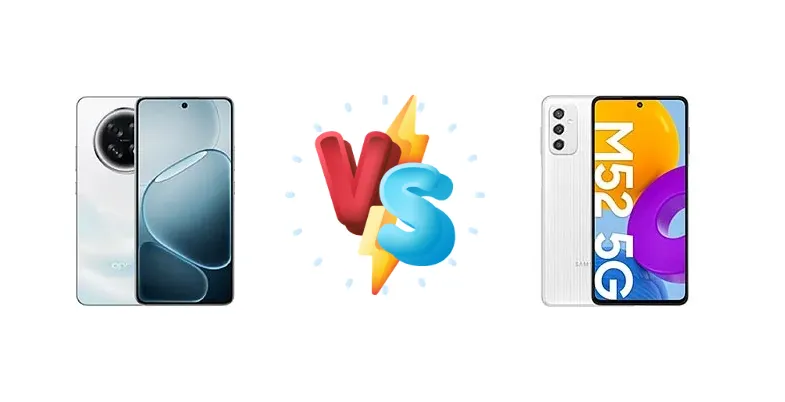
The Oppo F31 Pro+ arrives with a newer generation chipset and blazing-fast 80W charging, challenging the established Samsung Galaxy M52 5G, known for its solid endurance and respectable performance. This comparison dissects the core differences to determine which device offers the best blend of power, longevity, and value in the competitive mid-range 5G space.
🏆 Quick Verdict
For most users, the Oppo F31 Pro+ emerges as the stronger contender. Its Snapdragon 7 Gen 3, built on a 4nm process, provides a noticeable performance edge and improved efficiency, while the 80W charging dramatically reduces downtime. The M52 5G remains a viable option for those prioritizing established brand recognition and potentially longer software support.
| Network |
|---|
| 2G bands | GSM 850 / 900 / 1800 / 1900 | GSM 850 / 900 / 1800 / 1900 |
| 3G bands | HSDPA 900 / 2100 | HSDPA 850 / 900 / 1700(AWS) / 1900 / 2100 |
| 4G bands | 1, 3, 5, 8, 19, 28, 38, 40, 41, 42, 48 | 1, 2, 3, 4, 5, 7, 8, 12, 17, 20, 26, 28, 38, 40, 41, 66 |
| 5G bands | 1, 3, 5, 8, 28, 38, 40, 41, 77, 78 SA/NSA | SA/NSA/Sub6 |
| Speed | HSPA, LTE, 5G | HSPA, LTE, 5G |
| Technology | GSM / HSPA / LTE / 5G | GSM / HSPA / LTE / 5G |
| Launch |
|---|
| Announced | 2025, September 16 | 2021, September 24 |
| Status | Available. Released 2025, September 16 | Available. Released 2021, October 03 |
| Body |
|---|
| Build | - | Glass front (Gorilla Glass 5), plastic frame, plastic back |
| Dimensions | 163.1 x 77.6 x 7.7 mm or 7.9 mm | 164.2 x 76.4 x 7.4 mm (6.46 x 3.01 x 0.29 in) |
| SIM | Nano-SIM + Nano-SIM | Nano-SIM + Nano-SIM |
| Weight | 195 or 204 g (6.88 oz) | 173 g (6.10 oz) |
| Display |
|---|
| Protection | AGC DT-Star D+ | Corning Gorilla Glass 5 |
| Resolution | 1280 x 2800 pixels, 19.5:9 ratio (~453 ppi density) | 1080 x 2400 pixels, 20:9 ratio (~393 ppi density) |
| Size | 6.8 inches, 112.8 cm2 (~89.1% screen-to-body ratio) | 6.7 inches, 108.4 cm2 (~86.4% screen-to-body ratio) |
| Type | AMOLED, 1B colors, 120Hz, 1600 nits (HBM) | Super AMOLED Plus, 120Hz |
| Platform |
|---|
| CPU | Octa-core (1x2.63 GHz Cortex-A715 & 3x2.4 GHz Cortex-A715 & 4x1.8 GHz Cortex-A510) | Octa-core (1x2.4 GHz Cortex-A78 & 3x2.2 GHz Cortex-A78 & 4x1.9 GHz Cortex-A55) |
| Chipset | Qualcomm SM7550-AB Snapdragon 7 Gen 3 (4 nm) | Qualcomm SM7325 Snapdragon 778G 5G (6 nm) |
| GPU | Adreno 720 | Adreno 642L |
| OS | Android 15, ColorOS 15 | Android 11, upgradable to Android 13, One UI 5.1 |
| Memory |
|---|
| Card slot | No | microSDXC (uses shared SIM slot) |
| Internal | 256GB 8GB RAM, 256GB 12GB RAM | 128GB 6GB RAM, 128GB 8GB RAM |
| Main Camera |
|---|
| Dual | 50 MP, f/1.8, (wide), PDAF, OIS
Auxiliary lens | - |
| Features | Color spectrum sensor, LED flash, HDR, panorama | LED flash, panorama, HDR |
| Single | - | 32 MP, f/2.2, 26mm (wide) |
| Triple | - | 64 MP, f/1.8, 26mm (wide), 1/1.97", 0.7um, PDAF
12 MP, f/2.2, 123˚, (ultrawide), 1/3.06", 1.12µm
5 MP (macro) |
| Video | 4K@30fps, 1080p@30/60/120fps, gyro-EIS, OIS | 4K@30fps, 1080p@30/60fps |
| Selfie camera |
|---|
| Features | Panorama | - |
| Single | 32 MP, f/2.4, (wide) | 32 MP, f/2.2, 26mm (wide) |
| Video | 1080p@30fps, gyro-EIS | 4K@30fps, 1080p@30fps |
| Sound |
|---|
| 3.5mm jack | - | No |
| 35mm jack | No | No |
| Loudspeaker | Yes, with stereo speakers | Yes |
| Comms |
|---|
| Bluetooth | 5.2, A2DP, LE, aptX HD | 5.0, A2DP, LE |
| Infrared port | Yes | - |
| NFC | No | Yes |
| Positioning | GPS (L1+L5), BDS (B1I+B1c+B2a), GALILEO (E1+E5a), QZSS (L1+L5), NavIC (L5), GLONASS | GPS, GLONASS, GALILEO, BDS, QZSS |
| Radio | No | Unspecified |
| USB | USB Type-C 2.0, OTG | USB Type-C 2.0, OTG |
| WLAN | Wi-Fi 802.11 a/b/g/n/ac/6, dual-band | Wi-Fi 802.11 a/b/g/n/ac/6, dual-band, Wi-Fi Direct |
| Features |
|---|
| Sensors | Fingerprint (under display, optical), accelerometer, gyro, proximity, compass | Fingerprint (side-mounted), accelerometer, gyro, proximity, compass |
| Battery |
|---|
| Charging | 80W wired, 13.5W PD, 44W UFCS, 33W PPS, 42% in 20 min
10W reverse wired | 25W wired |
| Type | Si/C Li-Ion 7000 mAh | Li-Ion 5000 mAh |
| Misc |
|---|
| Colors | Festival Pink, Himalayan White, Gemstone Blue | Icy Blue, Blazing Black, White |
| Models | CPH2757 | SM-M526BR, SM-M526BR/DS, SM-M526B, SM-M526B/DS |
| Price | About 320 EUR | About 300 EUR |
| SAR | 1.16 W/kg (head) 0.99 W/kg (body) | - |
| SAR EU | - | 0.79 W/kg (head) 1.40 W/kg (body) |
| Tests |
|---|
| Battery life | - |
Endurance rating 123h
|
| Camera | - |
Photo / Video |
| Display | - |
Contrast ratio: Infinite (nominal) |
| Loudspeaker | - |
-30.0 LUFS (Average)
|
| Performance | - |
AnTuTu: 504424 (v9)
GeekBench: 2796 (v5.1)
GFXBench: 28fps (ES 3.1 onscreen) |
Oppo F31 Pro+
- Significantly faster 80W charging
- More efficient Snapdragon 7 Gen 3 (4nm)
- Potentially better sustained performance due to newer architecture
- Limited information on display specifications
- Camera specs are currently unknown
Samsung Galaxy M52 5G
- Excellent battery endurance (123h)
- Bright 777 nit display
- Established brand reputation and support
- Slower 25W charging
- Older Snapdragon 778G (6nm) chipset
- Potential for throttling under heavy load
Display Comparison
The Samsung Galaxy M52 5G boasts a measured peak brightness of 777 nits, ensuring excellent visibility outdoors. While the Oppo F31 Pro+’s display specs are not provided, it’s reasonable to expect a comparable brightness level given its positioning. Both phones feature an 'Infinite' (Samsung) contrast ratio, typical of AMOLED panels. However, the lack of information regarding the Oppo’s panel technology (LTPO, refresh rate) makes a definitive comparison difficult. The M52 5G’s display is a known quantity, offering a vibrant and easily viewable experience.
Camera Comparison
Both devices offer photo and video capabilities, but detailed camera specifications are limited. Without sensor size, aperture, or OIS details, a direct comparison is challenging. However, the market segment suggests both will rely on computational photography to enhance image quality. The absence of information regarding the Oppo’s camera system makes it difficult to assess its strengths. The M52 5G likely benefits from Samsung’s established image processing algorithms, but the Oppo could potentially offer a more modern sensor and software stack.
Performance
The core difference lies in the chipsets. The Oppo F31 Pro+ utilizes the Qualcomm Snapdragon 7 Gen 3 (4nm), featuring a Cortex-A715 prime core clocked at 2.63 GHz. This contrasts with the Samsung Galaxy M52 5G’s Snapdragon 778G 5G (6nm) and its Cortex-A78 prime core at 2.4 GHz. The 4nm fabrication process of the 7 Gen 3 translates to improved power efficiency and thermal management compared to the 6nm 778G. The Oppo’s CPU configuration (1x2.63GHz + 3x2.4GHz + 4x1.8GHz) suggests a focus on sustained performance, while the M52 5G’s (1x2.4GHz + 3x2.2GHz + 4x1.9GHz) may exhibit more throttling under prolonged heavy loads. The newer architecture of the 7 Gen 3 should deliver a tangible performance boost in demanding applications and games.
Battery Life
The Samsung Galaxy M52 5G achieves an impressive endurance rating of 123 hours, indicating excellent battery life. However, the Oppo F31 Pro+ compensates with its groundbreaking 80W wired charging. While the M52 5G is limited to 25W charging, the F31 Pro+ supports 80W, 13.5W PD, 44W UFCS, and 33W PPS, achieving a 42% charge in just 20 minutes. This drastically reduces charging time, effectively mitigating any potential battery capacity disadvantage. The Oppo’s inclusion of 10W reverse wired charging is also a useful addition.
Buying Guide
Buy the Oppo F31 Pro+ if you prioritize raw performance for gaming and multitasking, and value incredibly fast charging speeds. This phone is ideal for users who are constantly on the go and need to minimize downtime. Buy the Samsung Galaxy M52 5G if you prefer a phone with a proven track record for battery endurance and a potentially wider availability of service and support, and aren't as concerned with having the absolute latest chipset.
Frequently Asked Questions
❓ Will the Snapdragon 778G in the Samsung Galaxy M52 5G struggle with demanding games like Genshin Impact?
The Snapdragon 778G is capable of running Genshin Impact, but you may need to lower graphics settings to maintain a stable frame rate. The 6nm process can lead to thermal throttling during extended gaming sessions, potentially causing performance dips. The Oppo F31 Pro+'s Snapdragon 7 Gen 3, with its 4nm process, is better equipped to handle sustained gaming loads.
❓ How long does it *actually* take to fully charge the Oppo F31 Pro+ with the 80W charger?
While Oppo claims a 42% charge in 20 minutes, a full 0-100% charge is estimated to take around 30-35 minutes. This is a significant improvement over the Samsung Galaxy M52 5G’s 25W charging, which would likely take well over an hour to fully replenish the battery.
❓ Does the Samsung Galaxy M52 5G support carrier aggregation for improved 5G speeds?
Yes, the Snapdragon 778G supports carrier aggregation, allowing the M52 5G to combine multiple 5G bands for faster and more reliable connectivity, provided your carrier supports it. The Oppo F31 Pro+'s 7 Gen 3 also supports carrier aggregation, so this isn't a differentiating factor.