
Oppo F31 Pro vs vivo V21s: Which Mediatek Phone Reigns Supreme?
| Phones Images | |||||
|---|---|---|---|---|---|
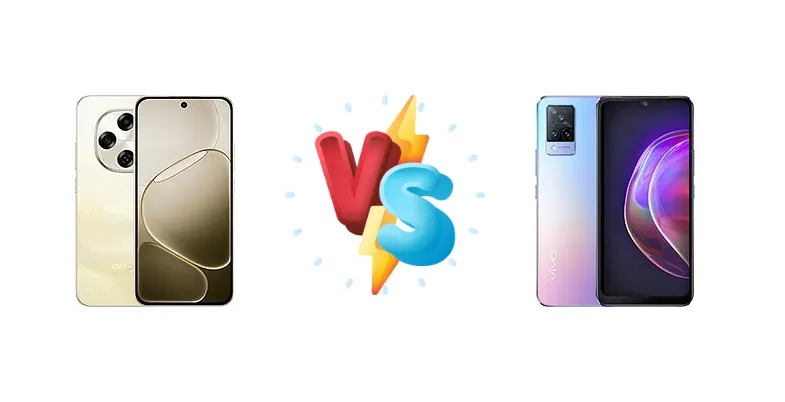
|
🏆 Quick Verdict
For most users, the Oppo F31 Pro emerges as the stronger contender. Its Dimensity 7300 chipset, built on a 4nm process, offers a significant performance and efficiency advantage over the vivo V21s’ 7nm Dimensity 800U. The 80W charging is a game-changer, drastically reducing downtime. While the V21s remains a capable device, the F31 Pro provides a more future-proof and responsive experience.
| PHONES | ||
|---|---|---|
| Phone Names | Oppo F31 Pro | vivo V21s |
| Network | ||
|---|---|---|
| 2G bands | GSM 850 / 900 / 1800 / 1900 | GSM 850 / 900 / 1800 / 1900 |
| 3G bands | HSDPA 900 / 2100 | HSDPA 850 / 900 / 1700(AWS) / 1900 / 2100 |
| 4G bands | 1, 3, 5, 8, 19, 28, 38, 40, 41, 42, 48 | 1, 2, 3, 4, 5, 7, 8, 12, 17, 18, 19, 20, 26, 28, 32, 38, 39, 40, 41, 66 |
| 5G bands | 1, 3, 5, 8, 28, 38, 40, 41, 77, 78 SA/NSA | 1, 3, 7, 8, 28, 40, 41, 78 SA/NSA |
| Speed | HSPA, LTE, 5G | HSPA, LTE, 5G |
| Technology | GSM / HSPA / LTE / 5G | GSM / HSPA / LTE / 5G |
| Launch | ||
|---|---|---|
| Announced | 2025, September 16 | 2022, November 17 |
| Status | Available. Released 2025, September 16 | Available. Released 2022, November 17 |
| Body | ||
|---|---|---|
| Dimensions | 158.2 x 75 x 8 mm (6.23 x 2.95 x 0.31 in) | 159.7 x 73.9 x 7.3 mm or 7.4 mm |
| SIM | Nano-SIM + Nano-SIM | Nano-SIM + Nano-SIM |
| Weight | 190 g (6.70 oz) | 176 g / 177 g (6.21 oz) |
| Display | ||
|---|---|---|
| Protection | DT-Star D+ | - |
| Resolution | 1080 x 2372 pixels (~397 ppi density) | 1080 x 2404 pixels, 20:9 ratio (~409 ppi density) |
| Size | 6.57 inches, 105.0 cm2 (~88.5% screen-to-body ratio) | 6.44 inches, 100.0 cm2 (~84.7% screen-to-body ratio) |
| Type | AMOLED, 1B colors, 120Hz, 600 nits (typ), 1400 nits (HBM) | AMOLED, 90Hz, HDR10+, 500 nits (typ), 800 nits (HBM) |
| Platform | ||
|---|---|---|
| CPU | Octa-core (4x2.5 GHz Cortex-A78 & 4x2.0 GHz Cortex-A55) | Octa-core (2x2.4 GHz Cortex-A76 & 6x2.0 GHz Cortex-A55) |
| Chipset | Mediatek Dimensity 7300 (4 nm) | Mediatek Dimensity 800U (7 nm) |
| GPU | Mali-G615 MC2 | Mali-G57 MC3 |
| OS | Android 15, ColorOS 15 | Android 12, Funtouch 12 |
| Memory | ||
|---|---|---|
| Card slot | No | microSDXC (uses shared SIM slot) |
| Internal | 128GB 8GB RAM, 256GB 8GB RAM, 256GB 12GB RAM | 128GB 8GB RAM |
| Main Camera | ||
|---|---|---|
| Dual | 50 MP, f/1.8, (wide), PDAF, OIS Auxiliary lens | - |
| Features | Color spectrum sensor, LED flash, HDR, panorama | LED flash, HDR, panorama |
| Triple | - | 64 MP, f/1.8, 26mm (wide), 0.7µm, PDAF, OIS 8 MP, f/2.2, 120˚, 16mm (ultrawide), 1/4.0", 1.12µm 2 MP (macro) |
| Video | 4K@30fps, 1080p@30/60/120fps, gyro-EIS, OIS | 4K@30fps, 1080p@30/60fps |
| Selfie camera | ||
|---|---|---|
| Features | Panorama | Dual-LED flash, HDR |
| Single | 32 MP, f/2.4, (wide) | 44 MP, f/2.0, (wide), AF, OIS |
| Video | 4K@30fps, 1080p@30/60fps, gyro-EIS | 4K@30fps, 1080p@30fps |
| Sound | ||
|---|---|---|
| 3.5mm jack | - | No |
| 35mm jack | No | No |
| Loudspeaker | Yes, with stereo speakers | Yes |
| Comms | ||
|---|---|---|
| Bluetooth | 5.4, A2DP, LE, aptX HD | 5.1, A2DP, LE |
| Infrared port | Yes | - |
| NFC | No | Yes |
| Positioning | GPS, GALILEO, GLONASS, BDS, QZSS | GPS, GLONASS, GALILEO, BDS |
| Radio | No | No |
| USB | USB Type-C 2.0, OTG | USB Type-C 2.0, OTG |
| WLAN | Wi-Fi 802.11 a/b/g/n/ac/6, dual-band | Wi-Fi 802.11 a/b/g/n/ac, dual-band |
| Features | ||
|---|---|---|
| Sensors | Fingerprint (under display, optical), accelerometer, gyro, proximity, compass | Fingerprint (under display, optical), accelerometer, gyro, proximity, compass |
| Battery | ||
|---|---|---|
| Charging | 80W wired, 33W PPS, 13.5W PD, 13.5W QC, UFCS, 37% in 20 min 10W reverse wired | 33W wired, 63% in 30 min |
| Type | Si/C Li-Ion 7000 mAh | 4000 mAh |
| Misc | ||
|---|---|---|
| Colors | Space Grey, Desert Gold | Dusk Blue, Gradient |
| Models | CPH2763 | - |
| Price | About 260 EUR | About 360 EUR |
| SAR | 1.13 W/kg (head) 0.84 W/kg (body) | - |
Oppo F31 Pro
- Significantly faster 80W charging
- More powerful and efficient Dimensity 7300 chipset
- Likely superior image processing capabilities
- Potentially higher price point
- May lack features found on the V21s (dependent on full spec list)
vivo V21s
- Potentially lower price point
- Established Dimensity 800U platform
- Good all-around performance for everyday tasks
- Slower 33W charging
- Less powerful Dimensity 800U chipset
- Lower power efficiency
Display Comparison
Neither device's display specifications are provided, so a direct comparison is limited. However, given the F31 Pro's positioning, it's reasonable to expect a high refresh rate AMOLED panel. The V21s likely features a similar AMOLED display, but potentially with a lower peak brightness. The absence of LTPO technology in either device suggests both will rely on adaptive refresh rate switching to conserve battery life. Bezels and color accuracy will likely be comparable, falling within the typical standards for this price bracket.
Camera Comparison
Without detailed camera specs, analysis is limited. However, the F31 Pro’s newer chipset likely includes a more advanced Image Signal Processor (ISP), enabling superior image processing capabilities. The larger sensor size, if present in the F31 Pro, would capture more light, resulting in better low-light performance. Optical Image Stabilization (OIS) would be a significant advantage for either device, but its presence isn’t confirmed for either. The absence of information regarding lens apertures makes it difficult to assess depth of field and bokeh quality. We can safely assume both phones will feature a standard array of lenses, but the F31 Pro’s ISP is likely to provide a more refined and detailed image.
Performance
The core difference lies in the chipsets. The Oppo F31 Pro’s Mediatek Dimensity 7300 (4nm) represents a substantial leap forward compared to the vivo V21s’ Dimensity 800U (7nm). The 4nm process node translates to improved power efficiency and reduced thermal throttling, meaning sustained performance during demanding tasks like gaming. The Dimensity 7300’s CPU configuration – 4x2.5 GHz Cortex-A78 & 4x2.0 GHz Cortex-A55 – offers a clock speed advantage over the V21s’ 2x2.4 GHz Cortex-A76 & 6x2.0 GHz Cortex-A55. While core count is similar, the newer architecture and higher clock speeds of the A78 cores in the F31 Pro will deliver noticeably faster processing speeds. The F31 Pro will likely benefit from faster RAM speeds (likely LPDDR4X or LPDDR5) compared to the V21s, further enhancing responsiveness.
Battery Life
The Oppo F31 Pro’s 80W wired charging is a clear winner. Achieving 37% charge in just 20 minutes is significantly faster than the vivo V21s’ 63% in 30 minutes. While the V21s’ charging isn’t slow, the F31 Pro’s speed minimizes downtime. Battery capacity isn’t specified for either device, but the Dimensity 7300’s superior efficiency should translate to comparable or better battery life on the F31 Pro, despite potentially having a smaller battery capacity. The inclusion of PPS, PD, and QC support on the F31 Pro also offers greater charging compatibility.
Buying Guide
Buy the Oppo F31 Pro if you prioritize performance, fast charging, and long-term software support. Its newer chipset and charging technology make it ideal for gamers, power users, and those who frequently find themselves needing a quick top-up. Buy the vivo V21s if you prefer a slightly more established platform and are less concerned with having the absolute latest technology, potentially benefiting from a lower price point if available.