
Oppo F31 Pro vs Samsung Galaxy A52s 5G: A Deep Dive into Mid-Range Power
| Phones Images | |||||
|---|---|---|---|---|---|
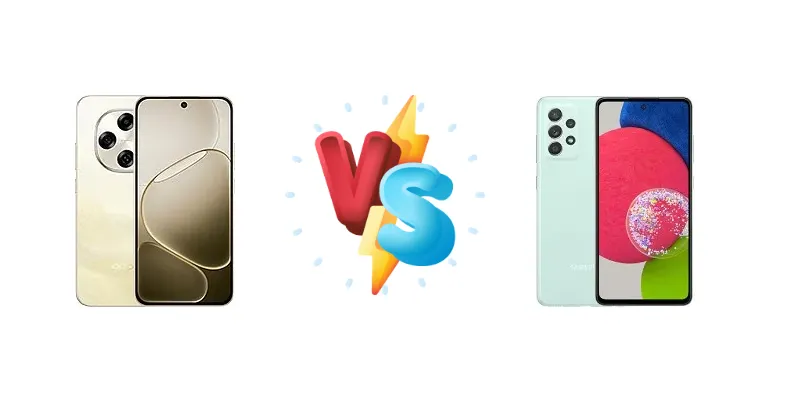
|
🏆 Quick Verdict
For the average user prioritizing rapid charging and potentially better long-term performance, the Oppo F31 Pro emerges as the winner. Its 80W charging and newer Dimensity 7300 chipset offer a significant advantage, despite the A52s 5G's established endurance rating and proven track record.
| PHONES | ||
|---|---|---|
| Phone Names | Oppo F31 Pro | Samsung Galaxy A52s 5G |
| Network | ||
|---|---|---|
| 2G bands | GSM 850 / 900 / 1800 / 1900 | GSM 850 / 900 / 1800 / 1900 |
| 3G bands | HSDPA 900 / 2100 | HSDPA 850 / 900 / 1700(AWS) / 1900 / 2100 |
| 4G bands | 1, 3, 5, 8, 19, 28, 38, 40, 41, 42, 48 | 1, 2, 3, 4, 5, 7, 8, 12, 17, 20, 26, 28, 32, 38, 40, 41, 66 |
| 5G bands | 1, 3, 5, 8, 28, 38, 40, 41, 77, 78 SA/NSA | 1, 3, 5, 7, 8, 20, 28, 38, 40, 41, 66, 78 SA/NSA/Sub6 |
| Speed | HSPA, LTE, 5G | HSPA 42.2/5.76 Mbps, LTE Cat18 1200/150 Mbps, 5G |
| Technology | GSM / HSPA / LTE / 5G | GSM / HSPA / LTE / 5G |
| Launch | ||
|---|---|---|
| Announced | 2025, September 16 | 2021, August 17 |
| Status | Available. Released 2025, September 16 | Available. Released 2021, September 01 |
| Body | ||
|---|---|---|
| Build | - | Glass front (Gorilla Glass 5), plastic back |
| Dimensions | 158.2 x 75 x 8 mm (6.23 x 2.95 x 0.31 in) | 159.9 x 75.1 x 8.4 mm (6.30 x 2.96 x 0.33 in) |
| SIM | Nano-SIM + Nano-SIM | · Nano-SIM· Nano-SIM + Nano-SIM |
| Weight | 190 g (6.70 oz) | 189 g (6.67 oz) |
| - | IP67 dust/water resistant (up to 1m for 30 min) | |
| Display | ||
|---|---|---|
| Protection | DT-Star D+ | Corning Gorilla Glass 5 |
| Resolution | 1080 x 2372 pixels (~397 ppi density) | 1080 x 2400 pixels, 20:9 ratio (~405 ppi density) |
| Size | 6.57 inches, 105.0 cm2 (~88.5% screen-to-body ratio) | 6.5 inches, 102.0 cm2 (~84.9% screen-to-body ratio) |
| Type | AMOLED, 1B colors, 120Hz, 600 nits (typ), 1400 nits (HBM) | Super AMOLED, 120Hz, 800 nits (HBM) |
| Platform | ||
|---|---|---|
| CPU | Octa-core (4x2.5 GHz Cortex-A78 & 4x2.0 GHz Cortex-A55) | Octa-core (1x2.4 GHz Cortex-A78 & 3x2.2 GHz Cortex-A78 & 4x1.9 GHz Cortex-A55) |
| Chipset | Mediatek Dimensity 7300 (4 nm) | Qualcomm SM7325 Snapdragon 778G 5G (6 nm) |
| GPU | Mali-G615 MC2 | Adreno 642L |
| OS | Android 15, ColorOS 15 | Android 11, upgradable to Android 14, One UI 6 |
| Memory | ||
|---|---|---|
| Card slot | No | microSDXC (uses shared SIM slot) |
| Internal | 128GB 8GB RAM, 256GB 8GB RAM, 256GB 12GB RAM | 128GB 4GB RAM, 128GB 6GB RAM, 128GB 8GB RAM, 256GB 6GB RAM, 256GB 8GB RAM |
| Main Camera | ||
|---|---|---|
| Dual | 50 MP, f/1.8, (wide), PDAF, OIS Auxiliary lens | - |
| Features | Color spectrum sensor, LED flash, HDR, panorama | LED flash, panorama, HDR |
| Quad | - | 64 MP, f/1.8, 26mm (wide), 1/1.7", 0.8µm, PDAF, OIS 12 MP, f/2.2, 123˚ (ultrawide), 1.12µm 5 MP (macro) Auxiliary lens |
| Single | - | 32 MP, f/2.2, 26mm (wide), 1/2.8", 0.8µm |
| Video | 4K@30fps, 1080p@30/60/120fps, gyro-EIS, OIS | 4K@30fps, 1080p@30/60fps; gyro-EIS |
| Selfie camera | ||
|---|---|---|
| Features | Panorama | HDR |
| Single | 32 MP, f/2.4, (wide) | 32 MP, f/2.2, 26mm (wide), 1/2.8", 0.8µm |
| Video | 4K@30fps, 1080p@30/60fps, gyro-EIS | 4K@30fps, 1080p@30/60fps |
| Sound | ||
|---|---|---|
| 3.5mm jack | - | Yes |
| 35mm jack | No | Yes |
| Loudspeaker | Yes, with stereo speakers | Yes, with stereo speakers |
| Comms | ||
|---|---|---|
| Bluetooth | 5.4, A2DP, LE, aptX HD | 5.0, A2DP, LE |
| Infrared port | Yes | - |
| NFC | No | Yes (market/region dependent) |
| Positioning | GPS, GALILEO, GLONASS, BDS, QZSS | GPS, GLONASS, GALILEO, BDS, QZSS |
| Radio | No | No |
| USB | USB Type-C 2.0, OTG | USB Type-C 2.0, OTG |
| WLAN | Wi-Fi 802.11 a/b/g/n/ac/6, dual-band | Wi-Fi 802.11 a/b/g/n/ac/6, dual-band, Wi-Fi Direct |
| Features | ||
|---|---|---|
| Sensors | Fingerprint (under display, optical), accelerometer, gyro, proximity, compass | Fingerprint (under display, optical), accelerometer, gyro, compass |
| - | Virtual Proximity Sensing | |
| Battery | ||
|---|---|---|
| Charging | 80W wired, 33W PPS, 13.5W PD, 13.5W QC, UFCS, 37% in 20 min 10W reverse wired | 25W wired |
| Type | Si/C Li-Ion 7000 mAh | Li-Ion 4500 mAh |
| Misc | ||
|---|---|---|
| Colors | Space Grey, Desert Gold | Awesome Black, Awesome White, Awesome Purple, Awesome Mint |
| Models | CPH2763 | SM-A528B, SM-A528B/DS, SM-A528N |
| Price | About 260 EUR | £ 112.98 / € 249.47 |
| SAR | 1.13 W/kg (head) 0.84 W/kg (body) | 0.72 W/kg (head) |
| SAR EU | - | 0.88 W/kg (head) 0.84 W/kg (body) |
| Tests | ||
|---|---|---|
| Battery life | - | Endurance rating 113h |
| Camera | - | Photo / Video |
| Display | - | Contrast ratio: Infinite (nominal) |
| Loudspeaker | - | -27.5 LUFS (Good) |
| Performance | - | AnTuTu: 429675 (v8), 506432(v9) GeekBench: 11060 (v4.4), 2801 (v5.1) GFXBench: 28fps (ES 3.1 onscreen) |
Oppo F31 Pro
- Significantly faster 80W charging
- More efficient 4nm Dimensity 7300 chipset
- Wider charging protocol support (PPS, PD, QC, UFCS)
- Display specifications are unknown
- Camera details are lacking
Samsung Galaxy A52s 5G
- Proven 113-hour endurance rating
- 800 nits peak brightness for good outdoor visibility
- Well-established software ecosystem
- Slower 25W charging
- Less efficient 6nm Snapdragon 778G chipset
- Potential for thermal throttling under sustained load
Display Comparison
The Samsung Galaxy A52s 5G boasts a measured peak brightness of 800 nits, ensuring good visibility outdoors. While the Oppo F31 Pro’s display specifications aren’t provided, Samsung’s display benefits from an 'Infinite' contrast ratio, suggesting deep blacks. Without knowing the panel technology of the F31 Pro (OLED vs LCD), it’s difficult to assess color accuracy, but the A52s 5G’s Super AMOLED panel is known for vibrant colors. The lack of refresh rate information for the F31 Pro is a key omission, potentially giving the A52s 5G an edge if it supports a higher refresh rate.
Camera Comparison
Both devices are listed as having 'Photo / Video' capabilities, lacking specific details. However, the image processing philosophies of Oppo and Samsung differ significantly. Samsung typically favors vibrant, saturated colors, while Oppo often aims for a more natural look. Without sensor size or aperture information, it’s impossible to definitively declare a winner. The presence of OIS (Optical Image Stabilization) on either device would be a crucial advantage for low-light photography and video recording, but this is not specified. Ignoring the likely low-resolution macro lenses common in this segment, the main sensor performance will be the deciding factor.
Performance
The core difference lies in the chipsets: the Oppo F31 Pro utilizes the Mediatek Dimensity 7300 (4nm) while the Samsung Galaxy A52s 5G features the Qualcomm SM7325 Snapdragon 778G 5G (6nm). The Dimensity 7300’s 4nm process node is a significant advantage, promising superior power efficiency and potentially lower thermal throttling compared to the 6nm Snapdragon 778G. The CPU architecture also differs; the F31 Pro employs four Cortex-A78 cores clocked at 2.5GHz alongside four Cortex-A55 cores, while the A52s 5G has one Cortex-A78 at 2.4GHz and *three* additional Cortex-A78 cores at 2.2GHz, plus four Cortex-A55 cores. This suggests the A52s 5G might excel in multi-threaded tasks, but the F31 Pro’s newer architecture and smaller node should provide better single-core performance and efficiency. The A52s 5G’s LPDDR5 RAM is standard for its class, but the F31 Pro’s RAM specification is unknown.
Battery Life
The Samsung Galaxy A52s 5G has an endurance rating of 113 hours, indicating solid battery life. However, the Oppo F31 Pro’s 80W wired charging is a game-changer. It can reportedly reach 37% charge in just 20 minutes, significantly faster than the A52s 5G’s 25W charging. While the A52s 5G’s endurance rating suggests it can last a full day for many users, the F31 Pro’s rapid charging mitigates range anxiety. The F31 Pro also supports 33W PPS, 13.5W PD, 13.5W QC, and UFCS, offering broader compatibility with various chargers, and even 10W reverse wired charging.
Buying Guide
Buy the Oppo F31 Pro if you need blazing-fast charging, prioritize future-proofing with a newer chipset, and frequently engage in power-intensive tasks. Buy the Samsung Galaxy A52s 5G if you value a well-established platform with a known endurance rating, prefer a potentially more refined software experience, and aren't as concerned about the absolute fastest charging speeds.