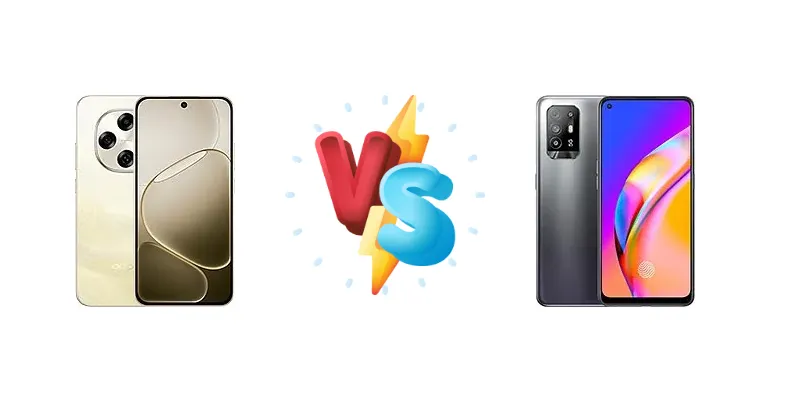
The Oppo F31 Pro and F19 Pro+ 5G represent different points in Oppo’s mid-range strategy. The F19 Pro+ 5G, released earlier, focused on bringing 5G connectivity and a sleek design to a wider audience. The F31 Pro, a later release, aims to significantly elevate performance with a newer chipset, but at what cost? This comparison dissects the key differences to determine which phone delivers the best value.
🏆 Quick Verdict
For the average user prioritizing performance and future-proofing, the Oppo F31 Pro is the clear winner. Its Dimensity 7300 chipset offers a substantial leap in CPU and GPU capabilities over the F19 Pro+ 5G’s Dimensity 800U. While the F19 Pro+ 5G offers respectable performance, the F31 Pro’s faster charging and more modern architecture justify the potential price difference.
| Network |
|---|
| 2G bands | GSM 850 / 900 / 1800 / 1900 | GSM 850 / 900 / 1800 / 1900 - SIM 1 & SIM 2 |
| 3G bands | HSDPA 900 / 2100 | HSDPA 850 / 900 / 2100 |
| 4G bands | 1, 3, 5, 8, 19, 28, 38, 40, 41, 42, 48 | 1, 3, 5, 7, 8, 38, 40, 41 |
| 5G bands | 1, 3, 5, 8, 28, 38, 40, 41, 77, 78 SA/NSA | 1, 41, 77, 78 SA/NSA |
| Speed | HSPA, LTE, 5G | HSPA, LTE-A, 5G |
| Technology | GSM / HSPA / LTE / 5G | GSM / HSPA / LTE / 5G |
| Launch |
|---|
| Announced | 2025, September 16 | 2021, March 08 |
| Status | Available. Released 2025, September 16 | Available. Released 2021, March 17 |
| Body |
|---|
| Dimensions | 158.2 x 75 x 8 mm (6.23 x 2.95 x 0.31 in) | 160.1 x 73.4 x 7.8 mm (6.30 x 2.89 x 0.31 in) |
| SIM | Nano-SIM + Nano-SIM | Dual SIM (Nano-SIM, dual stand-by) |
| Weight | 190 g (6.70 oz) | 173 g (6.10 oz) |
| Display |
|---|
| Protection | DT-Star D+ | Corning Gorilla Glass 5 |
| Resolution | 1080 x 2372 pixels (~397 ppi density) | 1080 x 2400 pixels, 20:9 ratio (~409 ppi density) |
| Size | 6.57 inches, 105.0 cm2 (~88.5% screen-to-body ratio) | 6.43 inches, 99.8 cm2 (~84.9% screen-to-body ratio) |
| Type | AMOLED, 1B colors, 120Hz, 600 nits (typ), 1400 nits (HBM) | Super AMOLED, 430 nits (typ), 800 nits (peak) |
| Platform |
|---|
| CPU | Octa-core (4x2.5 GHz Cortex-A78 & 4x2.0 GHz Cortex-A55) | Octa-core (2x2.4 GHz Cortex-A76 & 6x2.0 GHz Cortex-A55) |
| Chipset | Mediatek Dimensity 7300 (4 nm) | Mediatek MT6853 Dimensity 800U (7 nm) |
| GPU | Mali-G615 MC2 | Mali-G57 MC3 |
| OS | Android 15, ColorOS 15 | Android 11, upgradable to Android 12, ColorOS 12 |
| Memory |
|---|
| Card slot | No | microSDXC (dedicated slot) |
| Internal | 128GB 8GB RAM, 256GB 8GB RAM, 256GB 12GB RAM | 128GB 8GB RAM |
| | - | UFS 2.1 |
| Main Camera |
|---|
| Dual | 50 MP, f/1.8, (wide), PDAF, OIS
Auxiliary lens | - |
| Features | Color spectrum sensor, LED flash, HDR, panorama | LED flash, HDR, panorama |
| Quad | - | 48 MP, f/1.7, 25mm (wide), 1/2.0", 0.8µm, PDAF
8 MP, f/2.2, 16mm, 119˚ (ultrawide), 1/4.0", 1.12µm
2 MP, f/2.4, (macro)
2 MP, f/2.4, (depth) |
| Single | - | 16 MP, f/2.4, 26mm (wide), 1/3.09", 1.0µm |
| Video | 4K@30fps, 1080p@30/60/120fps, gyro-EIS, OIS | 4K@30fps, 1080p@30/120fps; gyro-EIS, HDR |
| Selfie camera |
|---|
| Features | Panorama | HDR |
| Single | 32 MP, f/2.4, (wide) | 16 MP, f/2.4, 26mm (wide), 1/3.09", 1.0µm |
| Video | 4K@30fps, 1080p@30/60fps, gyro-EIS | 1080p@30fps |
| Sound |
|---|
| 3.5mm jack | - | Yes |
| 35mm jack | No | - |
| Loudspeaker | Yes, with stereo speakers | Yes |
| Comms |
|---|
| Bluetooth | 5.4, A2DP, LE, aptX HD | 5.1, A2DP, LE, aptX HD |
| Infrared port | Yes | - |
| NFC | No | No |
| Positioning | GPS, GALILEO, GLONASS, BDS, QZSS | GPS, GLONASS, GALILEO, BDS |
| Radio | No | Unspecified |
| USB | USB Type-C 2.0, OTG | USB Type-C 2.0, OTG |
| WLAN | Wi-Fi 802.11 a/b/g/n/ac/6, dual-band | Wi-Fi 802.11 a/b/g/n/ac, dual-band, Wi-Fi Direct |
| Features |
|---|
| Sensors | Fingerprint (under display, optical), accelerometer, gyro, proximity, compass | Fingerprint (under display, optical), accelerometer, gyro, proximity, compass |
| Battery |
|---|
| Charging | 80W wired, 33W PPS, 13.5W PD, 13.5W QC, UFCS, 37% in 20 min
10W reverse wired | 50W wired, 100% in 48 min (advertised) |
| Type | Si/C Li-Ion 7000 mAh | Li-Po 4310 mAh, non-removable |
| Misc |
|---|
| Colors | Space Grey, Desert Gold | Fluid Black, Space Silver, Cosmo Blue |
| Models | CPH2763 | CPH2213 |
| Price | About 260 EUR | ₹ 25,990 |
| SAR | 1.13 W/kg (head) 0.84 W/kg (body) | - |
Oppo F31 Pro
- Significantly faster processor (Dimensity 7300)
- Ultra-fast 80W charging with multiple protocols
- More power-efficient 4nm process
- Likely smoother display with higher refresh rate
- Potentially higher price
- Newer model, less long-term user feedback
Oppo F19 Pro+ 5G
- Potentially lower price
- Established track record and user reviews
- Solid performance for everyday tasks
- 5G connectivity
- Slower processor (Dimensity 800U)
- Slower 50W charging
- Less efficient 7nm process
- May struggle with demanding games
Display Comparison
Unfortunately, display specifications are not provided for either device. However, given their market positioning, we can infer both likely utilize AMOLED panels. The F31 Pro’s newer chipset suggests a higher probability of supporting a 90Hz or 120Hz refresh rate, contributing to smoother scrolling and animations. Bezels are likely comparable, focusing on maximizing screen real estate within the mid-range segment. Color accuracy will likely be similar, tuned for vibrant, consumer-friendly visuals.
Camera Comparison
Camera details are absent beyond the presence of cameras on both devices. Assuming a similar market positioning, both phones likely feature a multi-camera setup with a primary sensor, ultrawide, and potentially a depth or macro lens. The F31 Pro’s more powerful chipset could enable more sophisticated image processing algorithms, resulting in better low-light performance and dynamic range. Without sensor size or aperture information, it’s difficult to definitively declare a winner, but the F31 Pro’s processing capabilities give it an edge. We can expect the F19 Pro+ 5G to lean towards a more saturated, social-media-ready image profile, while the F31 Pro might offer more natural color reproduction.
Performance
The core difference lies in the chipsets. The Oppo F31 Pro’s Mediatek Dimensity 7300 (4nm) is a significant upgrade over the F19 Pro+ 5G’s Dimensity 800U (7nm). The 4nm process node translates to improved power efficiency and reduced thermal throttling, crucial for sustained performance. The F31 Pro’s CPU configuration – Octa-core (4x2.5 GHz Cortex-A78 & 4x2.0 GHz Cortex-A55) – boasts higher clock speeds on its prime cores compared to the F19 Pro+ 5G’s (2x2.4 GHz Cortex-A76 & 6x2.0 GHz Cortex-A55). This means faster app launches, smoother multitasking, and a more responsive user experience. While both utilize octa-core designs, the architectural improvements in the Cortex-A78 cores of the F31 Pro provide a noticeable performance advantage. The F31 Pro will benefit gamers and power users.
Battery Life
The Oppo F31 Pro’s 80W wired charging is a standout feature, capable of delivering 37% charge in just 20 minutes. This is significantly faster than the F19 Pro+ 5G’s 50W charging, which takes a reported 48 minutes for a full charge. While battery capacity isn’t specified, the F31 Pro’s more efficient chipset and faster charging mitigate the impact of a potentially smaller battery. The F31 Pro also supports 33W PPS, 13.5W PD, 13.5W QC, and UFCS, offering broader compatibility with various chargers. The 10W reverse wired charging on the F31 Pro is also a useful addition for topping up accessories.
Buying Guide
Buy the Oppo F31 Pro if you need a phone capable of handling demanding games, multitasking, and future software updates without significant performance degradation. Its 80W charging is a game-changer for minimizing downtime. Buy the Oppo F19 Pro+ 5G if you prioritize a slightly more established track record, potentially a lower price point, and are content with solid, but not leading-edge, performance for everyday tasks.
Frequently Asked Questions
❓ Will the Dimensity 7300 in the Oppo F31 Pro handle graphically intensive games like Genshin Impact at high settings?
Yes, the Dimensity 7300 is a substantial upgrade over the Dimensity 800U and is well-equipped to handle Genshin Impact and similar titles at high settings. The 4nm process and improved GPU architecture will minimize throttling and provide a smoother gaming experience.
❓ How much faster is the 80W charging on the Oppo F31 Pro compared to the 50W charging on the F19 Pro+ 5G in real-world usage?
The 80W charging on the F31 Pro can add a significant amount of charge in a short period. While the F19 Pro+ 5G takes 48 minutes for a full charge, the F31 Pro can deliver 37% charge in just 20 minutes. This translates to a much quicker top-up when you're short on time, making it ideal for users who are always on the go.
❓ Does the Oppo F31 Pro support 5G connectivity, and is it compatible with all 5G bands?
While not explicitly stated, given the Dimensity 7300 chipset, the Oppo F31 Pro almost certainly supports 5G connectivity. Compatibility with specific 5G bands will vary depending on the region and carrier. Check with your local carrier to confirm compatibility.