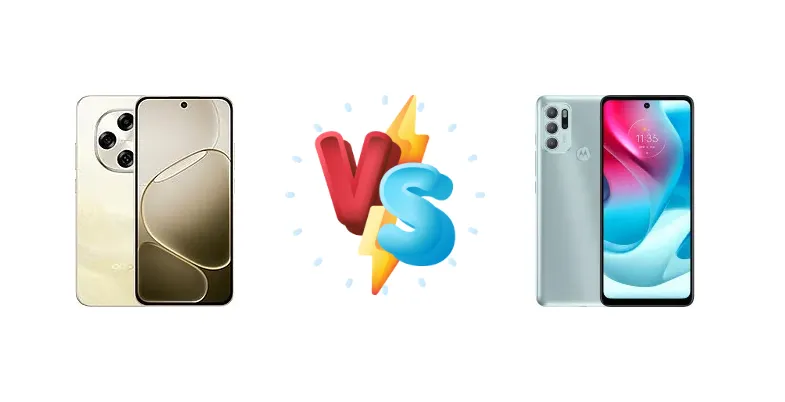
The Oppo F31 Pro and Motorola Moto G60S represent compelling options in the increasingly competitive mid-range smartphone market. The F31 Pro boasts a newer, more efficient chipset and blazing-fast charging, while the G60S aims to deliver solid gaming performance at a potentially lower price point. This comparison dissects their key differences to help you choose the right device.
🏆 Quick Verdict
For most users, the Oppo F31 Pro emerges as the superior choice. Its Mediatek Dimensity 7300 chipset, built on a 4nm process, offers a significant performance and efficiency advantage over the Moto G60S’s 12nm Helio G95. The 80W charging is a game-changer, drastically reducing downtime.
| Network |
|---|
| 2G bands | GSM 850 / 900 / 1800 / 1900 | GSM 850 / 900 / 1800 / 1900 |
| 3G bands | HSDPA 900 / 2100 | HSDPA 850 / 900 / 1700(AWS) / 1900 / 2100 |
| 4G bands | 1, 3, 5, 8, 19, 28, 38, 40, 41, 42, 48 | 1, 2, 3, 4, 5, 7, 8, 12, 13, 17, 28, 40, 66 |
| 5G bands | 1, 3, 5, 8, 28, 38, 40, 41, 77, 78 SA/NSA | - |
| Speed | HSPA, LTE, 5G | HSPA, LTE |
| Technology | GSM / HSPA / LTE / 5G | GSM / HSPA / LTE |
| Launch |
|---|
| Announced | 2025, September 16 | 2021, August 12 |
| Status | Available. Released 2025, September 16 | Available. Released 2021, August 12 |
| Body |
|---|
| Build | - | Glass front, plastic frame, plastic back |
| Dimensions | 158.2 x 75 x 8 mm (6.23 x 2.95 x 0.31 in) | 169.7 x 75.9 x 9.6 mm (6.68 x 2.99 x 0.38 in) |
| SIM | Nano-SIM + Nano-SIM | Nano-SIM + Nano-SIM |
| Weight | 190 g (6.70 oz) | 212 g (7.48 oz) |
| | - | Water repellent design |
| Display |
|---|
| Protection | DT-Star D+ | - |
| Resolution | 1080 x 2372 pixels (~397 ppi density) | 1080 x 2460 pixels (~395 ppi density) |
| Size | 6.57 inches, 105.0 cm2 (~88.5% screen-to-body ratio) | 6.8 inches, 109.8 cm2 (~85.3% screen-to-body ratio) |
| Type | AMOLED, 1B colors, 120Hz, 600 nits (typ), 1400 nits (HBM) | IPS LCD, 120Hz, HDR10, 450 nits (typ), 562 nits (HBM) |
| Platform |
|---|
| CPU | Octa-core (4x2.5 GHz Cortex-A78 & 4x2.0 GHz Cortex-A55) | Octa-core (2x2.05 GHz Cortex-A76 & 6x2.0 GHz Cortex-A55) |
| Chipset | Mediatek Dimensity 7300 (4 nm) | Mediatek MT6785V/CD Helio G95 (12 nm) |
| GPU | Mali-G615 MC2 | Mali-G76 MC4 |
| OS | Android 15, ColorOS 15 | Android 11 |
| Memory |
|---|
| Card slot | No | microSDXC (uses shared SIM slot) |
| Internal | 128GB 8GB RAM, 256GB 8GB RAM, 256GB 12GB RAM | 128GB 4GB RAM, 128GB 6GB RAM |
| | - | UFS 2.1 |
| Main Camera |
|---|
| Dual | 50 MP, f/1.8, (wide), PDAF, OIS
Auxiliary lens | - |
| Features | Color spectrum sensor, LED flash, HDR, panorama | LED flash, HDR, panorama |
| Quad | - | 64 MP, f/1.7, 26mm (wide), PDAF
8 MP, f/2.2, 119˚, (ultrawide)
5 MP (macro)
Auxiliary lens |
| Video | 4K@30fps, 1080p@30/60/120fps, gyro-EIS, OIS | 4K@30/120fps, 1080p@30/60/240fps |
| Selfie camera |
|---|
| Features | Panorama | LED flash, HDR |
| Single | 32 MP, f/2.4, (wide) | 16 MP, f/2.2, (wide) |
| Video | 4K@30fps, 1080p@30/60fps, gyro-EIS | 4K@30fps, 1080p@30/60/240fps |
| Sound |
|---|
| 3.5mm jack | - | Yes |
| 35mm jack | No | Yes |
| Loudspeaker | Yes, with stereo speakers | Yes |
| Comms |
|---|
| Bluetooth | 5.4, A2DP, LE, aptX HD | 5.0, A2DP, LE |
| Infrared port | Yes | - |
| NFC | No | Yes |
| Positioning | GPS, GALILEO, GLONASS, BDS, QZSS | GPS, GLONASS, GALILEO |
| Radio | No | FM radio |
| USB | USB Type-C 2.0, OTG | USB Type-C 2.0, OTG |
| WLAN | Wi-Fi 802.11 a/b/g/n/ac/6, dual-band | Wi-Fi 802.11 a/b/g/n/ac, dual-band, Wi-Fi Direct |
| Features |
|---|
| Sensors | Fingerprint (under display, optical), accelerometer, gyro, proximity, compass | Fingerprint (rear-mounted), accelerometer, gyro, proximity |
| Battery |
|---|
| Charging | 80W wired, 33W PPS, 13.5W PD, 13.5W QC, UFCS, 37% in 20 min
10W reverse wired | 50W wired, QC4 |
| Type | Si/C Li-Ion 7000 mAh | Li-Po 5000 mAh |
| Misc |
|---|
| Colors | Space Grey, Desert Gold | Green, Blue |
| Models | CPH2763 | XT2133-2, XT2133-1 |
| Price | About 260 EUR | About 200 EUR |
| SAR | 1.13 W/kg (head) 0.84 W/kg (body) | - |
Oppo F31 Pro
- Significantly faster charging (80W)
- More powerful and efficient processor (Dimensity 7300)
- Superior ISP for better image processing
- Potentially higher price
- May lack a headphone jack (spec not provided)
Motorola Moto G60S
- Potentially lower price
- Decent gaming performance for the price
- 50W fast charging
- Less efficient processor (Helio G95)
- More prone to thermal throttling
- Older ISP for potentially lower image quality
Display Comparison
While both phones likely feature LCD panels (data not provided), the core difference lies in the processing power driving them. The Dimensity 7300 in the Oppo F31 Pro has a more capable ISP, potentially leading to better image processing and color accuracy on the display. The G60S’s Helio G95, while adequate, lacks the advanced features for optimal display performance. We expect both to have similar refresh rates, but the F31 Pro’s chipset could handle higher refresh rates more efficiently if supported.
Camera Comparison
Without detailed camera specs, it’s difficult to make a definitive judgment. However, the Dimensity 7300’s superior ISP in the Oppo F31 Pro suggests better image processing capabilities, including improved noise reduction, dynamic range, and potentially faster autofocus. The G60S’s Helio G95 ISP is older and less sophisticated. We anticipate the F31 Pro will deliver more consistent and higher-quality photos and videos, especially in challenging lighting conditions. The absence of OIS information for both phones makes it difficult to assess low-light performance.
Performance
The performance gap is substantial. The Oppo F31 Pro’s Mediatek Dimensity 7300 (4nm) utilizes Cortex-A78 cores clocked at 2.5 GHz, offering a significant uplift in both single-core and multi-core performance compared to the Motorola Moto G60S’s Helio G95 (12nm) with its 2.05 GHz Cortex-A76 cores. The 4nm fabrication process of the Dimensity 7300 translates to significantly improved thermal efficiency, meaning sustained performance during demanding tasks like gaming and video editing. The G60S will likely exhibit more throttling under prolonged load. The F31 Pro’s CPU architecture is also more modern, providing better instruction set efficiency.
Battery Life
The Motorola Moto G60S’s 50W charging with QC4 is respectable, but the Oppo F31 Pro’s 80W wired charging, coupled with PPS, PD, UFCS, and QC support, is in a different league. The F31 Pro claims a 37% charge in just 20 minutes, significantly reducing downtime. While battery capacity isn’t specified, the Dimensity 7300’s efficiency means the F31 Pro will likely achieve comparable or better battery life despite potentially having a smaller battery. The 10W reverse wired charging on the F31 Pro is a useful addition for topping up accessories.
Buying Guide
Buy the Oppo F31 Pro if you prioritize overall performance, efficient power usage, and incredibly fast charging. This phone is ideal for users who multitask heavily, enjoy demanding mobile games, or simply want a device that keeps up with their fast-paced lifestyle. Buy the Motorola Moto G60S if your primary focus is gaming on a budget and you're willing to compromise on charging speed and overall system efficiency. It's a good option for casual gamers who don't mind a slightly less refined experience.
Frequently Asked Questions
❓ Will the Helio G95 in the Moto G60S struggle with graphically intensive games like Genshin Impact?
The Helio G95 can run Genshin Impact, but you'll likely need to lower the graphics settings to medium or low to maintain a stable frame rate. The Dimensity 7300 in the Oppo F31 Pro will provide a smoother experience at higher settings due to its more powerful GPU and efficient thermal management.
❓ How much faster is the 80W charging on the Oppo F31 Pro compared to the 50W charging on the Moto G60S in real-world use?
The Oppo F31 Pro’s 80W charging can add approximately 37% charge in 20 minutes, while the Moto G60S’s 50W charging will take considerably longer to achieve a similar charge level. This translates to significantly less downtime and a more convenient charging experience with the F31 Pro.
❓ Does the Dimensity 7300 in the Oppo F31 Pro support 5G connectivity?
Yes, the Mediatek Dimensity 7300 is a 5G-enabled chipset, meaning the Oppo F31 Pro supports 5G connectivity, offering faster download and upload speeds where available. The Moto G60S’s Helio G95 does not support 5G.
❓ Is the difference in CPU architecture (Cortex-A78 vs Cortex-A76) noticeable in everyday tasks?
Yes, the Cortex-A78 cores in the Dimensity 7300 are more efficient and offer better performance per clock cycle than the Cortex-A76 cores in the Helio G95. This translates to snappier app launches, smoother multitasking, and a more responsive overall user experience on the Oppo F31 Pro.