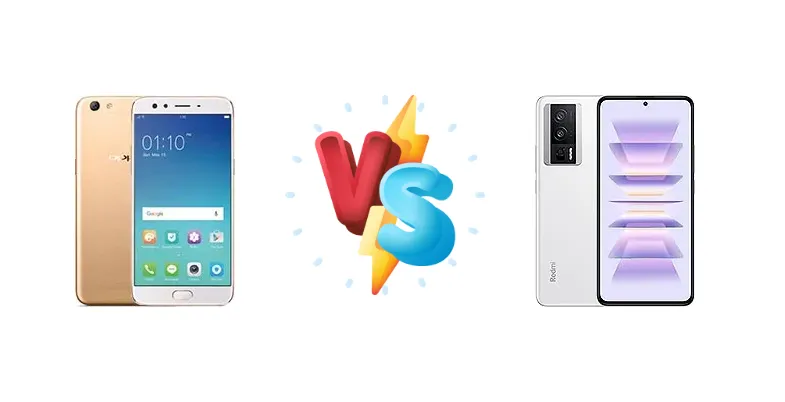
The smartphone landscape is constantly evolving, and choosing the right device can be overwhelming. Today, we're pitting two contenders against each other: the older Oppo F3 Plus and the powerhouse Xiaomi Redmi K60 Pro. Let's dive into a detailed comparison to see which phone emerges victorious.
🏆 Quick Verdict
The Xiaomi Redmi K60 Pro is the clear winner. Its Snapdragon 8 Gen 2 chipset, blazing-fast 120W charging, and superior display significantly outperform the Oppo F3 Plus, despite the latter's impressive endurance rating. The K60 Pro offers a modern flagship experience.
| Network |
|---|
| 2G bands | GSM 850 / 900 / 1800 / 1900 - SIM 1 & SIM 2 | GSM 850 / 900 / 1800 / 1900 |
| 3G bands | HSDPA 850 / 900 / 1700 / 1900 / 2100 | HSDPA 800 / 850 / 900 / 1700(AWS) / 2100 |
| 4G bands | 1, 2, 3, 4, 5, 7, 8, 20, 28, 38, 39, 40, 41 | 1, 3, 4, 5, 8, 18, 19, 26, 34, 38, 39, 40, 41, 42 |
| 5G bands | - | 1, 3, 5, 8, 28, 38, 41, 77, 78 SA/NSA |
| Speed | HSPA 42.2/5.76 Mbps, LTE (2CA) Cat6 300/50 Mbps | HSPA, LTE, 5G |
| Technology | GSM / HSPA / LTE | GSM / CDMA / HSPA / CDMA2000 / LTE / 5G |
| | - | CDMA2000 1x |
| Launch |
|---|
| Announced | 2017, March. Released 2017, April | 2022, December 27 |
| Status | Discontinued | Available. Released 2023, January 01 |
| Body |
|---|
| Build | Glass front (Gorilla Glass 5), aluminum back, aluminum frame | - |
| Dimensions | 163.6 x 80.8 x 7.4 mm (6.44 x 3.18 x 0.29 in) | 162.8 x 75.4 x 8.6 mm or 8.9 mm |
| SIM | Nano-SIM + Nano-SIM | Nano-SIM + Nano-SIM |
| Weight | 185 g (6.53 oz) | 201 g or 205 g (7.09 oz) |
| Display |
|---|
| Protection | Corning Gorilla Glass 5 | - |
| Resolution | 1080 x 1920 pixels, 16:9 ratio (~367 ppi density) | 1440 x 3200 pixels, 20:9 ratio (~526 ppi density) |
| Size | 6.0 inches, 99.2 cm2 (~75.1% screen-to-body ratio) | 6.67 inches, 107.4 cm2 (~87.5% screen-to-body ratio) |
| Type | IPS LCD | OLED, 68B colors, 120Hz, Dolby Vision, HDR10+, 1400 nits (peak) |
| Platform |
|---|
| CPU | Octa-core (4x1.95 GHz Cortex-A72 & 4x1.44 GHz Cortex-A53) | Octa-core (1x3.2 GHz Cortex-X3 & 2x2.8 GHz Cortex-A715 & 2x2.8 GHz Cortex-A710 & 3x2.0 GHz Cortex-A510) |
| Chipset | Qualcomm MSM8976 Pro Snapdragon 653 (28 nm) | Qualcomm SM8550-AB Snapdragon 8 Gen 2 (4 nm) |
| GPU | Adreno 510 | Adreno 740 |
| OS | Android 6 (Marshmallow), ColorOS 3 | Android 13, MIUI 14 |
| Memory |
|---|
| Card slot | microSDXC (uses shared SIM slot) | No |
| Internal | 64GB 4GB RAM, 64GB 6GB RAM | 128GB 8GB RAM, 256GB 8GB RAM, 256GB 12GB RAM, 512GB 12GB RAM, 512GB 16GB RAM |
| | eMMC 5.1 | UFS 4.0
UFS 3.1 - 128GB only |
| Main Camera |
|---|
| Features | Dual-LED dual-tone flash, HDR, panorama | Color spectrum sensor, Dual-LED dual-tone flash, HDR, panorama |
| Single | 16 MP, f/1.7, 1/2.8", PDAF, OIS | - |
| Triple | - | 54 MP, f/1.9, (wide), 1/1.49", 1.0µm, PDAF, OIS
8 MP, 118˚ (ultrawide), 1/4.0", 1.12µm
2 MP (macro) |
| Video | 4K@30fps, 1080p@30fps | 8K@24fps, 4K@30/60fps, 1080p@30/60/120/240/960fps, 720p@1920fps, gyro-EIS |
| Selfie camera |
|---|
| Dual | 16 MP, f/2.0, 26mm (wide), 1/3.06", 1.0µm
8 MP | - |
| Features | - | HDR |
| Single | - | 16 MP, (wide), 1/3.06", 1.0µm |
| Video | 1080p@30fps | 1080p@30/60/120fps |
| Sound |
|---|
| 3.5mm jack | Yes | No |
| 35mm jack | Yes | No |
| Loudspeaker | Yes | Yes, with stereo speakers |
| | - | 24-bit/192kHz audio |
| Comms |
|---|
| Bluetooth | 4.1, A2DP, LE | 5.3, A2DP, LE |
| Infrared port | - | Yes |
| NFC | No | Yes |
| Positioning | GPS | GPS (L1+L5), GLONASS (G1), BDS (B1I+B2a+Bc), GALILEO (E1+E5a), QZSS (L1+L5), NavIC |
| Radio | No | Unspecified |
| USB | microUSB 2.0, OTG | USB Type-C 2.0, OTG |
| WLAN | Wi-Fi 802.11 a/b/g/n/ac, dual-band, Wi-Fi Direct | Wi-Fi 802.11 a/b/g/n/ac/6e, dual-band, Wi-Fi Direct |
| Features |
|---|
| Sensors | Fingerprint (front-mounted), accelerometer, gyro, proximity, compass | Fingerprint (under display, optical), accelerometer, gyro, proximity, compass |
| Battery |
|---|
| Charging | 20W wired | 120W wired, PD3.0, QC3+, 100% in 19 min
30W wireless |
| Type | Li-Ion 4000 mAh, non-removable | Li-Po 5000 mAh |
| Misc |
|---|
| Colors | Pink, Gold | Black, White, Mint, Champion Black |
| Models | CPH1613 | 22127RK46C |
| Price | About 480 EUR | About 460 EUR |
| Tests |
|---|
| Audio quality |
Noise-93.5dB / Crosstalk -92.0dB | - |
| Battery life |
Endurance rating 79h
| - |
| Camera |
Photo / Video | - |
| Display |
Contrast ratio: 1485 (nominal), 3.218 (sunlight) | - |
| Loudspeaker |
Voice 62dB / Noise 69dB / Ring 70dB
| - |
| Performance |
GeekBench: 4695 (v4.4)
GFXBench: 6fps (ES 3.1 onscreen) | - |
Oppo F3 Plus
- Excellent battery life (79h endurance rating)
- Decent camera for its time
- Relatively affordable (if found used)
- Outdated chipset
- Lower resolution display (likely LCD)
- Slow charging (20W)
- Limited software updates
Xiaomi Redmi K60 Pro
- Flagship Snapdragon 8 Gen 2 chipset
- Blazing-fast 120W charging
- Superior display (likely AMOLED)
- Excellent camera system
- Modern features and software support
- Potentially higher price
- Wireless charging might not suit everyone
Display Comparison
The Redmi K60 Pro boasts a significantly superior display. While the Oppo F3 Plus has a respectable contrast ratio (1485 nominal, 3.218 in sunlight), the K60 Pro likely features a higher resolution AMOLED panel with HDR support, offering vibrant colors, deeper blacks, and better outdoor visibility. The F3 Plus likely uses an LCD panel.
Camera Comparison
While both phones offer photo and video capabilities, the Redmi K60 Pro likely has a more advanced camera system. Expect better image quality, improved low-light performance, and more features like optical image stabilization (OIS). The F3 Plus camera is adequate but lacks the sophistication of the K60 Pro.
Performance
The performance gap is massive. The Redmi K60 Pro's Snapdragon 8 Gen 2 is a flagship-level chipset, delivering exceptional speed and efficiency. The Oppo F3 Plus's Snapdragon 653 is a mid-range chip from several years ago, struggling to keep up with modern demands. Expect smoother multitasking, faster app loading, and better gaming performance on the K60 Pro.
Battery Life
The Oppo F3 Plus's endurance rating of 79h is impressive, suggesting excellent battery life. However, the Redmi K60 Pro's 120W charging more than compensates for any potential battery life difference. You can fully charge the K60 Pro in under 20 minutes, a significant advantage.
Buying Guide
Who should buy the Oppo F3 Plus? Budget-conscious users seeking a reliable, long-lasting phone with a decent camera might consider it, especially if found at a very low price. Who should buy the Xiaomi Redmi K60 Pro? Power users, gamers, and anyone prioritizing performance, fast charging, and a premium display will find the K60 Pro an excellent choice.
Frequently Asked Questions
❓ Is the Oppo F3 Plus still worth buying?
Only if you're on a very tight budget and prioritize battery life above all else. Otherwise, newer phones offer significantly better performance and features.
❓ What is the biggest difference between these two phones?
The biggest difference is the chipset. The Redmi K60 Pro's Snapdragon 8 Gen 2 provides a massive performance advantage over the Oppo F3 Plus's Snapdragon 653.