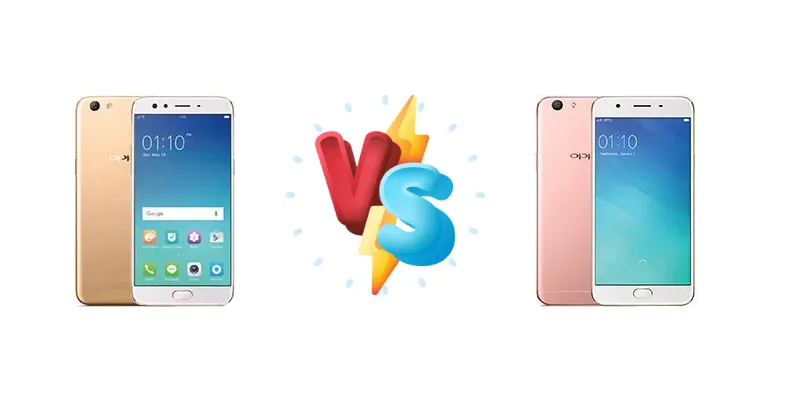
Oppo's F-series phones were popular choices for selfie enthusiasts and budget-conscious buyers. The F3 Plus and F1s both offered compelling features, but which one ultimately delivers a better experience? This comprehensive comparison dives deep into their specs and performance to help you decide.
🏆 Quick Verdict
The Oppo F3 Plus clearly wins due to its significantly more powerful processor, superior display contrast, and impressive battery endurance. While the F1s remains a decent option, the F3 Plus offers a noticeable upgrade in almost every key area, justifying its higher price point.
| Network |
|---|
| 2G bands | GSM 850 / 900 / 1800 / 1900 - SIM 1 & SIM 2 | GSM 850 / 900 / 1800 / 1900 |
| 3G bands | HSDPA 850 / 900 / 1700 / 1900 / 2100 | HSDPA 850 / 900 / 2100 |
| 4G bands | 1, 2, 3, 4, 5, 7, 8, 20, 28, 38, 39, 40, 41 | 1, 3, 5, 7, 8, 20, 28, 38, 39, 40, 41 - Global |
| Speed | HSPA 42.2/5.76 Mbps, LTE (2CA) Cat6 300/50 Mbps | HSPA 42.2/5.76 Mbps, LTE (2CA) Cat6 300/50 Mbps or LTE Cat4 150/50 Mbps |
| Technology | GSM / HSPA / LTE | GSM / HSPA / LTE |
| | - | 1, 3, 5, 40 - India |
| Launch |
|---|
| Announced | 2017, March. Released 2017, April | 2016, August 03. Released 2016, August |
| Status | Discontinued | Discontinued |
| Body |
|---|
| Build | Glass front (Gorilla Glass 5), aluminum back, aluminum frame | Glass front (Gorilla Glass 4), aluminum back, aluminum frame |
| Dimensions | 163.6 x 80.8 x 7.4 mm (6.44 x 3.18 x 0.29 in) | 154.5 x 76 x 7.4 mm (6.08 x 2.99 x 0.29 in) |
| SIM | Nano-SIM + Nano-SIM | Nano-SIM + Nano-SIM |
| Weight | 185 g (6.53 oz) | 160 g (5.64 oz) |
| Display |
|---|
| Protection | Corning Gorilla Glass 5 | Corning Gorilla Glass 4 |
| Resolution | 1080 x 1920 pixels, 16:9 ratio (~367 ppi density) | 720 x 1280 pixels, 16:9 ratio (~267 ppi density) |
| Size | 6.0 inches, 99.2 cm2 (~75.1% screen-to-body ratio) | 5.5 inches, 83.4 cm2 (~71.0% screen-to-body ratio) |
| Type | IPS LCD | IPS LCD |
| Platform |
|---|
| CPU | Octa-core (4x1.95 GHz Cortex-A72 & 4x1.44 GHz Cortex-A53) | Octa-core 1.5 GHz Cortex-A53 |
| Chipset | Qualcomm MSM8976 Pro Snapdragon 653 (28 nm) | Mediatek MT6755 (28 nm) or MTK7650 (28 nm) |
| GPU | Adreno 510 | Mali-T860MP2 |
| OS | Android 6 (Marshmallow), ColorOS 3 | Android 5.1 (Lollipop), upgradable to 6.0 (Marshmallow), ColorOS 3 |
| Memory |
|---|
| Card slot | microSDXC (uses shared SIM slot) | microSDXC (dedicated slot) |
| Internal | 64GB 4GB RAM, 64GB 6GB RAM | 32GB 3GB RAM, 64GB 4GB RAM |
| | eMMC 5.1 | eMMC 5.1 |
| Main Camera |
|---|
| Features | Dual-LED dual-tone flash, HDR, panorama | LED flash, panorama, HDR |
| Single | 16 MP, f/1.7, 1/2.8", PDAF, OIS | 13 MP, f/2.2, 1/3.0", PDAF |
| Video | 4K@30fps, 1080p@30fps | 1080p@30fps |
| Selfie camera |
|---|
| Dual | 16 MP, f/2.0, 26mm (wide), 1/3.06", 1.0µm
8 MP | - |
| Single | - | 16 MP, f/2.0, 26mm (wide), 1/3.06", 1.0µm |
| Video | 1080p@30fps | 1080p@30fps |
| Sound |
|---|
| 3.5mm jack | Yes | Yes |
| 35mm jack | Yes | Yes |
| Loudspeaker | Yes | Yes |
| Comms |
|---|
| Bluetooth | 4.1, A2DP, LE | 4.0, A2DP |
| NFC | No | No |
| Positioning | GPS | GPS |
| Radio | No | FM radio |
| USB | microUSB 2.0, OTG | microUSB 2.0, OTG |
| WLAN | Wi-Fi 802.11 a/b/g/n/ac, dual-band, Wi-Fi Direct | Wi-Fi 802.11 a/b/g/n, dual-band, Wi-Fi Direct, hotspot |
| Features |
|---|
| Sensors | Fingerprint (front-mounted), accelerometer, gyro, proximity, compass | Fingerprint (front-mounted), accelerometer, proximity, compass |
| Battery |
|---|
| Charging | 20W wired | - |
| Type | Li-Ion 4000 mAh, non-removable | Li-Po 3075 mAh, non-removable |
| Misc |
|---|
| Colors | Pink, Gold | Gold, Rose Gold, Gray |
| Models | CPH1613 | A1601 |
| Price | About 480 EUR | About 150 EUR |
| SAR | - | 0.31 W/kg (head) 0.36 W/kg (body) |
| SAR EU | - | 1.60 W/kg (head) 1.05 W/kg (body) |
| Tests |
|---|
| Audio quality |
Noise-93.5dB / Crosstalk -92.0dB | - |
| Battery life |
Endurance rating 79h
| - |
| Camera |
Photo / Video |
Photo / Video |
| Display |
Contrast ratio: 1485 (nominal), 3.218 (sunlight) | - |
| Loudspeaker |
Voice 62dB / Noise 69dB / Ring 70dB
| - |
| Performance |
GeekBench: 4695 (v4.4)
GFXBench: 6fps (ES 3.1 onscreen) | - |
Oppo F3 Plus
- Superior Performance
- Excellent Battery Life
- Vibrant Display
- Faster Charging
- Potentially Higher Price (at launch)
Oppo F1s
- More Affordable
- Decent Selfie Camera (for its time)
- Slower Performance
- Shorter Battery Life
- Less Vibrant Display
Display Comparison
The Oppo F3 Plus boasts a significantly better display with a nominal contrast ratio of 1485 compared to the F1s (estimated around 800-1000 based on typical LCD panels of the era). Sunlight readability is also notably better on the F3 Plus with a 3.218 rating, making it easier to view in bright conditions. The F1s display, while adequate, lacks the vibrancy and clarity of the F3 Plus.
Camera Comparison
Both phones feature decent camera setups for their time, but the F3 Plus likely has a slight edge in image quality due to its more advanced processor and potentially better image processing algorithms. Both offer Photo/Video capabilities, but detailed camera specs (aperture, sensor size) are missing for the F1s, making a definitive comparison difficult.
Performance
The F3 Plus's Qualcomm Snapdragon 653 chipset and Octa-core CPU (4x1.95 GHz Cortex-A72 & 4x1.44 GHz Cortex-A53) provides a substantial performance advantage over the F1s's Mediatek MT6755 or MTK7650 chipset and 1.5 GHz Cortex-A53 CPU. Expect smoother multitasking, faster app loading times, and better gaming performance on the F3 Plus.
Battery Life
The F3 Plus shines in battery life, boasting an impressive endurance rating of 79 hours. This is a significant advantage over the F1s, which likely offered around 20-25 hours of typical usage. The F3 Plus's 20W wired charging also provides faster charging speeds.
Buying Guide
The Oppo F3 Plus is ideal for users who prioritize performance, a vibrant display, and long battery life. It's a good choice for those who enjoy gaming or multitasking. The Oppo F1s is best suited for users on a tighter budget who primarily need a reliable phone for basic tasks and decent selfies.
Frequently Asked Questions
❓ Is the Oppo F3 Plus worth the extra cost compared to the F1s?
Yes, the F3 Plus offers a significant upgrade in performance, display quality, and battery life, making it a worthwhile investment if your budget allows.
❓ Which phone is better for taking selfies?
Both phones were marketed as selfie-focused devices. While detailed camera specs are lacking for the F1s, the F3 Plus likely has slightly better image processing capabilities.