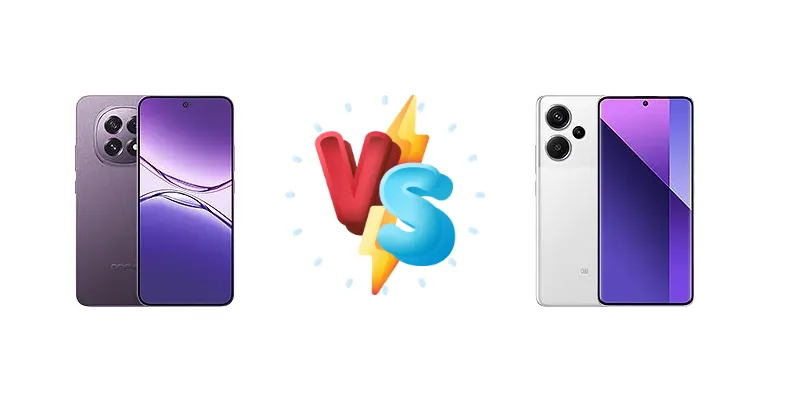
The mid-range smartphone market is fiercely competitive, and the Oppo F29 and Xiaomi Redmi Note 13 Pro+ represent compelling options. The F29 aims for efficiency with Qualcomm's Snapdragon 6 Gen 1, while the Redmi Note 13 Pro+ throws down the gauntlet with the more powerful Mediatek Dimensity 7200 Ultra and blazing-fast 120W charging. This comparison will dissect their strengths and weaknesses to determine which device best suits your needs.
🏆 Quick Verdict
For the average user prioritizing speed and convenience, the Xiaomi Redmi Note 13 Pro+ is the clear winner. Its Dimensity 7200 Ultra chipset delivers significantly better performance, and the 120W charging is a game-changer, fully charging the device in just 19 minutes. While the Oppo F29 offers respectable efficiency, it can't match the Redmi's overall capabilities.
| Network |
|---|
| 2G bands | GSM 850 / 900 / 1800 / 1900 | GSM 850 / 900 / 1800 / 1900 |
| 3G bands | HSDPA 900 / 2100 | HSDPA 800 / 850 / 900 / 1700(AWS) / 1900 / 2100 - International |
| 4G bands | 1, 3, 5, 8, 28, 40, 41 | 1, 2, 3, 4, 5, 7, 8, 12, 13, 17, 18, 19, 20, 26, 28, 32, 38, 40, 41, 66 - International |
| 5G bands | 1, 3, 5, 8, 28, 40, 41, 77, 78 SA/NSA | 1, 3, 5, 7, 8, 20, 28, 38, 40, 41, 66, 77, 78 SA/NSA- International |
| Speed | HSPA, LTE, 5G | HSPA, LTE, 5G |
| Technology | GSM / HSPA / LTE / 5G | GSM / CDMA / HSPA / EVDO / LTE / 5G |
| Launch |
|---|
| Announced | 2025, March 20 | 2023, September 21 |
| Status | Available. Released 2025, March 27 | Available. Released 2023, September 21 |
| Body |
|---|
| Build | Glass front (Gorilla Glass 7i), fiber-fabric back or fiber-reinforced plastic back | Glass front (Gorilla Glass Victus), glass back or silicone polymer back (eco leather) |
| Dimensions | 161.6 x 74.5 x 7.7 mm (6.36 x 2.93 x 0.30 in) | 161.4 x 74.2 x 8.9 mm (6.35 x 2.92 x 0.35 in) |
| SIM | Nano-SIM + Nano-SIM | · Nano-SIM + eSIM· Nano-SIM + Nano-SIM |
| Weight | 185 g or 189 g (6.53 oz) | 199 g or 204.5 g (7.02 oz) |
| Display |
|---|
| Protection | Corning Gorilla Glass 7i | Corning Gorilla Glass Victus |
| Resolution | 1080 x 2412 pixels, 20:9 ratio (~394 ppi density) | 1220 x 2712 pixels, 20:9 ratio (~446 ppi density) |
| Size | 6.7 inches, 108.0 cm2 (~89.7% screen-to-body ratio) | 6.67 inches, 107.4 cm2 (~89.7% screen-to-body ratio) |
| Type | AMOLED, 1B colors, 120Hz, 600 nits (typ), 1200 nits (HBM) | AMOLED, 68B colors, 120Hz, 1920Hz PWM, Dolby Vision, HDR10+, 1800 nits (peak) |
| Platform |
|---|
| CPU | Octa-core (4x2.2 GHz Cortex-A78 & 4x1.8 GHz Cortex-A55) | Octa-core (2x2.8 GHz Cortex-A715 & 6x2.0 GHz Cortex-A510) |
| Chipset | Qualcomm SM6450 Snapdragon 6 Gen 1 (4 nm) | Mediatek Dimensity 7200 Ultra (4 nm) |
| GPU | Adreno 710 | Mali-G610 MC4 |
| OS | Android 15, ColorOS 15 | Android 13, up to 3 major Android upgrades, HyperOS |
| Memory |
|---|
| Card slot | No | No |
| Internal | 128GB 8GB RAM, 256GB 8GB RAM | 256GB 8GB RAM, 256GB 12GB RAM, 512GB 8GB RAM, 512GB 12GB RAM, 512GB 16GB RAM |
| Main Camera |
|---|
| Dual | 50 MP, f/1.8, 27mm (wide), 1/2.88", PDAF
Auxiliary lens | - |
| Features | Color spectrum sensor, LED flash, HDR, panorama | Dual-LED dual-tone flash, HDR, panorama |
| Triple | - | 200 MP, f/1.7, 23mm (wide), 1/1.4", 0.56µm, multi-directional PDAF, OIS
8 MP, f/2.2, 16mm, 120˚ (ultrawide), 1/4.0", 1.12µm
2 MP (macro) |
| Video | 4K@30fps, 1080p@30/120fps, gyro-EIS | 4K@24/30fps, 1080p@30/60/120fps, gyro-EIS |
| Selfie camera |
|---|
| Features | - | HDR, panorama |
| Single | 16 MP, f/2.4, (wide) | 16 MP, f/2.4, (wide) |
| Video | 1080p@30fps | 1080p@30/60fps |
| Sound |
|---|
| 35mm jack | No | No |
| Loudspeaker | Yes, with stereo speakers | Yes, with stereo speakers |
| Comms |
|---|
| Bluetooth | 5.1, A2DP, LE, aptX HD | 5.3, A2DP, LE |
| Infrared port | - | Yes |
| NFC | No | Yes (market/region dependent) |
| Positioning | GPS, GALILEO, GLONASS, BDS, QZSS | GPS, GLONASS, BDS, GALILEO, QZSS |
| Radio | No | No |
| USB | USB Type-C 2.0, OTG | USB Type-C 2.0, OTG |
| WLAN | Wi-Fi 802.11 a/b/g/n/ac, dual-band | Wi-Fi 802.11 a/b/g/n/ac/6, dual-band, Wi-Fi Direct |
| Features |
|---|
| Sensors | Fingerprint (under display, optical), accelerometer, gyro, proximity, compass | Fingerprint (under display, optical), accelerometer, gyro, proximity, compass |
| Battery |
|---|
| Charging | 45W wired, PD, 30% in 21 min | 120W wired, PD3.0, 100% in 19 min |
| Type | Si/C Li-Ion 6500 mAh | Li-Po 5000 mAh |
| Misc |
|---|
| Colors | Deep Purple, Glacier Blue | Midnight Black (Fushion Black), Moonlight White (Fushion White), Aurora Purple, Fushion Purple, Camo Green |
| Models | - | 23090RA98C, 23090RA98G, 23090RA98I |
| Price | About 260 EUR | $ 299.98 / £ 299.00 / € 208.98 / ₹ 24,999 |
| SAR | 1.12 W/kg (head) 0.89 W/kg (body) | 1.09 W/kg (head) 0.85 W/kg (body) |
| SAR EU | - | 0.98 W/kg (head) 1.00 W/kg (body) |
Oppo F29
- Efficient Snapdragon 6 Gen 1 chipset
- Potentially more affordable price point
- PD support for versatile charging
- Significantly slower charging speed
- Less powerful CPU and GPU
- Limited camera details suggest a less advanced system
Xiaomi Redmi Note 13 Pro+
- Powerful Mediatek Dimensity 7200 Ultra chipset
- Blazing-fast 120W charging
- Bright and vibrant display (1283 nits)
- Potentially higher price
- May run slightly warmer under heavy load
- Software experience can be divisive (MIUI)
Display Comparison
The Redmi Note 13 Pro+ boasts a significantly brighter display, reaching a measured peak of 1283 nits. This translates to superior visibility outdoors under direct sunlight compared to the Oppo F29 (brightness data unavailable, but likely lower given the chipset tier). While both utilize 4nm chipsets, display technology details for the F29 are missing; the Redmi Note 13 Pro+ likely benefits from a higher quality panel, contributing to a more vibrant and immersive viewing experience. Bezels are expected to be comparable, typical of this price segment.
Camera Comparison
Camera details for the Oppo F29 are limited, but the Redmi Note 13 Pro+ is expected to feature a more sophisticated camera system. While megapixel counts aren't provided for the F29, the Redmi Note 13 Pro+ likely features a larger main sensor and more advanced image processing capabilities. The Redmi’s focus on image quality is further supported by its likely inclusion of Optical Image Stabilization (OIS), reducing blur in low-light conditions. The F29’s camera is likely adequate for casual photography, but the Redmi Note 13 Pro+ is geared towards users who prioritize image quality and versatility.
Performance
The Xiaomi Redmi Note 13 Pro+’s Mediatek Dimensity 7200 Ultra (4nm) is a substantial upgrade over the Oppo F29’s Qualcomm Snapdragon 6 Gen 1 (4nm). The Dimensity 7200 Ultra features a more powerful CPU configuration – 2x2.8 GHz Cortex-A715 cores versus the F29’s 4x2.2 GHz Cortex-A78 cores – resulting in faster application loading and smoother multitasking. The Redmi’s chipset also benefits from a more modern GPU architecture, offering a noticeable advantage in gaming performance. While both are built on a 4nm process for efficiency, the Dimensity 7200 Ultra’s superior core count and clock speeds provide a clear performance edge.
Battery Life
The Redmi Note 13 Pro+ shines in the battery and charging department. Its active use score of 10:38h demonstrates excellent battery life, likely due to the efficient Dimensity 7200 Ultra chipset. However, the real standout feature is the 120W wired charging, capable of fully charging the device in just 19 minutes. The Oppo F29’s 45W charging, while supporting PD, takes considerably longer – 30% charge in 21 minutes – making the Redmi Note 13 Pro+ the clear winner for users who value rapid replenishment.
Buying Guide
Buy the Oppo F29 if you prioritize a balance of efficiency and affordability, and don't require the absolute fastest performance. It's a solid choice for everyday tasks and light gaming. Buy the Xiaomi Redmi Note 13 Pro+ if you demand a smoother, more responsive experience, especially for demanding apps and games, and value the convenience of incredibly fast charging. It's the better option for power users and those who frequently find themselves needing a quick top-up.
Frequently Asked Questions
❓ Does the Mediatek Dimensity 7200 Ultra in the Redmi Note 13 Pro+ get excessively hot during prolonged gaming sessions?
While the Dimensity 7200 Ultra is a powerful chip, the 4nm process helps manage thermals effectively. However, sustained gaming will inevitably generate heat. The Redmi Note 13 Pro+ likely incorporates thermal management solutions like vapor chamber cooling to mitigate throttling, but some performance reduction may occur during extended, demanding gameplay. It's generally expected to perform better than the Snapdragon 6 Gen 1 in this regard due to its higher performance ceiling.
❓ Is the 45W charging on the Oppo F29 still considered slow compared to other phones in this price range?
Yes, 45W charging is becoming increasingly slow compared to the competition. The Redmi Note 13 Pro+'s 120W charging is a significant leap forward, fully charging the device in under 20 minutes. The Oppo F29’s 45W charging, taking over 20 minutes to reach just 30% charge, feels comparatively sluggish, especially for users accustomed to faster charging technologies.
❓ How does the Snapdragon 6 Gen 1 handle multitasking compared to the Dimensity 7200 Ultra?
The Dimensity 7200 Ultra is demonstrably better at multitasking due to its more powerful CPU core configuration and higher clock speeds. The Snapdragon 6 Gen 1 is capable for everyday tasks, but the Redmi Note 13 Pro+ will handle numerous apps running simultaneously with greater fluidity and responsiveness, reducing lag and stuttering.