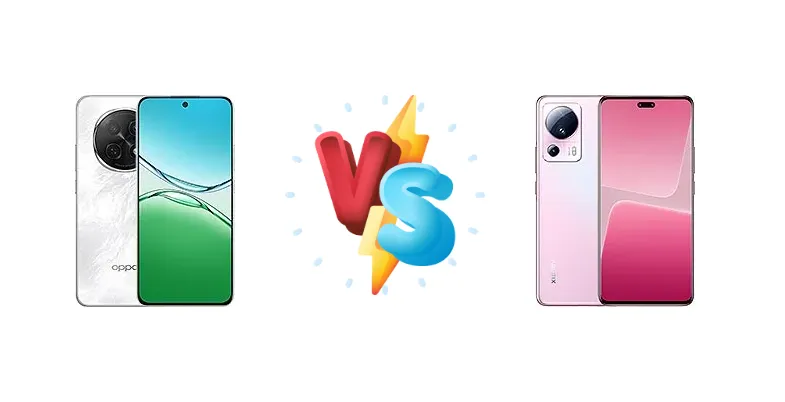
The mid-range smartphone market is fiercely competitive, and the Oppo F29 Pro and Xiaomi 13 Lite represent compelling options for users seeking premium features without the flagship price tag. This comparison dives deep into their specifications, focusing on the core differences in chipset architecture, display capabilities, and charging speeds to determine which device offers the best overall experience.
🏆 Quick Verdict
For the average user prioritizing sustained performance and faster charging, the Oppo F29 Pro emerges as the stronger contender. Its Mediatek Dimensity 7300 Energy chipset, built on a 4nm process, offers a performance edge over the Snapdragon 7 Gen 1, while the 80W charging significantly reduces downtime. However, the Xiaomi 13 Lite’s excellent endurance rating and display brightness remain competitive.
| Network |
|---|
| 2G bands | GSM 850 / 900 / 1800 / 1900 | GSM 850 / 900 / 1800 / 1900 |
| 3G bands | HSDPA 900 / 2100 | HSDPA 800 / 850 / 900 / 1700(AWS) / 1900 / 2100 |
| 4G bands | 1, 3, 5, 8, 28, 40, 41 | 1, 2, 3, 4, 5, 7, 8, 12, 13, 17, 18, 19, 20, 26, 28, 32, 38, 40, 41, 42, 66 |
| 5G bands | 1, 3, 5, 8, 28, 40, 41, 77, 78 SA/NSA | 1, 3, 5, 7, 8, 20, 28, 38, 40, 41, 66, 77, 78 SA/NSA |
| Speed | HSPA, LTE, 5G | HSPA, LTE, 5G |
| Technology | GSM / HSPA / LTE / 5G | GSM / HSPA / LTE / 5G |
| Launch |
|---|
| Announced | 2025, March 20 | 2023, February 26 |
| Status | Available. Released 2025, April 01 | Available. Released 2023, March 08 |
| Body |
|---|
| Build | Glass front (Gorilla Glass Victus 2), fiber fabric back | Glass front (Gorilla Glass 5), glass back, plastic frame |
| Dimensions | 161.5 x 74.9 x 7.6 mm (6.36 x 2.95 x 0.30 in) | 159.2 x 72.7 x 7.2 mm (6.27 x 2.86 x 0.28 in) |
| SIM | Nano-SIM + Nano-SIM | · Nano-SIM + eSIM· Nano-SIM + Nano-SIM |
| Weight | 180 g (6.35 oz) | 171 g (6.03 oz) |
| | - | IP53, dust and splash resistant |
| Display |
|---|
| Protection | Corning Gorilla Glass Victus 2 | Corning Gorilla Glass 5 |
| Resolution | 1080 x 2412 pixels, 20:9 ratio (~394 ppi density) | 1080 x 2400 pixels, 20:9 ratio (~402 ppi density) |
| Size | 6.7 inches, 108.0 cm2 (~89.3% screen-to-body ratio) | 6.55 inches, 103.6 cm2 (~89.5% screen-to-body ratio) |
| Type | AMOLED, 1B colors, 120Hz, 600 nits (typ), 1200 nits (HBM) | AMOLED, 68B colors, Dolby Vision, HDR10+, 120Hz, 500 nits (typ), 1000 nits (peak) |
| Platform |
|---|
| CPU | Octa-core (4x2.5 GHz Cortex-A78 & 4x2.0 GHz Cortex-A55) | Octa-core (1x2.4 GHz Cortex-A710 & 3x2.36 GHz Cortex-A710 & 4x1.8 GHz Cortex-A510) |
| Chipset | Mediatek Dimensity 7300 Energy (4 nm) | Qualcomm SM7450-AB Snapdragon 7 Gen 1 (4 nm) |
| GPU | Mali-G615 MC2 | Adreno 644 |
| OS | Android 15, ColorOS 15 | Android 12, MIUI 14 |
| Memory |
|---|
| Card slot | No | No |
| Internal | 128GB 8GB RAM, 256GB 8GB RAM, 256GB 12GB RAM | 64GB 8GB RAM, 128GB 8GB RAM, 256GB 8GB RAM |
| | - | UFS 2.2 |
| Main Camera |
|---|
| Dual | 50 MP, f/1.8, 27mm (wide), 1/2.88", PDAF, OIS
Auxiliary lens | - |
| Features | Color spectrum sensor, LED flash, HDR, panorama | Dual-LED dual-tone flash, HDR, panorama |
| Triple | - | 50 MP, f/1.8, 23mm (wide), 1/1.56", 1.0µm, PDAF
8 MP, f/2.2, 119˚ (ultrawide), 1/4.0", 1.12µm
2 MP (macro) |
| Video | 4K@30fps, 1080p@30/60/120/480fps, 720p@960fps, gyro-EIS, OIS | 4K@30fps, 1080p@30/60/120fps, 720p@960fps |
| Selfie camera |
|---|
| Dual | - | 32 MP, f/2.4, 100˚ (ultrawide), 1/2.74", 0.8µm
8 MP, f/2.3, (depth) |
| Features | - | Dual-LED flash, HDR |
| Single | 16 MP, f/2.4, (wide) | - |
| Video | 1080p@30fps, gyro-EIS | 1080p@30/60fps |
| Sound |
|---|
| 3.5mm jack | - | No |
| 35mm jack | No | No |
| Loudspeaker | Yes, with stereo speakers | Yes |
| | - | 24-bit/192kHz audio |
| Comms |
|---|
| Bluetooth | 5.4, A2DP, LE, aptX HD | 5.2, A2DP, LE |
| Infrared port | Yes | Yes |
| NFC | No | Yes (market/region dependent) |
| Positioning | GPS, GALILEO, GLONASS, BDS, QZSS | GPS (L1), GLONASS (G1), BDS (B1I+B1c), GALILEO (E1), QZSS (L1) |
| Radio | No | No |
| USB | USB Type-C 2.0, OTG | USB Type-C 2.0, OTG |
| WLAN | Wi-Fi 802.11 a/b/g/n/ac/6, dual-band | Wi-Fi 802.11 a/b/g/n/ac/6, dual-band |
| Features |
|---|
| Sensors | Fingerprint (under display, optical), accelerometer, gyro, proximity, compass | Fingerprint (under display, optical), accelerometer, gyro, proximity, compass |
| Battery |
|---|
| Charging | 80W wired, PD, 45% in 20 min | 67W wired, 100% in 40 min |
| Type | Si/C Li-Ion 6000 mAh | Li-Po 4500 mAh |
| Misc |
|---|
| Colors | Marble White, Granite Black | Black, Lite Blue, Lite Pink |
| Models | CPH2705 | - |
| Price | About 300 EUR | About 180 EUR |
| SAR | 1.00 W/kg (head) 0.77 W/kg (body) | - |
| Tests |
|---|
| Battery life | - |
Endurance rating 93h
|
| Camera | - |
Photo / Video |
| Display | - |
Contrast ratio: Infinite (nominal) |
| Loudspeaker | - |
-28.5 LUFS (Average)
|
| Performance | - |
AnTuTu: 534143 (v9)
GeekBench: 2936 (v5.1), 2434 (v6)
GFXBench: 33fps (ES 3.1 onscreen) |
Oppo F29 Pro
- Faster 80W charging significantly reduces downtime.
- Potentially stronger CPU performance with Dimensity 7300 Energy.
- 4nm process for improved thermal efficiency.
- Battery capacity and display specs currently unknown.
- Camera details are missing, making image quality assessment difficult.
Xiaomi 13 Lite
- Excellent 93-hour endurance rating for all-day battery life.
- Bright 938 nit display for outdoor visibility.
- Fast 67W charging.
- Snapdragon 7 Gen 1 may offer slightly less peak CPU performance.
- Charging is slower than the Oppo F29 Pro.
Display Comparison
The Xiaomi 13 Lite boasts a notably bright display, reaching a measured peak of 938 nits, making it highly visible outdoors. While the Oppo F29 Pro’s display specifications are currently unavailable, the Xiaomi’s ‘Infinite’ contrast ratio (nominal) suggests a strong visual experience. The Xiaomi 13 Lite’s brightness is a clear advantage for users who frequently use their phones in direct sunlight. Without knowing the panel type or refresh rate of the Oppo F29 Pro, it’s difficult to assess its color accuracy or smoothness compared to the Xiaomi.
Camera Comparison
Both devices are listed as having Photo/Video capabilities, but detailed sensor information is lacking for both. Without knowing megapixel counts, sensor sizes, or aperture values, a direct comparison is impossible. However, the presence or absence of Optical Image Stabilization (OIS) would be a critical differentiator. Assuming both phones target the mid-range market, image processing algorithms will play a significant role in determining image quality, particularly in low-light conditions. The absence of detail regarding the camera systems makes it difficult to assess which phone offers a superior photographic experience.
Performance
The core difference lies in the chipsets: the Oppo F29 Pro utilizes the Mediatek Dimensity 7300 Energy (4nm), while the Xiaomi 13 Lite features the Qualcomm Snapdragon 7 Gen 1 (4nm). Both are built on the efficient 4nm node, but the Dimensity 7300 Energy’s CPU configuration – a mix of Cortex-A78 and A55 cores clocked up to 2.5 GHz – suggests a stronger focus on peak performance compared to the Snapdragon 7 Gen 1’s Cortex-A710 and A510 setup. The Snapdragon 7 Gen 1’s CPU has a slightly different core arrangement, with more A710 cores, which may benefit multi-threaded tasks, but the higher clock speeds of the A78 cores in the Dimensity 7300 Energy likely translate to snappier responsiveness in everyday use. The impact of RAM speed (LPDDR5x vs. unspecified for Oppo) would also contribute to overall system performance.
Battery Life
The Xiaomi 13 Lite boasts an impressive endurance rating of 93 hours, indicating excellent battery life. While the Oppo F29 Pro’s battery capacity is unknown, its 80W wired charging capability is a significant advantage. The Xiaomi 13 Lite takes 40 minutes for a full charge at 67W, while the Oppo F29 Pro claims 45% charge in just 20 minutes with its 80W system. This faster charging speed could offset a potentially smaller battery capacity in the Oppo F29 Pro, providing a more convenient user experience for those who frequently need to top up their device.
Buying Guide
Buy the Oppo F29 Pro if you need a phone capable of handling demanding applications and games with consistent performance, and if minimizing charging time is a priority. The 80W charging is a significant advantage. Buy the Xiaomi 13 Lite if you prioritize all-day battery life and a bright, vibrant display for media consumption, and are willing to trade some raw processing power for extended usage between charges.
Frequently Asked Questions
❓ How does the Dimensity 7300 Energy handle graphically intensive games like Genshin Impact on the Oppo F29 Pro?
The Dimensity 7300 Energy’s CPU and GPU architecture, combined with the 4nm process, should provide a smooth gaming experience in titles like Genshin Impact. However, sustained performance will depend on the phone’s thermal management system. Expect playable frame rates at medium to high settings, but prolonged gaming sessions may result in some throttling.
❓ Is the 67W charging on the Xiaomi 13 Lite fast enough for quick top-ups throughout the day?
While 67W is considered fast charging, it takes 40 minutes for a full charge. This is adequate for overnight charging, but the Oppo F29 Pro’s 80W charging offers a significant advantage for quick top-ups. A 20-minute charge on the Oppo F29 Pro provides 45% battery, which is considerably faster than the Xiaomi 13 Lite’s charging rate.
❓ Does the Xiaomi 13 Lite support features like HDR10+ for enhanced video playback?
While not explicitly stated in the provided specifications, Xiaomi typically includes HDR10+ support in its mid-range and flagship devices. Checking the full specifications on Xiaomi’s official website is recommended to confirm HDR10+ compatibility for optimal video streaming and playback.