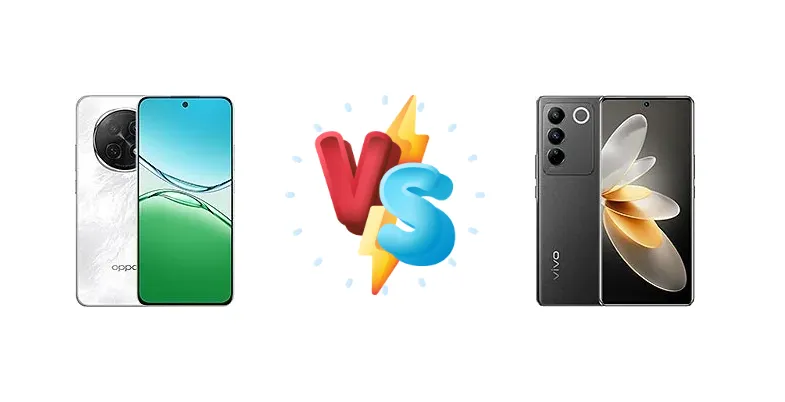
The Oppo F29 Pro and vivo V27 Pro represent compelling options in the increasingly competitive mid-range smartphone market. Both leverage MediaTek's Dimensity series, but with distinct chipsets and feature sets. This comparison dissects the key differences, focusing on performance, camera capabilities, and battery life to determine which device offers the best value.
🏆 Quick Verdict
For most users, the vivo V27 Pro emerges as the stronger choice. Its Dimensity 8200 chipset provides a noticeable performance uplift over the F29 Pro’s Dimensity 7300 Energy, translating to smoother multitasking and gaming. While the Oppo F29 Pro boasts faster 80W charging, the V27 Pro’s overall package is more compelling.
| Network |
|---|
| 2G bands | GSM 850 / 900 / 1800 / 1900 | GSM 850 / 900 / 1800 / 1900 |
| 3G bands | HSDPA 900 / 2100 | HSDPA 850 / 900 / 1700(AWS) / 2100 |
| 4G bands | 1, 3, 5, 8, 28, 40, 41 | 1, 3, 4, 5, 8, 28, 38, 40, 41 |
| 5G bands | 1, 3, 5, 8, 28, 40, 41, 77, 78 SA/NSA | 1, 3, 5, 8, 28, 77, 78 SA/NSA |
| Speed | HSPA, LTE, 5G | HSPA, LTE, 5G |
| Technology | GSM / HSPA / LTE / 5G | GSM / HSPA / LTE / 5G |
| Launch |
|---|
| Announced | 2025, March 20 | 2023, March 01 |
| Status | Available. Released 2025, April 01 | Available. Released 2023, March 01 |
| Body |
|---|
| Build | Glass front (Gorilla Glass Victus 2), fiber fabric back | Glass front, plastic frame, glass back |
| Dimensions | 161.5 x 74.9 x 7.6 mm (6.36 x 2.95 x 0.30 in) | 164.1 x 74.8 x 7.4 mm (6.46 x 2.94 x 0.29 in) |
| SIM | Nano-SIM + Nano-SIM | Nano-SIM + Nano-SIM |
| Weight | 180 g (6.35 oz) | 182 g (6.42 oz) |
| | - | Color changing back panel color |
| Display |
|---|
| Protection | Corning Gorilla Glass Victus 2 | - |
| Resolution | 1080 x 2412 pixels, 20:9 ratio (~394 ppi density) | 1080 x 2400 pixels, 20:9 ratio (~388 ppi density) |
| Size | 6.7 inches, 108.0 cm2 (~89.3% screen-to-body ratio) | 6.78 inches, 111.0 cm2 (~90.4% screen-to-body ratio) |
| Type | AMOLED, 1B colors, 120Hz, 600 nits (typ), 1200 nits (HBM) | AMOLED, 1B colors, 120Hz, HDR10+ |
| Platform |
|---|
| CPU | Octa-core (4x2.5 GHz Cortex-A78 & 4x2.0 GHz Cortex-A55) | Octa-core (1x3.1 GHz Cortex-A78 & 3x3.0 GHz Cortex-A78 & 4x2.0 GHz Cortex-A55) |
| Chipset | Mediatek Dimensity 7300 Energy (4 nm) | Mediatek Dimensity 8200 (4 nm) |
| GPU | Mali-G615 MC2 | Mali-G610 MC6 |
| OS | Android 15, ColorOS 15 | Android 13, Funtouch 13 |
| Memory |
|---|
| Card slot | No | No |
| Internal | 128GB 8GB RAM, 256GB 8GB RAM, 256GB 12GB RAM | 128GB 8GB RAM, 256GB 8GB RAM, 256GB 12GB RAM |
| | - | UFS 3.1 |
| Main Camera |
|---|
| Dual | 50 MP, f/1.8, 27mm (wide), 1/2.88", PDAF, OIS
Auxiliary lens | - |
| Features | Color spectrum sensor, LED flash, HDR, panorama | Ring-LED flash, panorama, HDR |
| Single | - | 50 MP, f/2.5, (wide), AF |
| Triple | - | 50 MP, f/1.9, (wide), 1/1.56", 1.0µm, PDAF, OIS
8 MP, f/2.2, 16mm, 120˚ (ultrawide), 1/4.0", 1.12µm
2 MP (macro) |
| Video | 4K@30fps, 1080p@30/60/120/480fps, 720p@960fps, gyro-EIS, OIS | 4K@30/60fps, 1080p@30fps, gyro-EIS |
| Selfie camera |
|---|
| Features | - | Dual-LED flash, HDR |
| Single | 16 MP, f/2.4, (wide) | 50 MP, f/2.5, (wide), AF |
| Video | 1080p@30fps, gyro-EIS | 4K@30/60fps, 1080p@30fps, gyro-EIS |
| Sound |
|---|
| 3.5mm jack | - | No |
| 35mm jack | No | No |
| Loudspeaker | Yes, with stereo speakers | Yes |
| | - | 24-bit/192kHz audio |
| Comms |
|---|
| Bluetooth | 5.4, A2DP, LE, aptX HD | 5.3, A2DP, LE |
| Infrared port | Yes | - |
| NFC | No | Yes |
| Positioning | GPS, GALILEO, GLONASS, BDS, QZSS | GPS, GLONASS, GALILEO, BDS, NavIC |
| Radio | No | No |
| USB | USB Type-C 2.0, OTG | USB Type-C 2.0, OTG |
| WLAN | Wi-Fi 802.11 a/b/g/n/ac/6, dual-band | Wi-Fi 802.11 a/b/g/n/ac/6, dual-band, Wi-Fi Direct |
| Features |
|---|
| Sensors | Fingerprint (under display, optical), accelerometer, gyro, proximity, compass | Fingerprint (under display, optical), accelerometer, gyro, proximity, compass |
| Battery |
|---|
| Charging | 80W wired, PD, 45% in 20 min | 66W wired, 50% in 19 min, 72% in 30 min |
| Type | Si/C Li-Ion 6000 mAh | 4600 mAh |
| Misc |
|---|
| Colors | Marble White, Granite Black | Magic Blue, Noble Black |
| Models | CPH2705 | V2230 |
| Price | About 300 EUR | About 440 EUR |
| SAR | 1.00 W/kg (head) 0.77 W/kg (body) | 1.22 W/kg (head) 0.89 W/kg (body) |
| Tests |
|---|
| Battery life | - |
Endurance rating 121h
|
| Camera | - |
Photo / Video |
| Display | - |
Contrast ratio: Infinite (nominal) |
| Loudspeaker | - |
-29.1 LUFS (Average)
|
| Performance | - |
AnTuTu: 846767 (v9)
GeekBench: 3933 (v5.1), 3421 (v6)
GFXBench: 57fps (ES 3.1 onscreen) |
Oppo F29 Pro
- Faster 80W wired charging
- Potentially more efficient chipset (Dimensity 7300 Energy)
- Competitive price point (assumed)
- Less powerful chipset (Dimensity 7300 Energy)
- Display brightness unspecified, likely lower than V27 Pro
vivo V27 Pro
- More powerful chipset (Dimensity 8200)
- Brighter display (978 nits)
- Superior image processing capabilities (likely)
- Slower 66W wired charging
- Potentially higher price point
Display Comparison
The vivo V27 Pro boasts a significantly brighter display, reaching a measured 978 nits. This is crucial for outdoor usability, where the Oppo F29 Pro’s brightness remains unspecified. While both displays are described as having an 'infinite' contrast ratio (a marketing term), the V27 Pro’s higher peak brightness provides a more vibrant and readable experience in bright conditions. Details regarding panel technology (e.g., AMOLED, refresh rate) are missing for both, but the V27 Pro’s brightness advantage is a clear win.
Camera Comparison
Both phones are listed as having 'Photo / Video' capabilities, lacking specific details. However, the camera experience will likely be influenced by the chipset’s image signal processor (ISP). The Dimensity 8200 in the V27 Pro generally offers superior image processing capabilities compared to the Dimensity 7300 Energy. Without sensor size or aperture information, it’s difficult to make a definitive judgment, but the V27 Pro’s more powerful chipset suggests better low-light performance and overall image quality. The absence of details on OIS is also a drawback for both.
Performance
The core difference lies in the chipsets. The vivo V27 Pro’s Dimensity 8200 features a single 3.1 GHz Cortex-A78 core and three additional 3.0 GHz Cortex-A78 cores, alongside four 2.0 GHz Cortex-A55 cores. This contrasts with the Oppo F29 Pro’s Dimensity 7300 Energy, which utilizes four 2.5 GHz Cortex-A78 cores and four 2.0 GHz Cortex-A55 cores. The 8200’s higher clock speeds and core configuration translate to a tangible performance advantage, particularly in CPU-intensive tasks and gaming. Both chips are built on a 4nm process, offering good efficiency, but the 8200’s architecture is demonstrably more powerful. The V27 Pro will handle demanding games and multitasking with greater ease.
Battery Life
Both devices achieve an endurance rating of 121 hours, suggesting similar overall battery life despite unspecified battery capacities. However, the charging speeds differ significantly. The Oppo F29 Pro supports 80W wired charging, claiming 45% charge in 20 minutes. The vivo V27 Pro offers 66W charging, reaching 50% in 19 minutes and 72% in 30 minutes. While the F29 Pro is initially faster, the V27 Pro’s sustained charging rate is more consistent. The F29 Pro’s faster peak charging is beneficial for quick top-ups, but the V27 Pro’s overall charging experience is more balanced.
Buying Guide
Buy the Oppo F29 Pro if you prioritize extremely fast charging and frequently top up your phone throughout the day. Its 80W charging is a significant advantage. Buy the vivo V27 Pro if you value sustained performance for gaming and demanding applications, and appreciate a brighter display for outdoor visibility. The V27 Pro is the better all-rounder.
Frequently Asked Questions
❓ Does the Dimensity 8200 in the vivo V27 Pro get noticeably warmer during extended gaming sessions compared to the Dimensity 7300 Energy in the Oppo F29 Pro?
While both chips are 4nm, the Dimensity 8200 is more powerful and therefore *may* generate more heat under sustained load. However, vivo typically employs effective thermal management solutions, and the V27 Pro’s larger chipset and potentially better cooling system should mitigate any significant overheating issues. The F29 Pro's Energy chip is designed for efficiency, but may throttle performance sooner to maintain temperatures.
❓ Is the 66W charging on the vivo V27 Pro slow compared to the 80W charging on the Oppo F29 Pro, and will I notice a significant difference in daily use?
While 80W is faster initially, the difference in real-world charging times isn't massive. The V27 Pro reaches 50% in 19 minutes, while the F29 Pro reaches 45% in 20. The V27 Pro maintains a more consistent charging rate, reaching 72% in 30 minutes. For most users, the convenience of a slightly faster initial charge on the F29 Pro won't outweigh the V27 Pro’s overall smoother charging experience.
❓ Given the lack of detailed camera specs, how much of a difference can I expect in photo quality between these two phones?
The Dimensity 8200’s superior image signal processor (ISP) in the V27 Pro is the key differentiator. This translates to better noise reduction, dynamic range, and overall image clarity, especially in challenging lighting conditions. While sensor size and lens quality are crucial, the chipset’s processing power significantly impacts the final image quality.