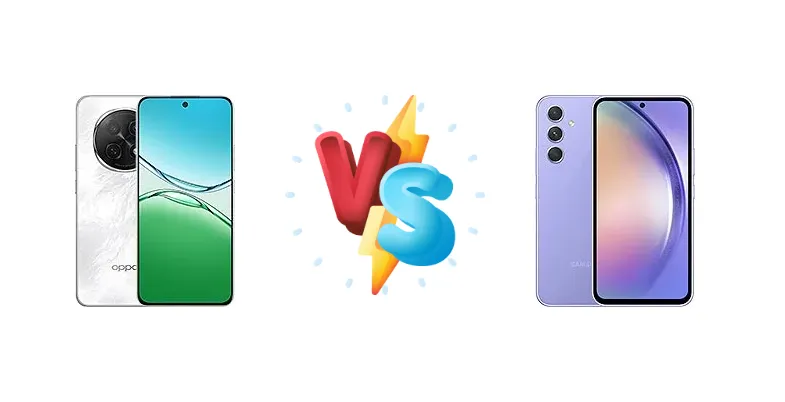
The Oppo F29 Pro and Samsung Galaxy A54 represent compelling options in the increasingly competitive mid-range smartphone market. The F29 Pro aims to deliver a performance edge with its Mediatek Dimensity 7300, while the Galaxy A54 focuses on a well-rounded experience with a strong emphasis on battery life and Samsung’s established software ecosystem. This comparison dives deep into the specifics to determine which device best suits your needs.
🏆 Quick Verdict
For users prioritizing raw performance and incredibly fast charging, the Oppo F29 Pro is the clear winner. Its Dimensity 7300 offers a slight edge in CPU performance, and the 80W charging is significantly faster than the Galaxy A54’s 25W. However, the Galaxy A54’s excellent battery endurance and refined software experience make it a strong contender for those valuing longevity and a polished user interface.
| Network |
|---|
| 2G bands | GSM 850 / 900 / 1800 / 1900 | GSM 850 / 900 / 1800 / 1900 |
| 3G bands | HSDPA 900 / 2100 | HSDPA 850 / 900 / 1700(AWS) / 1900 / 2100 |
| 4G bands | 1, 3, 5, 8, 28, 40, 41 | 1, 2, 3, 4, 5, 7, 8, 12, 17, 20, 26, 28, 32, 38, 40, 41, 66 - International |
| 5G bands | 1, 3, 5, 8, 28, 40, 41, 77, 78 SA/NSA | 1, 3, 7, 8, 20, 28, 38, 40, 41, 77, 78 SA/NSA/Sub6 - International |
| Speed | HSPA, LTE, 5G | HSPA, LTE, 5G |
| Technology | GSM / HSPA / LTE / 5G | GSM / HSPA / LTE / 5G |
| | - | 25, 41, 66, 71 SA/NSA/Sub6/mmWave - USA |
| Launch |
|---|
| Announced | 2025, March 20 | 2023, March 15 |
| Status | Available. Released 2025, April 01 | Available. Released 2023, March 24 |
| Body |
|---|
| Build | Glass front (Gorilla Glass Victus 2), fiber fabric back | Glass front (Gorilla Glass 5), glass back (Gorilla Glass 5), plastic frame |
| Dimensions | 161.5 x 74.9 x 7.6 mm (6.36 x 2.95 x 0.30 in) | 158.2 x 76.7 x 8.2 mm (6.23 x 3.02 x 0.32 in) |
| SIM | Nano-SIM + Nano-SIM | · Nano-SIM + eSIM· Nano-SIM + Nano-SIM |
| Weight | 180 g (6.35 oz) | 202 g (7.13 oz) |
| | - | IP67 dust/water resistant (up to 1m for 30 min) |
| Display |
|---|
| Protection | Corning Gorilla Glass Victus 2 | Corning Gorilla Glass 5 |
| Resolution | 1080 x 2412 pixels, 20:9 ratio (~394 ppi density) | 1080 x 2340 pixels, 19.5:9 ratio (~403 ppi density) |
| Size | 6.7 inches, 108.0 cm2 (~89.3% screen-to-body ratio) | 6.4 inches, 100.5 cm2 (~82.9% screen-to-body ratio) |
| Type | AMOLED, 1B colors, 120Hz, 600 nits (typ), 1200 nits (HBM) | Super AMOLED, 120Hz, HDR10+, 1000 nits (HBM) |
| Platform |
|---|
| CPU | Octa-core (4x2.5 GHz Cortex-A78 & 4x2.0 GHz Cortex-A55) | Octa-core (4x2.4 GHz Cortex-A78 & 4x2.0 GHz Cortex-A55) |
| Chipset | Mediatek Dimensity 7300 Energy (4 nm) | Exynos 1380 (5 nm) |
| GPU | Mali-G615 MC2 | Mali-G68 MP5 |
| OS | Android 15, ColorOS 15 | Android 13, up to 4 major Android upgrades, One UI 7 |
| Memory |
|---|
| Card slot | No | microSDXC (uses shared SIM slot) |
| Internal | 128GB 8GB RAM, 256GB 8GB RAM, 256GB 12GB RAM | 128GB 4GB RAM, 128GB 6GB RAM, 128GB 8GB RAM, 256GB 6GB RAM, 256GB 8GB RAM |
| Main Camera |
|---|
| Dual | 50 MP, f/1.8, 27mm (wide), 1/2.88", PDAF, OIS
Auxiliary lens | - |
| Features | Color spectrum sensor, LED flash, HDR, panorama | LED flash, panorama, HDR |
| Single | - | 32 MP, f/2.2, 26mm (wide), 1/2.8", 0.8µm |
| Triple | - | 50 MP, f/1.8, 23mm (wide), 1/1.56", 1.0µm, PDAF, OIS
12 MP, f/2.2, 13mm, 123˚ (ultrawide), 1/3.X", 1.12µm
5 MP (macro) |
| Video | 4K@30fps, 1080p@30/60/120/480fps, 720p@960fps, gyro-EIS, OIS | 4K@30fps, 1080p@30/60fps, 720p@480fps, gyro-EIS |
| Selfie camera |
|---|
| Single | 16 MP, f/2.4, (wide) | 32 MP, f/2.2, 26mm (wide), 1/2.8", 0.8µm |
| Video | 1080p@30fps, gyro-EIS | 4K@30fps, 1080p@30/60fps |
| Sound |
|---|
| 3.5mm jack | - | No |
| 35mm jack | No | No |
| Loudspeaker | Yes, with stereo speakers | Yes, with stereo speakers |
| Comms |
|---|
| Bluetooth | 5.4, A2DP, LE, aptX HD | 5.3, A2DP, LE |
| Infrared port | Yes | - |
| NFC | No | Yes (market/region dependent) |
| Positioning | GPS, GALILEO, GLONASS, BDS, QZSS | GPS, GLONASS, GALILEO, BDS |
| Radio | No | No |
| USB | USB Type-C 2.0, OTG | USB Type-C 2.0, OTG |
| WLAN | Wi-Fi 802.11 a/b/g/n/ac/6, dual-band | Wi-Fi 802.11 a/b/g/n/ac/6, dual-band, Wi-Fi Direct |
| Features |
|---|
| Sensors | Fingerprint (under display, optical), accelerometer, gyro, proximity, compass | Fingerprint (under display, optical), accelerometer, gyro, compass, barometer (USA only) |
| | - | Virtual proximity sensing |
| Battery |
|---|
| Charging | 80W wired, PD, 45% in 20 min | 25W wired |
| Type | Si/C Li-Ion 6000 mAh | 5000 mAh |
| Misc |
|---|
| Colors | Marble White, Granite Black | Lime, Graphite, Violet, White |
| Models | CPH2705 | SM-A546V, SM-A546U, SM-A546U1, SM-A546B, SM-A546B/DS, SM-A546E, SM-A546E/DS, SM-A5460, SM-A546M, SM-A546M/DS, SM-A546W |
| Price | About 300 EUR | € 210.00 / $ 119.11 / £ 169.95 / ₹ 28,999 |
| SAR | 1.00 W/kg (head) 0.77 W/kg (body) | 0.81 W/kg (head) 0.67 W/kg (body) |
| SAR EU | - | 0.69 W/kg (head) 1.34 W/kg (body) |
| Tests |
|---|
| Battery life | - |
Endurance rating 119h
|
| Camera | - |
Photo / Video |
| Display | - |
Contrast ratio: Infinite (nominal) |
| Loudspeaker | - |
-26.6 LUFS (Good)
|
| Performance | - |
AnTuTu: 506678 (v9)
GeekBench: 2703 (v5.1), 2797 (v6)
GFXBench: 25fps (ES 3.1 onscreen) |
Oppo F29 Pro
- Faster charging (80W)
- Potentially better CPU performance (Dimensity 7300)
- More efficient 4nm process node
- Battery capacity unknown
- Camera specs largely unspecified
Samsung Galaxy A54
- Excellent battery life (11:15h active use)
- Bright and vibrant display (980 nits)
- Samsung’s One UI software ecosystem
- Slower charging (25W)
- Exynos 1380 may throttle under heavy load
Display Comparison
The Samsung Galaxy A54 boasts a 980 nits peak brightness, ensuring excellent visibility even in direct sunlight. While the Oppo F29 Pro’s peak brightness isn’t specified, the A54’s figure is a strong benchmark. Both devices likely utilize AMOLED panels, given their market segment, but the A54’s ‘Infinite’ contrast ratio suggests a well-tuned display. The absence of LTPO technology on either device means refresh rate scaling won’t be as efficient as on flagship models, potentially impacting battery life during dynamic content viewing. Bezels are likely comparable, focusing on maximizing screen real estate within their respective form factors.
Camera Comparison
Both phones offer photo and video capabilities, but detailed sensor information is lacking for the Oppo F29 Pro. The Galaxy A54’s camera system is likely centered around a primary sensor with Optical Image Stabilization (OIS), crucial for sharp images and stable videos. Without knowing the megapixel count or aperture of the F29 Pro’s main sensor, it’s difficult to make a direct comparison. The inclusion of a 2MP macro camera on either device is largely a marketing tactic, offering limited practical benefit due to the small sensor size and lack of detail. Image processing styles will differ – Samsung typically favors vibrant, saturated colors, while Oppo often aims for a more natural look.
Performance
The Oppo F29 Pro’s Mediatek Dimensity 7300 (4nm) and the Samsung Galaxy A54’s Exynos 1380 (5nm) represent a fascinating architectural comparison. While both CPUs feature the same Cortex-A78 and A55 core configuration (4x2.5 GHz and 4x2.0 GHz vs 4x2.4 GHz and 4x2.0 GHz respectively), the Dimensity 7300’s 4nm process node provides a potential advantage in power efficiency and thermal management. This could translate to sustained performance during extended gaming sessions. The 5nm Exynos 1380 is still capable, but may be more prone to throttling under heavy load. RAM speed (LPDDR4x vs LPDDR5x, assumed for F29 Pro) will also contribute to overall responsiveness, favoring the Oppo.
Battery Life
The Samsung Galaxy A54’s endurance rating of 119 hours and active use score of 11:15h demonstrate impressive battery life. The Oppo F29 Pro’s battery capacity is unknown, but its 80W wired charging is a significant advantage. This allows for a 45% charge in just 20 minutes, drastically reducing downtime. While the A54’s 25W charging is adequate, it’s considerably slower. The F29 Pro’s faster charging could offset a potentially smaller battery capacity, providing a similar overall user experience for those who prioritize quick top-ups.
Buying Guide
Buy the Oppo F29 Pro if you need a phone for demanding tasks like mobile gaming or video editing, and value the convenience of extremely rapid charging. You’ll benefit from the newer chipset and faster power delivery. Buy the Samsung Galaxy A54 if you prioritize all-day battery life, a vibrant display, and Samsung’s feature-rich One UI software. It’s the better choice for users who prioritize a smooth, reliable experience over peak performance.
Frequently Asked Questions
❓ Does the Exynos 1380 in the Galaxy A54 overheat during prolonged gaming sessions?
The Exynos 1380 is a capable chip, but its 5nm process isn't as efficient as the 4nm Dimensity 7300 in the Oppo F29 Pro. While it won't necessarily overheat, users may experience some thermal throttling during extended, graphically demanding games, leading to a slight drop in frame rates. The A54's software likely includes thermal management features to mitigate this.
❓ How much faster is the 80W charging on the Oppo F29 Pro compared to the Galaxy A54’s 25W charging?
The Oppo F29 Pro’s 80W charging is significantly faster. It can achieve a 45% charge in just 20 minutes, whereas the Galaxy A54’s 25W charging will take considerably longer to reach the same level. This makes the F29 Pro ideal for users who frequently need to quickly top up their battery.
❓ Is the lack of detailed camera specs for the Oppo F29 Pro a cause for concern?
Yes, it is. Without knowing the sensor size, aperture, and OIS capabilities of the F29 Pro’s camera, it’s difficult to assess its image quality. The Galaxy A54’s camera system is well-defined, offering a known level of performance. The absence of this information for the F29 Pro suggests it may not be a primary strength of the device.