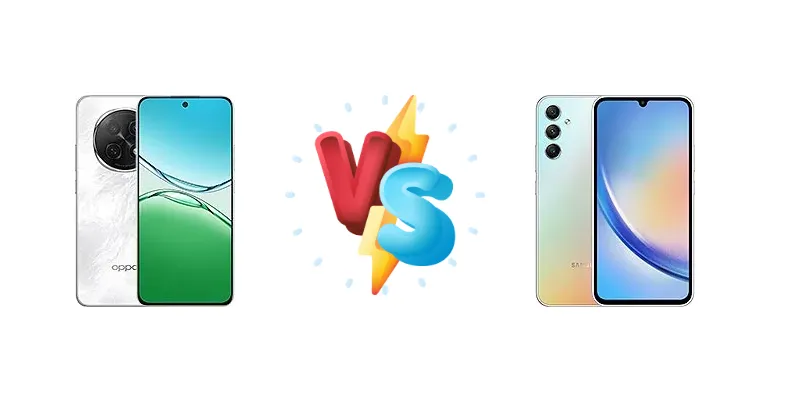
The mid-range smartphone market is fiercely competitive, and the Oppo F29 Pro and Samsung Galaxy A34 represent compelling options for users seeking a balance of features and affordability. This comparison dives deep into their specifications, focusing on the key differences in performance, display quality, charging speed, and battery endurance to help you determine which device best suits your needs.
🏆 Quick Verdict
For users prioritizing charging speed and potentially more efficient performance, the Oppo F29 Pro emerges as the winner. Its 80W charging and newer Dimensity 7300 chip offer a tangible advantage. However, the Samsung Galaxy A34 counters with a brighter display and proven battery endurance.
| Network |
|---|
| 2G bands | GSM 850 / 900 / 1800 / 1900 | GSM 850 / 900 / 1800 / 1900 |
| 3G bands | HSDPA 900 / 2100 | HSDPA 850 / 900 / 1700(AWS) / 1900 / 2100 |
| 4G bands | 1, 3, 5, 8, 28, 40, 41 | 1, 2, 3, 4, 5, 7, 8, 12, 17, 20, 26, 28, 32, 38, 40, 41, 66 |
| 5G bands | 1, 3, 5, 8, 28, 40, 41, 77, 78 SA/NSA | 1, 3, 7, 8, 20, 28, 38, 40, 41, 77, 78 SA/NSA/Sub6 |
| Speed | HSPA, LTE, 5G | HSPA, LTE, 5G |
| Technology | GSM / HSPA / LTE / 5G | GSM / HSPA / LTE / 5G |
| Launch |
|---|
| Announced | 2025, March 20 | 2023, March 14 |
| Status | Available. Released 2025, April 01 | Available. Released 2023, March 24 |
| Body |
|---|
| Build | Glass front (Gorilla Glass Victus 2), fiber fabric back | Glass front (Gorilla Glass 5), plastic frame, plastic back |
| Dimensions | 161.5 x 74.9 x 7.6 mm (6.36 x 2.95 x 0.30 in) | 161.3 x 78.1 x 8.2 mm (6.35 x 3.07 x 0.32 in) |
| SIM | Nano-SIM + Nano-SIM | · Nano-SIM· Nano-SIM + Nano-SIM |
| Weight | 180 g (6.35 oz) | 199 g (7.02 oz) |
| | - | IP67 dust/water resistant (up to 1m for 30 min) |
| Display |
|---|
| Protection | Corning Gorilla Glass Victus 2 | Corning Gorilla Glass 5 |
| Resolution | 1080 x 2412 pixels, 20:9 ratio (~394 ppi density) | 1080 x 2340 pixels, 19.5:9 ratio (~390 ppi density) |
| Size | 6.7 inches, 108.0 cm2 (~89.3% screen-to-body ratio) | 6.6 inches, 106.9 cm2 (~84.9% screen-to-body ratio) |
| Type | AMOLED, 1B colors, 120Hz, 600 nits (typ), 1200 nits (HBM) | Super AMOLED, 120Hz, 1000 nits (HBM) |
| Platform |
|---|
| CPU | Octa-core (4x2.5 GHz Cortex-A78 & 4x2.0 GHz Cortex-A55) | Octa-core (2x2.6 GHz Cortex-A78 & 6x2.0 GHz Cortex-A55) |
| Chipset | Mediatek Dimensity 7300 Energy (4 nm) | Mediatek Dimensity 1080 (6 nm) |
| GPU | Mali-G615 MC2 | Mali-G68 MC4 |
| OS | Android 15, ColorOS 15 | Android 13, up to 4 major Android upgrades, One UI 6.1 |
| Memory |
|---|
| Card slot | No | microSDXC (uses shared SIM slot) |
| Internal | 128GB 8GB RAM, 256GB 8GB RAM, 256GB 12GB RAM | 128GB 4GB RAM, 128GB 6GB RAM, 128GB 8GB RAM, 256GB 6GB RAM, 256GB 8GB RAM |
| Main Camera |
|---|
| Dual | 50 MP, f/1.8, 27mm (wide), 1/2.88", PDAF, OIS
Auxiliary lens | - |
| Features | Color spectrum sensor, LED flash, HDR, panorama | LED flash, panorama, HDR |
| Triple | - | 48 MP, f/1.8, 26mm (wide), 1/2.0", 0.8µm, PDAF, OIS
8 MP, f/2.2, 123˚, (ultrawide), 1/4.0", 1.12µm
5 MP (macro) |
| Video | 4K@30fps, 1080p@30/60/120/480fps, 720p@960fps, gyro-EIS, OIS | 4K@30fps, 1080p@30/60fps, 720p@480fps |
| Selfie camera |
|---|
| Single | 16 MP, f/2.4, (wide) | 13 MP, f/2.2, 26mm (wide), 1/3.1", 1.12µm |
| Video | 1080p@30fps, gyro-EIS | 4K@30fps, 1080p@30fps |
| Sound |
|---|
| 3.5mm jack | - | No |
| 35mm jack | No | No |
| Loudspeaker | Yes, with stereo speakers | Yes, with stereo speakers |
| Comms |
|---|
| Bluetooth | 5.4, A2DP, LE, aptX HD | 5.3, A2DP, LE |
| Infrared port | Yes | - |
| NFC | No | Yes (market/region dependent) |
| Positioning | GPS, GALILEO, GLONASS, BDS, QZSS | GPS, GLONASS, GALILEO, BDS |
| Radio | No | No |
| USB | USB Type-C 2.0, OTG | USB Type-C 2.0, OTG |
| WLAN | Wi-Fi 802.11 a/b/g/n/ac/6, dual-band | Wi-Fi 802.11 a/b/g/n/ac, dual-band, Wi-Fi Direct |
| Features |
|---|
| Sensors | Fingerprint (under display, optical), accelerometer, gyro, proximity, compass | Fingerprint (under display, optical), accelerometer, gyro, compass |
| | - | Virtual proximity sensing |
| Battery |
|---|
| Charging | 80W wired, PD, 45% in 20 min | 25W wired |
| Type | Si/C Li-Ion 6000 mAh | Li-Ion 5000 mAh |
| Misc |
|---|
| Colors | Marble White, Granite Black | Lime, Graphite, Violet, Silver |
| Models | CPH2705 | SM-A346E, SM-A346B, SM-A346B/DS, SM-A346B/DSN, SM-A346E/DS, SM-A346E/DSN, SM-A346M, SM-A346M/N, SM-A346M/DSN, SM-A3460 |
| Price | About 300 EUR | € 169.99 / $ 175.00 / £ 164.99 / ₹ 23,999 |
| SAR | 1.00 W/kg (head) 0.77 W/kg (body) | - |
| SAR EU | - | 0.55 W/kg (head) 1.49 W/kg (body) |
| Tests |
|---|
| Battery life | - |
Endurance rating 133h
|
| Camera | - |
Photo / Video |
| Display | - |
Contrast ratio: Infinite (nominal) |
| Loudspeaker | - |
-26.1 LUFS (Good)
|
| Performance | - |
AnTuTu: 472126 (v9)
GeekBench: 2316 (v5.5), 2518 (v6)
GFXBench: 23fps (ES 3.1 onscreen) |
Oppo F29 Pro
- Significantly faster 80W charging
- More efficient Dimensity 7300 (4nm) chipset
- Potentially better gaming performance
- Display brightness data unavailable
- Camera specifications unknown
Samsung Galaxy A34
- Brighter 1009 nit display for outdoor use
- Proven 133-hour battery endurance
- Samsung's established camera processing
- Slower 25W charging
- Older Dimensity 1080 (6nm) chipset
Display Comparison
The Samsung Galaxy A34 boasts a significantly brighter display, reaching a measured 1009 nits. This is crucial for outdoor visibility, a clear advantage over the Oppo F29 Pro (brightness data unavailable). While the A34’s contrast ratio is listed as ‘Infinite’ (nominal), this is typical marketing speak; real-world contrast will depend on panel technology. The Oppo F29 Pro’s display specs are currently unknown, making it difficult to assess its color accuracy or viewing angles. The A34’s brightness is a key differentiator for users who frequently use their phones outdoors.
Camera Comparison
Both devices offer photo and video capabilities, but detailed camera specifications are lacking for the Oppo F29 Pro. The Samsung Galaxy A34’s camera system is likely to be more refined, benefiting from Samsung’s image processing expertise. Without knowing the sensor sizes, apertures, or OIS implementation on the F29 Pro, it’s difficult to make a direct comparison. It's safe to assume the A34 will deliver more consistent results, especially in low-light conditions, given Samsung's track record. We'd caution against relying heavily on any 2MP macro cameras found on either device.
Performance
The Oppo F29 Pro utilizes the Mediatek Dimensity 7300 Energy (4nm), while the Samsung Galaxy A34 features the older Dimensity 1080 (6nm). The 4nm process node of the Dimensity 7300 should translate to improved power efficiency and potentially lower thermal throttling during sustained workloads. The F29 Pro’s CPU configuration (4x2.5 GHz Cortex-A78 & 4x2.0 GHz Cortex-A55) is paired with the newer chip, while the A34 has (2x2.6 GHz Cortex-A78 & 6x2.0 GHz Cortex-A55). The A34's slightly higher clock speeds on the prime cores don't necessarily equate to better real-world performance given the process node difference. Gamers and power users will likely see a benefit from the F29 Pro’s more modern chipset.
Battery Life
Both phones share an endurance rating of 133 hours, suggesting similar overall battery life despite the Oppo F29 Pro’s unknown battery capacity. However, the charging speeds are drastically different. The Oppo F29 Pro’s 80W wired charging, with PD support and a 45% charge in 20 minutes, is a significant advantage over the Samsung Galaxy A34’s 25W charging. This means the F29 Pro can quickly top up its battery, minimizing downtime, even if its overall capacity is smaller. The A34’s slower charging is a trade-off for its consistent endurance.
Buying Guide
Buy the Oppo F29 Pro if you need blazing-fast charging and anticipate demanding tasks like gaming or video editing, benefiting from the newer Dimensity 7300's architecture. Buy the Samsung Galaxy A34 if you prioritize a vibrant, easily visible display in bright conditions and value a consistently reliable battery life, even if it means slower charging speeds.
Frequently Asked Questions
❓ Does the Dimensity 7300 in the Oppo F29 Pro get hot during extended gaming sessions?
The Dimensity 7300's 4nm process should result in better thermal efficiency compared to the 6nm Dimensity 1080 in the Galaxy A34. While sustained gaming will inevitably generate heat, the F29 Pro is likely to experience less throttling and maintain higher frame rates for longer periods.
❓ How long does it *actually* take to fully charge the Oppo F29 Pro with the 80W charger?
Oppo claims a 45% charge in 20 minutes. Extrapolating from this, a full 0-100% charge should take approximately 35-45 minutes, making it significantly faster than the Samsung Galaxy A34's 25W charging, which will likely take well over an hour.
❓ Is the battery life difference between the two phones noticeable in everyday use?
Both phones have an endurance rating of 133 hours, suggesting similar battery life under typical usage. However, the Oppo F29 Pro's faster charging means you're less likely to be inconvenienced by needing to charge frequently, even if the overall battery capacity is slightly smaller.