
Oppo F29 Pro vs Nothing Phone (2): A Detailed Comparison of Performance and Battery Life
| Phones Images | |||||
|---|---|---|---|---|---|
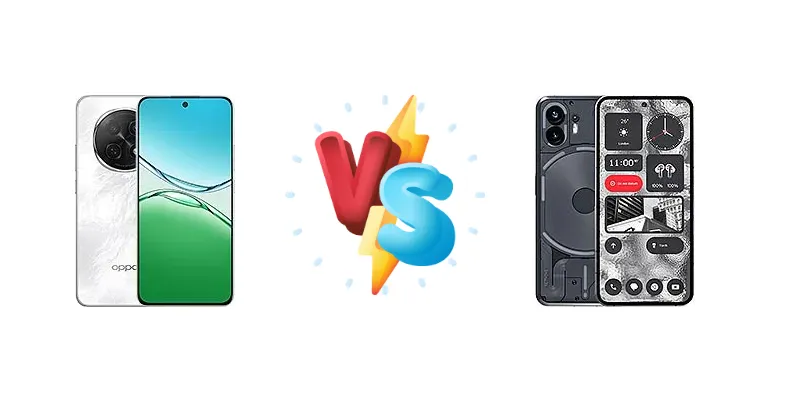
|
🏆 Quick Verdict
For the average user prioritizing longevity and a balanced experience, the Nothing Phone (2) is the better choice. Its Snapdragon 8+ Gen 1 chipset, coupled with a remarkable 14:21h active use battery score, provides sustained performance and all-day usability. While the Oppo F29 Pro boasts faster 80W charging, it can't match the Nothing Phone (2)'s overall efficiency.
| PHONES | ||
|---|---|---|
| Phone Names | Oppo F29 Pro | Nothing Phone (2) |
| Network | ||
|---|---|---|
| 2G bands | GSM 850 / 900 / 1800 / 1900 | GSM 850 / 900 / 1800 / 1900 |
| 3G bands | HSDPA 900 / 2100 | HSDPA 800 / 850 / 900 / 1700(AWS) / 1900 / 2100 |
| 4G bands | 1, 3, 5, 8, 28, 40, 41 | 1, 2, 3, 4, 5, 7, 8, 12, 17, 18, 19, 20, 25, 26, 28, 30, 32, 34, 38, 39, 40, 41, 42, 48, 66, 71 |
| 5G bands | 1, 3, 5, 8, 28, 40, 41, 77, 78 SA/NSA | 1, 2, 3, 5, 7, 8, 12, 20, 25, 28, 30, 38, 40, 41, 66, 71, 75, 77, 78 SA/NSA |
| Speed | HSPA, LTE, 5G | HSPA, LTE, 5G |
| Technology | GSM / HSPA / LTE / 5G | GSM / HSPA / LTE / 5G |
| Launch | ||
|---|---|---|
| Announced | 2025, March 20 | 2023, July 11 |
| Status | Available. Released 2025, April 01 | Available. Released 2023, July 17 |
| Body | ||
|---|---|---|
| Build | Glass front (Gorilla Glass Victus 2), fiber fabric back | Glass front (Gorilla Glass 5), glass back (Gorilla Glass 5), aluminum frame |
| Dimensions | 161.5 x 74.9 x 7.6 mm (6.36 x 2.95 x 0.30 in) | 162.1 x 76.4 x 8.6 mm (6.38 x 3.01 x 0.34 in) |
| SIM | Nano-SIM + Nano-SIM | Nano-SIM + Nano-SIM |
| Weight | 180 g (6.35 oz) | 201.2 g (7.09 oz) |
| Display | ||
|---|---|---|
| Protection | Corning Gorilla Glass Victus 2 | Corning Gorilla Glass 5 |
| Resolution | 1080 x 2412 pixels, 20:9 ratio (~394 ppi density) | 1080 x 2412 pixels, 20:9 ratio (~394 ppi density) |
| Size | 6.7 inches, 108.0 cm2 (~89.3% screen-to-body ratio) | 6.7 inches, 108.0 cm2 (~87.2% screen-to-body ratio) |
| Type | AMOLED, 1B colors, 120Hz, 600 nits (typ), 1200 nits (HBM) | LTPO OLED, 1B colors, 120Hz, 1920Hz PWM, HDR10+, 1600 nits (HBM), 1600 nits (peak) |
| Platform | ||
|---|---|---|
| CPU | Octa-core (4x2.5 GHz Cortex-A78 & 4x2.0 GHz Cortex-A55) | Octa-core (1x3.0 GHz Cortex-X2 & 3x2.5 GHz Cortex-A710 & 4x1.80 GHz Cortex-A510) |
| Chipset | Mediatek Dimensity 7300 Energy (4 nm) | Qualcomm SM8475 Snapdragon 8+ Gen 1 (4 nm) |
| GPU | Mali-G615 MC2 | Adreno 730 |
| OS | Android 15, ColorOS 15 | Android 13, upgradable to Android 15, up to 3 major Android upgrades, Nothing OS 3.0 |
| Memory | ||
|---|---|---|
| Card slot | No | No |
| Internal | 128GB 8GB RAM, 256GB 8GB RAM, 256GB 12GB RAM | 128GB 8GB RAM, 256GB 12GB RAM, 512GB 12GB RAM |
| Main Camera | ||
|---|---|---|
| Dual | 50 MP, f/1.8, 27mm (wide), 1/2.88", PDAF, OIS Auxiliary lens | 50 MP, f/1.9, 24mm (wide), 1/1.56", 1.0µm, PDAF, OIS 50 MP, f/2.2, 114˚ (ultrawide), 1/2.76", 0.64µm, AF |
| Features | Color spectrum sensor, LED flash, HDR, panorama | LED flash, panorama, HDR |
| Video | 4K@30fps, 1080p@30/60/120/480fps, 720p@960fps, gyro-EIS, OIS | 4K@30/60fps, 1080p@30/60fps, gyro-EIS, live HDR, OIS |
| Selfie camera | ||
|---|---|---|
| Features | - | HDR |
| Single | 16 MP, f/2.4, (wide) | 32 MP, f/2.5, (wide), 1/2.74", 0.8µm |
| Video | 1080p@30fps, gyro-EIS | 1080p@30fps |
| Sound | ||
|---|---|---|
| 35mm jack | No | No |
| Loudspeaker | Yes, with stereo speakers | Yes, with stereo speakers |
| Comms | ||
|---|---|---|
| Bluetooth | 5.4, A2DP, LE, aptX HD | 5.3, A2DP, LE, aptX HD, aptX Adaptive |
| Infrared port | Yes | - |
| NFC | No | Yes |
| Positioning | GPS, GALILEO, GLONASS, BDS, QZSS | GPS (L1+L5), GLONASS (L1), BDS (B1I+B1c), GALILEO (E1), QZSS (L1), NavIC |
| Radio | No | No |
| USB | USB Type-C 2.0, OTG | USB Type-C 2.0, OTG |
| WLAN | Wi-Fi 802.11 a/b/g/n/ac/6, dual-band | Wi-Fi 802.11 a/b/g/n/ac/6, dual-band, Wi-Fi Direct |
| Features | ||
|---|---|---|
| Sensors | Fingerprint (under display, optical), accelerometer, gyro, proximity, compass | Fingerprint (under display, optical), accelerometer, proximity, gyro, compass |
| Battery | ||
|---|---|---|
| Charging | 80W wired, PD, 45% in 20 min | 45W wired, PD3.0, PPS, QC4, 100% in 55 min 15W wireless, 100% in 130 min 5W reverse wireless |
| Type | Si/C Li-Ion 6000 mAh | Li-Ion 4700 mAh |
| Misc | ||
|---|---|---|
| Colors | Marble White, Granite Black | White, Dark Gray |
| Models | CPH2705 | A065 |
| Price | About 300 EUR | $ 379.99 / £ 370.00 |
| SAR | 1.00 W/kg (head) 0.77 W/kg (body) | - |
Oppo F29 Pro
- 80W SuperVOOC charging for incredibly fast top-ups.
- Mediatek Dimensity 7300 Energy offers good efficiency.
- Potentially lower price point compared to the Nothing Phone (2).
- Battery life is unknown and likely less than the Nothing Phone (2).
- Camera specifications are limited, making it difficult to assess quality.
Nothing Phone (2)
- Exceptional battery life with 14:21h active use and 103h endurance.
- Powerful Snapdragon 8+ Gen 1 processor for smooth performance.
- 45W wired and 15W wireless charging with reverse wireless capabilities.
- Charging speed is slower than the Oppo F29 Pro.
- Higher price point compared to some competitors.
Display Comparison
The Nothing Phone (2) boasts a measured peak brightness of 998 nits, suggesting a vibrant and easily viewable display even in direct sunlight. While the Oppo F29 Pro’s display specifications are not provided, it’s reasonable to assume it falls slightly behind in peak brightness given the Nothing Phone (2)'s focus on display quality. The absence of LTPO technology in either phone means refresh rate scaling isn't as efficient as flagship devices, but both likely employ adaptive refresh rates to conserve power. Bezels and color accuracy are not specified, but Nothing’s design language emphasizes a clean, immersive viewing experience.
Camera Comparison
Detailed camera specifications for both phones are limited. However, the focus should be on the main sensor and image processing capabilities. The Nothing Phone (2) is marketed with a strong emphasis on its photo and video capabilities, suggesting a well-tuned camera system. The Oppo F29 Pro’s camera performance is less clear without specific sensor details. The presence of a 2MP macro camera on either device is largely irrelevant; image quality from such sensors is typically poor. The aperture and OIS (Optical Image Stabilization) are critical factors not provided, but the Snapdragon 8+ Gen 1’s ISP (Image Signal Processor) in the Nothing Phone (2) is likely more advanced.
Performance
The Nothing Phone (2) leverages the Qualcomm Snapdragon 8+ Gen 1 (4nm), a proven performer with an octa-core CPU configuration featuring a Cortex-X2 prime core clocked at 3.0 GHz. This contrasts with the Oppo F29 Pro’s Mediatek Dimensity 7300 Energy (4nm) which utilizes a Cortex-A78 based core configuration, peaking at 2.5 GHz. While both chips are built on a 4nm process for improved efficiency, the Snapdragon 8+ Gen 1’s architecture provides a performance advantage, particularly in sustained workloads. The Nothing Phone (2) is likely to exhibit less thermal throttling during extended gaming sessions. The Dimensity 7300 Energy is a newer chip, but the Snapdragon 8+ Gen 1’s mature optimization and higher peak clock speeds give it an edge.
Battery Life
The Nothing Phone (2) truly shines in battery life, achieving an impressive 14:21h of active use and an endurance rating of 103 hours. This significantly outperforms many competitors. The Oppo F29 Pro, while offering 80W wired charging – capable of reaching 45% charge in 20 minutes – doesn’t disclose its battery capacity or endurance. The Nothing Phone (2) supports 45W wired charging (100% in 55 minutes), 15W wireless charging (100% in 130 minutes), and even 5W reverse wireless charging. The faster wired charging of the Oppo F29 Pro is beneficial for quick top-ups, but the Nothing Phone (2)'s superior battery life reduces the need for frequent charging.
Buying Guide
Buy the Oppo F29 Pro if you absolutely need the fastest possible charging speeds and frequently top up your phone throughout the day. Its 80W wired charging can get you from 0 to 45% in just 20 minutes. Buy the Nothing Phone (2) if you value long-lasting battery life, a smooth and responsive user interface, and a more holistic smartphone experience. The Snapdragon 8+ Gen 1 offers excellent performance without sacrificing efficiency.