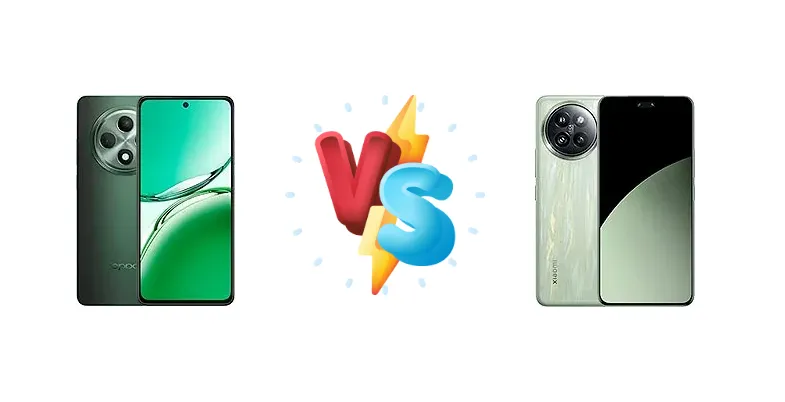
The mid-range smartphone market is fiercely competitive, and the Xiaomi 14 Civi and Oppo F27 represent compelling options. The Civi leverages Qualcomm’s latest Snapdragon 8s Gen 3, aiming for near-flagship performance, while the F27 counters with a focus on fast charging and a more established brand presence. This comparison dissects their key differences to help you choose the right device.
🏆 Quick Verdict
For users prioritizing raw performance and a brighter display, the Xiaomi 14 Civi is the clear winner. Its Snapdragon 8s Gen 3 chipset delivers a significant performance uplift. However, the Oppo F27 remains a strong contender for those valuing fast charging and a potentially more refined software experience.
| Network |
|---|
| 2G bands | GSM 850 / 900 / 1800 / 1900 | GSM 850 / 900 / 1800 / 1900 |
| 3G bands | HSDPA 900 / 2100 | HSDPA 800 / 850 / 900 / 1700(AWS) / 1900 / 2100 |
| 4G bands | 1, 3, 5, 8, 28, 40, 41 | 1, 3, 5, 8, 28, 40, 41 |
| 5G bands | 1, 3, 5, 8, 28, 40, 41, 77, 78 SA/NSA | 1, 3, 5, 8, 28, 40, 41, 78 SA/NSA |
| Speed | HSPA, LTE, 5G | HSPA, LTE, 5G |
| Technology | GSM / HSPA / LTE / 5G | GSM / HSPA / LTE / 5G |
| Launch |
|---|
| Announced | 2024, August 20 | 2024, June 12 |
| Status | Available. Released 2024, August 20 | Available. Released 2024, June 20 |
| Body |
|---|
| Build | - | Glass front (Gorilla Glass Victus 2), glass back or silicone polymer back (eco leather), aluminum frame |
| Dimensions | 163 x 75.8 x 7.7 mm (6.42 x 2.98 x 0.30 in) | 157.2 x 72.8 x 7.5 mm or 7.8 mm |
| SIM | Nano-SIM + Nano-SIM | Nano-SIM + Nano-SIM |
| Weight | 187 g (6.60 oz) | 177.6 g or 179.3 g (6.28 oz) |
| Display |
|---|
| Protection | Asahi Glass AGC DT-Star2 | Corning Gorilla Glass Victus 2 |
| Resolution | 1080 x 2400 pixels, 20:9 ratio (~395 ppi density) | 1236 x 2750 pixels, 20:9 ratio (~460 ppi density) |
| Size | 6.67 inches, 107.4 cm2 (~86.9% screen-to-body ratio) | 6.55 inches, 103.5 cm2 (~90.4% screen-to-body ratio) |
| Type | AMOLED, 120Hz, 600 nits (typ), 1200 nits (HMB), 2100 nits (peak) | AMOLED, 68B colors, 120Hz, Dolby Vision, HDR10+, 3000 nits (peak) |
| Platform |
|---|
| CPU | Octa-core (2x2.4 GHz Cortex-A76 & 6x2.0 GHz Cortex-A55) | Octa-core (1x3.0 GHz Cortex-X4 & 4x2.8 GHz Cortex-A720 & 3x2.0 GHz Cortex-A520) |
| Chipset | Mediatek Dimensity 6300 (6 nm) | Qualcomm SM8635 Snapdragon 8s Gen 3 (4 nm) |
| GPU | Mali-G57 MC2 | Adreno 735 |
| OS | Android 14, ColorOS 14 | Android 14, HyperOS |
| Memory |
|---|
| Card slot | microSDXC | No |
| Internal | 128GB 8GB RAM, 256GB 8GB RAM | 256GB 8GB RAM, 512GB 12GB RAM |
| Main Camera |
|---|
| Dual | 50 MP, f/1.8, 26mm (wide), PDAF
Auxiliary lens | - |
| Features | LED flash, HDR, panorama | Dual-LED flash, HDR, panorama, Leica lenses |
| Triple | - | 50 MP, f/1.6, 25mm (wide), 1/1.55", 1.0µm, PDAF, OIS
50 MP, f/2.0, 50mm (telephoto), 0.64µm, PDAF, 2x optical zoom
12 MP, f/2.2, 15mm, 120˚ (ultrawide), 1.12µm |
| Video | 1080p@30/60fps, gyro-EIS | 4K@24/30/60fps, 1080p@30/60/120/240/960fps, 720p@1920fps, gyro-EIS |
| Selfie camera |
|---|
| Dual | - | 32 MP, f/2.0, 26mm (wide), 1/2.8", 0.8µm, AF
32 MP, f/2.4, 100˚ (ultrawide), 1/2.8", 0.8µm |
| Features | Panorama | HDR |
| Single | 32 MP, f/2.4, 22mm (wide), 1/2.74", 0.8µm | - |
| Video | 1080p@30fps | 4K@30fps, 1080p@30/60fps; gyro-EIS |
| Sound |
|---|
| 35mm jack | No | No |
| Loudspeaker | Yes, with stereo speakers | Yes, with stereo speakers |
| Comms |
|---|
| Bluetooth | 5.3, A2DP, LE, aptX HD | 5.4, A2DP, LE |
| Infrared port | Yes | Yes |
| NFC | Yes (market/region dependent) | Yes |
| Positioning | GPS, GLONASS, GALILEO, BDS, QZSS | GPS, GLONASS, GALILEO, BDS, NavIC |
| Radio | Unspecified | No |
| USB | USB Type-C 2.0, OTG | USB Type-C 2.0, OTG |
| WLAN | Wi-Fi 802.11 a/b/g/n/ac, dual-band | Wi-Fi 802.11 a/b/g/n/ac/6, dual-band, Wi-Fi Direct |
| Features |
|---|
| Sensors | Fingerprint (under display, optical), accelerometer, gyro, proximity, compass | Fingerprint (under display, optical), accelerometer, gyro, proximity, compass |
| Battery |
|---|
| Charging | 45W wired, PD3.0
Reverse wired | 67W wired, PD3.0, 100% in 40 minutes |
| Type | 5000 mAh | Li-Po 4700 mAh |
| Misc |
|---|
| Colors | Emerald Green, Amber Orange | Cruise Blue, Matcha Green, Shadow Black |
| Models | - | 24053PY09I |
| Price | ₹ 18,999 | ₹ 26,249 |
| SAR | - | 0.93 W/kg (head) 0.81 W/kg (body) |
Oppo F27
- Faster 45W charging with PD3.0
- Established brand reputation
- Potentially more refined software experience
- Less powerful Dimensity 6300 chipset
- Display brightness likely lower than Xiaomi 14 Civi
Xiaomi 14 Civi
- Significantly more powerful Snapdragon 8s Gen 3
- Brighter 1441 nit display
- Faster 67W charging (100% in 40 mins)
- Excellent battery life (11:36h active use)
- Xiaomi’s MIUI software can be polarizing
- Potentially higher price point
Display Comparison
The Xiaomi 14 Civi immediately stands out with its measured peak brightness of 1441 nits, offering superior visibility in direct sunlight compared to the Oppo F27 (brightness data unavailable). While the F27’s panel technology isn’t specified, the Civi’s high brightness suggests a more advanced panel, potentially AMOLED. The Civi’s brightness advantage will be particularly noticeable for users consuming HDR content or using the phone outdoors frequently. Bezels are likely comparable given the market segment, but the Civi’s display is the clear winner in terms of raw performance.
Camera Comparison
Without detailed camera specifications for either device, a direct comparison is difficult. However, given the Xiaomi 14 Civi’s positioning, it’s reasonable to expect a more sophisticated camera system. The Snapdragon 8s Gen 3’s ISP (Image Signal Processor) is more advanced than the Dimensity 6300’s, potentially leading to better image processing, especially in low-light conditions. We can assume both phones will feature a primary camera, but the Civi likely benefits from a larger sensor and more advanced features like optical image stabilization (OIS). The presence of a 2MP macro camera on either device is unlikely to significantly impact image quality.
Performance
The core difference lies in the chipsets. The Xiaomi 14 Civi’s Snapdragon 8s Gen 3 (4nm) is a significant step up from the Oppo F27’s Mediatek Dimensity 6300 (6nm). The Snapdragon 8s Gen 3 features a 1x3.0 GHz Cortex-X4 prime core, alongside 4x2.8 GHz Cortex-A720 cores, and 3x2.0 GHz Cortex-A520 cores, offering substantially higher single-core and multi-core performance than the F27’s 2x2.4 GHz Cortex-A76 and 6x2.0 GHz Cortex-A55 configuration. The 4nm process node of the Snapdragon also translates to better thermal efficiency, reducing the likelihood of throttling during sustained workloads like gaming. This makes the Civi the superior choice for gamers and power users.
Battery Life
The Xiaomi 14 Civi boasts a significant advantage in charging speed with its 67W wired charging, capable of reaching 100% in just 40 minutes. The Oppo F27’s 45W charging, while still fast, is noticeably slower. The Civi also demonstrates strong battery life with an active use score of 11:36h, suggesting efficient power management. While the F27’s battery capacity is unknown, the Civi’s combination of fast charging and efficient power consumption makes it the more convenient option for users who frequently need to top up their battery.
Buying Guide
Buy the Oppo F27 if you need a reliable daily driver with exceptionally fast charging and prioritize a brand known for consistent software updates. Buy the Xiaomi 14 Civi if you prefer a more powerful processor for demanding tasks like gaming and content creation, and a brighter, more vibrant display is essential. The Civi is geared towards power users, while the F27 caters to everyday users.
Frequently Asked Questions
❓ Does the Snapdragon 8s Gen 3 in the Xiaomi 14 Civi get hot during extended gaming sessions?
The Snapdragon 8s Gen 3 is built on a 4nm process, which offers improved thermal efficiency compared to the 6nm Dimensity 6300 in the Oppo F27. While some heat generation is inevitable during prolonged gaming, the Civi is less likely to experience significant throttling, maintaining higher frame rates for longer periods.
❓ How does the 67W charging on the Xiaomi 14 Civi compare to the 45W charging on the Oppo F27 in real-world use?
The Xiaomi 14 Civi’s 67W charging is significantly faster, reaching 100% in just 40 minutes. The Oppo F27’s 45W charging will take considerably longer. This difference is most noticeable for users who frequently need to quickly top up their battery throughout the day.
❓ Is the difference in chipset performance between the Snapdragon 8s Gen 3 and Dimensity 6300 noticeable for everyday tasks like browsing and social media?
For basic tasks, the difference may not be immediately apparent. However, the Snapdragon 8s Gen 3 provides a smoother and more responsive experience when multitasking, switching between apps, and handling demanding applications. The Civi will also age better as apps become more resource-intensive.