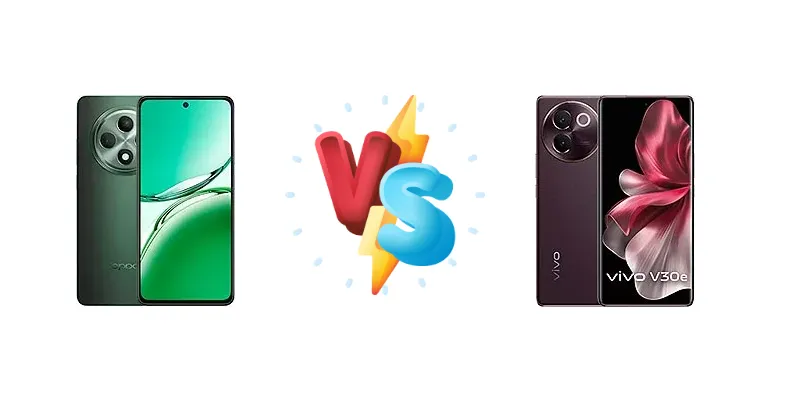
The Oppo F27 and vivo V30e represent a competitive segment of the smartphone market, targeting users who want a balance of features without breaking the bank. Both devices offer fast charging and modern designs, but diverge significantly in their core processing power, with Oppo opting for MediaTek’s Dimensity 6300 and vivo choosing the Qualcomm Snapdragon 6 Gen 1. This comparison will dissect these differences to determine which phone delivers the best experience for your needs.
🏆 Quick Verdict
For the average user prioritizing sustained performance and potentially better long-term software support, the vivo V30e emerges as the stronger contender. Its Snapdragon 6 Gen 1, built on a more efficient 4nm process, offers a slight edge in CPU and GPU performance, translating to smoother multitasking and gaming. However, the Oppo F27’s 45W charging provides a marginal advantage in topping up the battery.
| Network |
|---|
| 2G bands | GSM 850 / 900 / 1800 / 1900 | GSM 850 / 900 / 1800 / 1900 |
| 3G bands | HSDPA 900 / 2100 | HSDPA 850 / 900 / 1700(AWS) / 1900 / 2100 - Malaysia |
| 4G bands | 1, 3, 5, 8, 28, 40, 41 | 1, 2, 3, 4, 5, 7, 8, 18, 19, 20, 26, 28, 38, 39, 40, 41 - Malaysia |
| 5G bands | 1, 3, 5, 8, 28, 40, 41, 77, 78 SA/NSA | 1, 3, 5, 7, 8, 20, 28, 38, 40, 41, 77, 78 SA/NSA - Malaysia |
| Speed | HSPA, LTE, 5G | HSPA, LTE, 5G |
| Technology | GSM / HSPA / LTE / 5G | GSM / HSPA / LTE / 5G |
| Launch |
|---|
| Announced | 2024, August 20 | 2024, May 02 |
| Status | Available. Released 2024, August 20 | Available. Released 2024, May 09 |
| Body |
|---|
| Build | - | Glass front, plastic frame, glass back or plastic back |
| Dimensions | 163 x 75.8 x 7.7 mm (6.42 x 2.98 x 0.30 in) | 164.4 x 74.8 x 7.7 mm (6.47 x 2.94 x 0.30 in) |
| SIM | Nano-SIM + Nano-SIM | Nano-SIM + Nano-SIM |
| Weight | 187 g (6.60 oz) | 179 g or 188 g (6.31 oz) |
| Display |
|---|
| Protection | Asahi Glass AGC DT-Star2 | Schott Xensation |
| Resolution | 1080 x 2400 pixels, 20:9 ratio (~395 ppi density) | 1080 x 2400 pixels, 20:9 ratio (~388 ppi density) |
| Size | 6.67 inches, 107.4 cm2 (~86.9% screen-to-body ratio) | 6.78 inches, 111.0 cm2 (~90.3% screen-to-body ratio) |
| Type | AMOLED, 120Hz, 600 nits (typ), 1200 nits (HMB), 2100 nits (peak) | AMOLED, 1B colors, 120Hz, 1300 nits (peak) |
| Platform |
|---|
| CPU | Octa-core (2x2.4 GHz Cortex-A76 & 6x2.0 GHz Cortex-A55) | Octa-core (4x2.2 GHz Cortex-A78 & 4x1.8 GHz Cortex-A55) |
| Chipset | Mediatek Dimensity 6300 (6 nm) | Qualcomm SM6450 Snapdragon 6 Gen 1 (4 nm) |
| GPU | Mali-G57 MC2 | Adreno 710 |
| OS | Android 14, ColorOS 14 | Android 14, Funtouch 14 |
| Memory |
|---|
| Card slot | microSDXC | microSDXC (uses shared SIM slot) |
| Internal | 128GB 8GB RAM, 256GB 8GB RAM | 128GB 8GB RAM, 256GB 8GB RAM, 256GB 12GB RAM |
| Main Camera |
|---|
| Dual | 50 MP, f/1.8, 26mm (wide), PDAF
Auxiliary lens | 50 MP, f/1.8, 26mm (wide), 1/1.95", 0.8µm, PDAF, OIS (India only)
8 MP, f/2.2, 120˚ (ultrawide), 1/4.0", 1.12µm |
| Features | LED flash, HDR, panorama | Ring-LED flash, panorama, HDR |
| Video | 1080p@30/60fps, gyro-EIS | 4K@30fps, 1080p@30fps |
| Selfie camera |
|---|
| Features | Panorama | - |
| Single | 32 MP, f/2.4, 22mm (wide), 1/2.74", 0.8µm | 50 MP, f/2.5, 25mm (wide), AF - India
32 MP, f/2.0, 24mm (wide) - Malaysia |
| Video | 1080p@30fps | 4K@30fps (India only), 1080p@30fps |
| Sound |
|---|
| 35mm jack | No | No |
| Loudspeaker | Yes, with stereo speakers | Yes |
| Comms |
|---|
| Bluetooth | 5.3, A2DP, LE, aptX HD | 5.1, A2DP, LE |
| Infrared port | Yes | - |
| NFC | Yes (market/region dependent) | Yes (market/region dependent) |
| Positioning | GPS, GLONASS, GALILEO, BDS, QZSS | GPS, GLONASS, GALILEO, BDS, QZSS, NavIC |
| Radio | Unspecified | No |
| USB | USB Type-C 2.0, OTG | USB Type-C 2.0, OTG |
| WLAN | Wi-Fi 802.11 a/b/g/n/ac, dual-band | Wi-Fi 802.11 a/b/g/n/ac, dual-band |
| Features |
|---|
| Sensors | Fingerprint (under display, optical), accelerometer, gyro, proximity, compass | Fingerprint (under display, optical), accelerometer, gyro, proximity, compass |
| Battery |
|---|
| Charging | 45W wired, PD3.0
Reverse wired | 44W wired, PD
Reverse wired |
| Type | 5000 mAh | Li-Ion 5500 mAh |
| Misc |
|---|
| Colors | Emerald Green, Amber Orange | Velvet Red (Coco Brown), Silk Blue, Sky Mirror |
| Models | - | V2339 |
| Price | ₹ 18,999 | ₹ 23,999 |
Oppo F27
- Faster 45W charging
- PD3.0 charging protocol support
- Potentially more vibrant image processing
- Less efficient 6nm chipset
- Potentially more thermal throttling
- Older CPU core architecture
vivo V30e
- More efficient 4nm chipset
- Modern CPU core architecture (Cortex-A78)
- Potentially better sustained performance
- Slightly slower 44W charging
- May have a more neutral image processing style
- Potential for software bloat (typical of vivo)
Display Comparison
Neither Oppo nor vivo provide display specifications beyond the basics. Assuming both utilize standard LCD or AMOLED panels common in this price bracket, the key differentiator will be color accuracy and peak brightness. Without specific nit ratings, it’s difficult to declare a winner, but the panel technology used will be crucial. The absence of high refresh rates (90Hz or 120Hz) is a common omission in this segment, meaning both phones will likely offer a standard 60Hz experience.
Camera Comparison
Without detailed camera specs, a direct comparison is challenging. However, the market segment suggests both phones will feature a primary camera, an ultrawide, and potentially a macro lens. The sensor size of the main camera will be the most critical factor. Larger sensors capture more light, resulting in better low-light performance. Image processing algorithms will also play a significant role, with Oppo and vivo typically employing different styles – Oppo often favoring vibrant colors, while vivo leans towards more natural tones. The presence (or absence) of Optical Image Stabilization (OIS) on the main sensor would be a significant advantage for video recording and low-light photography.
Performance
The core battleground lies in the chipsets. The vivo V30e’s Snapdragon 6 Gen 1 (4nm) boasts a more modern architecture and fabrication process than the Oppo F27’s Dimensity 6300 (6nm). While the Dimensity 6300 features two Cortex-A76 cores clocked at 2.4GHz, the Snapdragon 6 Gen 1 counters with four Cortex-A78 cores at 2.2GHz. The A78 cores are generally more efficient and offer better single-core performance. The 4nm process of the Snapdragon also contributes to better thermal efficiency, potentially reducing throttling during extended gaming sessions. This translates to a smoother experience for demanding applications and games on the vivo V30e.
Battery Life
Both phones offer fast charging, with the Oppo F27 supporting 45W wired charging (PD3.0) and the vivo V30e at 44W (PD). While the difference is marginal, the 45W charging on the Oppo F27 will likely result in slightly faster 0-100% charge times. However, the Snapdragon 6 Gen 1’s 4nm process in the vivo V30e is more power-efficient, potentially offsetting the slightly slower charging speed with longer battery life during typical usage. The inclusion of reverse wired charging on both devices is a convenient feature for topping up accessories.
Buying Guide
Buy the Oppo F27 if you prioritize faster charging speeds and frequently need to quickly replenish your battery, even if it means potentially sacrificing a small amount of sustained performance. Buy the vivo V30e if you value a more efficient processor for smoother multitasking, potentially better gaming performance, and a more modern manufacturing process that could lead to improved thermal management and longer software support.
Frequently Asked Questions
❓ Will the Snapdragon 6 Gen 1 in the vivo V30e handle demanding games like PUBG Mobile smoothly?
The Snapdragon 6 Gen 1 is capable of running PUBG Mobile at medium to high settings with stable frame rates. The 4nm process and Cortex-A78 cores contribute to better thermal management, reducing the likelihood of significant frame drops during extended gaming sessions compared to the Oppo F27’s Dimensity 6300.
❓ Does the Oppo F27's 45W charging significantly reduce charging time compared to the vivo V30e's 44W?
The difference in charging speed is relatively small. While the Oppo F27 will likely charge slightly faster, the real-world difference will likely be a matter of minutes. The Snapdragon 6 Gen 1’s efficiency in the vivo V30e may also offset this difference by requiring less frequent charging.
❓ Which phone is likely to receive more software updates and security patches?
Qualcomm typically provides longer chipset support than MediaTek. Therefore, the vivo V30e, powered by the Snapdragon 6 Gen 1, is likely to receive more frequent and longer-lasting software updates and security patches compared to the Oppo F27.
❓ Is the difference in CPU architecture (A76 vs A78) noticeable in everyday tasks?
For basic tasks like browsing, social media, and messaging, the difference may be minimal. However, the Cortex-A78 cores in the Snapdragon 6 Gen 1 offer better single-core performance, which will be noticeable in more demanding applications and multitasking scenarios.