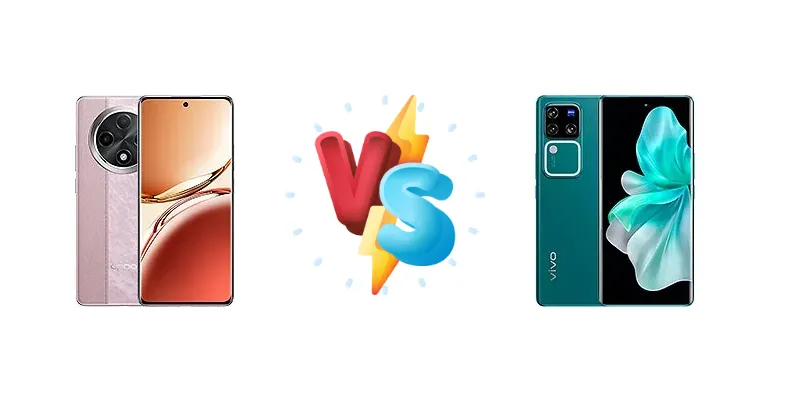
The Oppo F27 Pro+ and vivo V30 Pro represent compelling options in the increasingly competitive mid-range smartphone market. While both leverage Mediatek's Dimensity series, they diverge in chipset choice and feature prioritization, creating a clear distinction for potential buyers. This comparison will dissect their strengths and weaknesses to determine which device offers the best overall package.
🏆 Quick Verdict
For the average user prioritizing sustained performance and display quality, the vivo V30 Pro emerges as the stronger contender. Its Dimensity 8200 chipset, built on a more efficient 4nm process, provides a noticeable performance edge, complemented by a brighter, more vibrant display. However, the F27 Pro+ offers competitive charging speeds and may appeal to budget-conscious buyers.
| Network |
|---|
| 2G bands | GSM 850 / 900 / 1800 / 1900 | GSM 850 / 900 / 1800 / 1900 |
| 3G bands | HSDPA 900 / 2100 | HSDPA 850 / 900 / 1700(AWS) / 1900 / 2100 |
| 4G bands | 1, 3, 5, 8, 28, 40, 41 | 1, 2, 3, 4, 5, 7, 8, 12, 17, 18, 19, 20, 26, 28, 38, 39, 40, 41 |
| 5G bands | 1, 3, 5, 8, 28, 77, 78 SA/NSA | 1, 3, 5, 7, 8, 20, 28, 38, 40, 41, 77, 78 SA/NSA |
| Speed | HSPA, LTE, 5G | HSPA, LTE, 5G |
| Technology | GSM / HSPA / LTE / 5G | GSM / CDMA / HSPA / LTE / 5G |
| Launch |
|---|
| Announced | 2024, June 13 | 2024, February 28 |
| Status | Available. Released 2024, June 20 | Available. Released 2024, March 07 |
| Body |
|---|
| Build | - | Glass front (Schott α), glass back, plastic frame |
| Dimensions | 162.7 x 74.3 x 7.9 mm (6.41 x 2.93 x 0.31 in) | 164.4 x 75.1 x 7.5 mm (6.47 x 2.96 x 0.30 in) |
| SIM | Nano-SIM + Nano-SIM | Nano-SIM + Nano-SIM |
| Weight | 177 g (6.24 oz) | 188 g (6.63 oz) |
| Display |
|---|
| Protection | Corning Gorilla Glass Victus 2 | Schott α glass |
| Resolution | 1080 x 2412 pixels, 20:9 ratio (~394 ppi density) | 1260 x 2800 pixels, 20:9 ratio (~453 ppi density) |
| Size | 6.7 inches, 108.0 cm2 (~89.4% screen-to-body ratio) | 6.78 inches, 111.0 cm2 (~89.9% screen-to-body ratio) |
| Type | AMOLED, 1B colors, 120Hz, 500 nits (typ), 800 nits (HBM), 950 nits (peak) | AMOLED, 1B colors, HDR10+, 120Hz, 2800 nits (peak) |
| Platform |
|---|
| CPU | Octa-core (2x2.6 GHz Cortex-A78 & 6x2.0 GHz Cortex-A55) | Octa-core (1x3.1 GHz Cortex-A78 & 3x3.0 GHz Cortex-A78 & 4x2.0 GHz Cortex-A55) |
| Chipset | Mediatek Dimensity 7050 (6 nm) | Mediatek Dimensity 8200 (4 nm) |
| GPU | Mali-G68 MC4 | Mali-G610 MC6 |
| OS | Android 14, ColorOS 14 | Android 14, up to 2 major Android upgrades, Funtouch 14 |
| Memory |
|---|
| Card slot | No | No |
| Internal | 128GB 8GB RAM, 256GB 8GB RAM | 256GB 8GB RAM, 256GB 12GB RAM, 512GB 12GB RAM |
| Main Camera |
|---|
| Dual | 64 MP, f/1.7, (wide), 1/2.0", 0.7µm, PDAF
2 MP (macro) | - |
| Features | LED flash, HDR, panorama | Zeiss optics, Zeiss T* lens coating, Ring-LED flash, panorama, HDR |
| Triple | - | 50 MP, f/1.9, 23mm (wide), 1/1.49", 1.0µm, PDAF, OIS
50 MP, f/1.9, 50mm (telephoto), 1/2.51", 0.64µm, PDAF, 2x optical zoom
50 MP, f/2.0, 15mm, 119˚ (ultrawide), 1/2.76", 0.64µm, AF |
| Video | 4K@30fps, 1080p@30/60/120/480fps, 720p@960fps, gyro-EIS | 4K@30fps, 1080p@30fps |
| Selfie camera |
|---|
| Features | - | Dual-LED flash, HDR |
| Single | 8 MP, f/2.0, (wide) | 50 MP, f/2.0, 20mm (wide), 1/2.76", 0.64µm, AF |
| Video | 4K@30fps, 1080p@30fps, gyro-EIS | 4K@30fps, 1080p@30fps |
| Sound |
|---|
| 35mm jack | No | No |
| Loudspeaker | Yes | Yes |
| Comms |
|---|
| Bluetooth | 5.3, A2DP, LE, aptX HD, LHDC | 5.3, A2DP, LE, aptX HD |
| Infrared port | Yes | - |
| NFC | No | Yes |
| Positioning | GPS, GLONASS, GALILEO, BDS, QZSS | GPS (L1+L5), GLONASS, BDS (B1I+B1c+B2a), GALILEO (E1+E5a), QZSS (L1+L5), NavIC (L5) |
| Radio | No | No |
| USB | USB Type-C 2.0, OTG | USB Type-C 2.0, OTG |
| WLAN | Wi-Fi 802.11 a/b/g/n/ac/6, dual-band | Wi-Fi 802.11 a/b/g/n/ac/6, dual-band, Wi-Fi Direct |
| Features |
|---|
| Sensors | Fingerprint (under display, optical), accelerometer, gyro, proximity, compass | Fingerprint (under display, optical), accelerometer, proximity, gyro, compass |
| Battery |
|---|
| Charging | 67W wired, PD, 56% in 20 min
Reverse wired | 80W wired, PD, 100% in 43 min
Reverse wired |
| Type | 5000 mAh | Li-Ion 5000 mAh |
| Misc |
|---|
| Colors | Blue | Bloom White, Waving Aqua, Lush Green, Noble Black |
| Models | CPH2643 | V2319 |
| Price | ₹ 20,990 | About 450 EUR |
| SAR | 0.97 W/kg (head) 0.72 W/kg (body) | - |
Oppo F27 Pro+
- Competitive 67W fast charging
- Potentially lower price point
- Mediatek Dimensity 7050 offers solid performance for everyday tasks
- Less powerful chipset compared to the Dimensity 8200
- Likely lower display brightness and quality
- Battery life likely inferior to the V30 Pro
vivo V30 Pro
- More powerful and efficient Dimensity 8200 chipset
- Brighter and potentially higher-quality display (1197 nits)
- Superior battery life (13:25h active use)
- Higher price point
- Charging speed, while fast, is slightly slower to 100% than the F27 Pro+
Display Comparison
The vivo V30 Pro boasts a significant advantage in display technology, achieving a measured peak brightness of 1197 nits. This translates to superior visibility in direct sunlight compared to the Oppo F27 Pro+, which lacks published brightness data. While both likely utilize AMOLED panels, the V30 Pro’s higher brightness suggests a more advanced panel capable of wider color gamuts and better HDR performance. The absence of refresh rate data for the F27 Pro+ leaves a gap in comparison, but the V30 Pro’s likely 120Hz panel (based on market trends) would offer a smoother scrolling experience.
Camera Comparison
Without detailed camera specifications for either device, a direct comparison is limited. However, the chipset difference indirectly impacts camera performance. The Dimensity 8200’s superior ISP (Image Signal Processor) in the V30 Pro allows for faster image processing, better noise reduction, and improved dynamic range. While both phones likely feature multi-camera setups, the V30 Pro’s processing power will likely result in more detailed and vibrant photos, particularly in challenging lighting conditions. We can assume both will have a standard main, ultrawide, and potentially a depth or macro lens, but the V30 Pro’s image quality will likely be superior.
Performance
The core difference lies in the chipsets: the Oppo F27 Pro+ utilizes the Mediatek Dimensity 7050 (6nm), while the vivo V30 Pro features the Dimensity 8200 (4nm). The 8200’s more advanced 4nm fabrication process inherently offers better power efficiency and thermal management. Furthermore, the CPU configuration of the V30 Pro – a 1x3.1 GHz Cortex-A78, 3x3.0 GHz Cortex-A78, and 4x2.0 GHz Cortex-A55 – is more potent than the F27 Pro+'s 2x2.6 GHz Cortex-A78 & 6x2.0 GHz Cortex-A55. This translates to faster app loading times, smoother multitasking, and improved gaming performance on the V30 Pro. The V30 Pro is expected to handle graphically intensive games with higher frame rates and less throttling.
Battery Life
The vivo V30 Pro demonstrates a clear advantage in battery endurance, achieving an active use score of 13 hours and 25 minutes. While the Oppo F27 Pro+’s battery capacity is unknown, the V30 Pro’s score suggests efficient power management. The V30 Pro’s 80W charging allows for a full charge in 43 minutes, while the F27 Pro+ takes 20 minutes to reach 56%. Although the F27 Pro+ charges faster initially, the V30 Pro’s overall battery life and complete charge time offer a more practical solution for all-day use. Both support reverse wired charging, adding to their versatility.
Buying Guide
Buy the Oppo F27 Pro+ if you need a reliable daily driver with fast 67W charging and prioritize value for money. It's ideal for users who primarily browse, use social media, and occasionally game. Buy the vivo V30 Pro if you prefer a smoother, more responsive experience, especially for demanding tasks like gaming or video editing, and value a brighter, more immersive display. It’s geared towards power users and multimedia enthusiasts.
Frequently Asked Questions
❓ Does the Dimensity 7050 in the Oppo F27 Pro+ struggle with demanding games like Genshin Impact?
While the Dimensity 7050 is capable, Genshin Impact and similar graphically intensive titles will likely require reduced graphics settings to maintain a stable frame rate on the F27 Pro+. The Dimensity 8200 in the V30 Pro offers a significantly smoother experience with higher settings.
❓ How does the 80W charging on the vivo V30 Pro compare to the 67W charging on the Oppo F27 Pro+ in real-world use?
Although the F27 Pro+ charges faster initially (56% in 20 minutes), the V30 Pro’s 80W charging completes a full charge in 43 minutes. This means the V30 Pro provides a more complete and convenient charging cycle, especially for users who need a quick top-up before leaving the house.
❓ Is the difference in chipset performance between the Dimensity 7050 and 8200 noticeable for everyday tasks like browsing and social media?
For basic tasks, the difference may be subtle. However, the Dimensity 8200’s faster processing speeds will result in snappier app launches, smoother scrolling, and quicker multitasking, providing a more refined user experience overall.