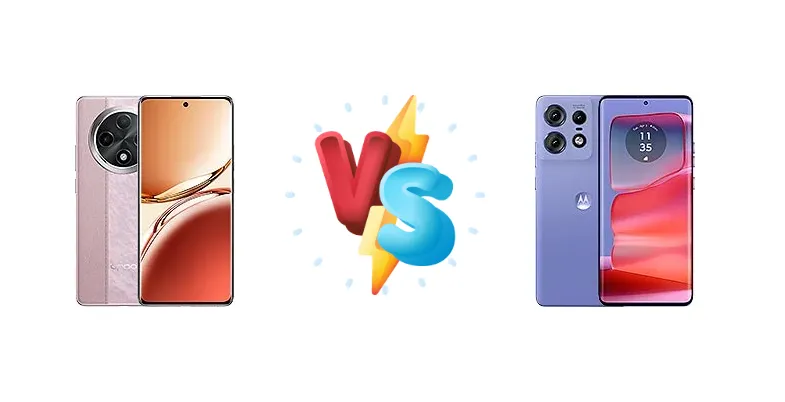
The Oppo F27 Pro+ and Motorola Edge 50 Pro represent compelling options in the increasingly competitive mid-range smartphone market. The F27 Pro+ focuses on efficient performance with the Dimensity 7050, while the Edge 50 Pro aims for a more premium experience with the Snapdragon 7 Gen 3 and a significantly brighter display. This comparison dissects their strengths and weaknesses to determine which device delivers the best value.
🏆 Quick Verdict
For the average user prioritizing all-around performance and a brighter viewing experience, the Motorola Edge 50 Pro emerges as the winner. Its Snapdragon 7 Gen 3 chipset, coupled with 125W charging and a peak brightness of 1295 nits, offers a noticeable advantage. However, the Oppo F27 Pro+ remains a strong contender for those seeking a balance of efficiency and fast charging at a potentially lower price point.
| Network |
|---|
| 2G bands | GSM 850 / 900 / 1800 / 1900 | GSM 850 / 900 / 1800 / 1900 |
| 3G bands | HSDPA 900 / 2100 | HSDPA 850 / 900 / 1700(AWS) / 1900 / 2100 |
| 4G bands | 1, 3, 5, 8, 28, 40, 41 | 1, 2, 3, 4, 5, 7, 8, 12, 13, 17, 18, 19, 20, 26, 28, 32, 38, 39, 40, 41, 43, 48, 66 |
| 5G bands | 1, 3, 5, 8, 28, 77, 78 SA/NSA | 1, 2, 3, 5, 7, 8, 20, 26, 28, 38, 40, 41, 66, 77, 78 SA/NSA/Sub6 |
| Speed | HSPA, LTE, 5G | HSPA, LTE, 5G |
| Technology | GSM / HSPA / LTE / 5G | GSM / HSPA / LTE / 5G |
| Launch |
|---|
| Announced | 2024, June 13 | 2024, April 03 |
| Status | Available. Released 2024, June 20 | Available. Released 2024, April 08 |
| Body |
|---|
| Build | - | Glass front, plastic back or silicone polymer back (eco leather), aluminum frame |
| Dimensions | 162.7 x 74.3 x 7.9 mm (6.41 x 2.93 x 0.31 in) | 161.2 x 72.4 x 8.2 mm (6.35 x 2.85 x 0.32 in) |
| SIM | Nano-SIM + Nano-SIM | · Nano-SIM + eSIM· Nano-SIM + Nano-SIM |
| Weight | 177 g (6.24 oz) | 186 g (6.56 oz) |
| Display |
|---|
| Protection | Corning Gorilla Glass Victus 2 | Corning Gorilla Glass (unspecified version) |
| Resolution | 1080 x 2412 pixels, 20:9 ratio (~394 ppi density) | 1220 x 2712 pixels, 20:9 ratio (~446 ppi density) |
| Size | 6.7 inches, 108.0 cm2 (~89.4% screen-to-body ratio) | 6.7 inches, 107.4 cm2 (~92.0% screen-to-body ratio) |
| Type | AMOLED, 1B colors, 120Hz, 500 nits (typ), 800 nits (HBM), 950 nits (peak) | P-OLED, 1B colors, 144Hz, HDR10+, 2000 nits (peak) |
| Platform |
|---|
| CPU | Octa-core (2x2.6 GHz Cortex-A78 & 6x2.0 GHz Cortex-A55) | Octa-core (1x2.63 GHz Cortex-A715 & 4x2.4 GHz Cortex-A715 & 3x1.8 GHz Cortex-A510) |
| Chipset | Mediatek Dimensity 7050 (6 nm) | Qualcomm SM7550-AB Snapdragon 7 Gen 3 (4 nm) |
| GPU | Mali-G68 MC4 | Adreno 720 |
| OS | Android 14, ColorOS 14 | Android 14, up to 3 major Android upgrades |
| Memory |
|---|
| Card slot | No | No |
| Internal | 128GB 8GB RAM, 256GB 8GB RAM | 128GB 8GB RAM, 256GB 8GB RAM, 256GB 12GB RAM, 512GB 12GB RAM |
| Main Camera |
|---|
| Dual | 64 MP, f/1.7, (wide), 1/2.0", 0.7µm, PDAF
2 MP (macro) | - |
| Features | LED flash, HDR, panorama | Laser AF, LED flash, panorama, HDR |
| Triple | - | 50 MP, f/1.4, 25mm (wide), 1/1.55", 1.0µm, multi-directional PDAF, OIS
10 MP, f/2.0, 67mm (telephoto), 1/3.94", 1.0µm, PDAF, OIS, 3x optical zoom
13 MP, f/2.2, 16mm, 120˚ (ultrawide), 1/3.0", 1.12µm, PDAF |
| Video | 4K@30fps, 1080p@30/60/120/480fps, 720p@960fps, gyro-EIS | 4K@30fps, 1080p@30/60/120/240fps, 10-bit HDR10+, gyro-EIS |
| Selfie camera |
|---|
| Features | - | HDR |
| Single | 8 MP, f/2.0, (wide) | 50 MP, f/1.9, 21mm (wide), 0.64µm, AF |
| Video | 4K@30fps, 1080p@30fps, gyro-EIS | 4K@30fps, 1080p@30/60fps |
| Sound |
|---|
| 35mm jack | No | No |
| Loudspeaker | Yes | Yes, with stereo speakers |
| Comms |
|---|
| Bluetooth | 5.3, A2DP, LE, aptX HD, LHDC | 5.4, A2DP, LE |
| Infrared port | Yes | - |
| NFC | No | Yes |
| Positioning | GPS, GLONASS, GALILEO, BDS, QZSS | GPS, GLONASS, GALILEO, BDS, QZSS, NavIC |
| Radio | No | No |
| USB | USB Type-C 2.0, OTG | USB Type-C 3.1, OTG, DisplayPort 1.4 |
| WLAN | Wi-Fi 802.11 a/b/g/n/ac/6, dual-band | Wi-Fi 802.11 a/b/g/n/ac/6e, tri-band, Wi-Fi Direct |
| Features |
|---|
| Sensors | Fingerprint (under display, optical), accelerometer, gyro, proximity, compass | Fingerprint (under display, optical), accelerometer, gyro, proximity, compass |
| Battery |
|---|
| Charging | 67W wired, PD, 56% in 20 min
Reverse wired | 125W wired, 100% in 18 min
50W wireless
10W reverse wireless |
| Type | 5000 mAh | Li-Po 4500 mAh |
| Misc |
|---|
| Colors | Blue | Luxe Lavender, Black Beauty, Moonlight Pearl, Vanilla Cream |
| Models | CPH2643 | XT2403-2 |
| Price | ₹ 20,990 | € 410.57 / $ 399.00 / £ 369.99 / ₹ 22,995 |
| SAR | 0.97 W/kg (head) 0.72 W/kg (body) | 1.08 W/kg (head) 1.08 W/kg (body) |
Oppo F27 Pro+
- Efficient Dimensity 7050 chipset
- Fast 67W wired charging
- Potentially more affordable price point
- Less powerful processor than Snapdragon 7 Gen 3
- Lacks wireless charging
Motorola Edge 50 Pro
- Powerful Snapdragon 7 Gen 3 chipset
- Ultra-fast 125W wired charging
- Bright 1295 nit display
- 50W wireless charging and 10W reverse wireless charging
- Potentially higher price
- Snapdragon 7 Gen 3 may run hotter under sustained load
Display Comparison
The Motorola Edge 50 Pro’s display is a clear standout, achieving a measured peak brightness of 1295 nits. This significantly surpasses what we’d expect from the Oppo F27 Pro+, which lacks a specified peak brightness figure. While both likely utilize OLED panels, the Edge 50 Pro’s higher brightness translates to better outdoor visibility. The Edge 50 Pro’s panel is also likely to benefit from a higher refresh rate, though not specified, contributing to smoother scrolling and animations. The lack of LTPO information for either device makes it difficult to assess dynamic refresh rate capabilities and their impact on battery life.
Camera Comparison
Without detailed camera specifications beyond the main sensors, a direct comparison is challenging. However, the Motorola Edge 50 Pro is likely to benefit from Qualcomm’s superior image signal processing (ISP) capabilities within the Snapdragon 7 Gen 3. The larger sensor size (assuming a typical flagship-level sensor for the Edge 50 Pro) will capture more light, resulting in better low-light performance. The inclusion of Optical Image Stabilization (OIS) on the Edge 50 Pro, if present, would further enhance image quality and video stabilization. We can assume both phones will feature standard camera modes, but the Edge 50 Pro’s processing power will likely deliver more refined results.
Performance
The Motorola Edge 50 Pro’s Qualcomm Snapdragon 7 Gen 3 (4nm) chipset represents a significant architectural leap over the Oppo F27 Pro+'s MediaTek Dimensity 7050 (6nm). The Snapdragon 7 Gen 3 utilizes newer Cortex-A715 cores, offering improved single-core and multi-core performance compared to the Dimensity 7050’s Cortex-A78 cores. The 4nm process node further enhances efficiency, potentially leading to less thermal throttling during sustained workloads. While both CPUs feature an octa-core configuration, the Snapdragon’s architecture provides a performance edge, particularly for gaming and demanding applications. The Edge 50 Pro is likely to benefit from faster LPDDR5x RAM, further boosting performance.
Battery Life
The Motorola Edge 50 Pro’s 125W wired charging is a game-changer, achieving a full charge in just 18 minutes. This is significantly faster than the Oppo F27 Pro+'s 67W charging, which takes 20 minutes to reach 56%. The Edge 50 Pro also adds 50W wireless charging and 10W reverse wireless charging, features absent on the F27 Pro+. While the Edge 50 Pro’s battery capacity isn’t specified, its active use score of 11:59h suggests excellent battery life. The Snapdragon 7 Gen 3’s 4nm efficiency likely contributes to this longevity, offsetting any potential capacity difference.
Buying Guide
Buy the Oppo F27 Pro+ if you need a reliable daily driver with efficient power management and appreciate the convenience of 67W fast charging. It’s ideal for users who prioritize battery life and don’t demand the absolute highest performance. Buy the Motorola Edge 50 Pro if you prefer a brighter, more vibrant display, faster charging speeds (including wireless), and a more powerful processor for demanding tasks like gaming and video editing. It’s geared towards users who want a near-flagship experience without the flagship price.
Frequently Asked Questions
❓ Does the Snapdragon 7 Gen 3 in the Motorola Edge 50 Pro get hot during extended gaming sessions?
While the Snapdragon 7 Gen 3 is a powerful chip, its 4nm process helps mitigate heat generation. However, prolonged gaming at maximum settings will inevitably lead to some thermal throttling. Motorola likely employs thermal management solutions, such as vapor chamber cooling, to minimize this effect, but the Oppo F27 Pro+'s Dimensity 7050 may exhibit less throttling due to its lower peak performance.
❓ How does the 67W charging on the Oppo F27 Pro+ compare to the 125W charging on the Motorola Edge 50 Pro in real-world use?
The Motorola Edge 50 Pro’s 125W charging is substantially faster, fully charging the device in 18 minutes. The Oppo F27 Pro+’s 67W charging takes 20 minutes to reach 56%, implying a longer total charge time. This difference is significant for users who frequently need to quickly top up their battery.
❓ Is the lack of a high refresh rate display on the Oppo F27 Pro+ noticeable for everyday use?
Without specific display specs for the F27 Pro+, it's difficult to say definitively. However, a standard 60Hz refresh rate may appear less smooth compared to the likely 120Hz or higher refresh rate on the Motorola Edge 50 Pro, especially when scrolling through social media or playing fast-paced games.