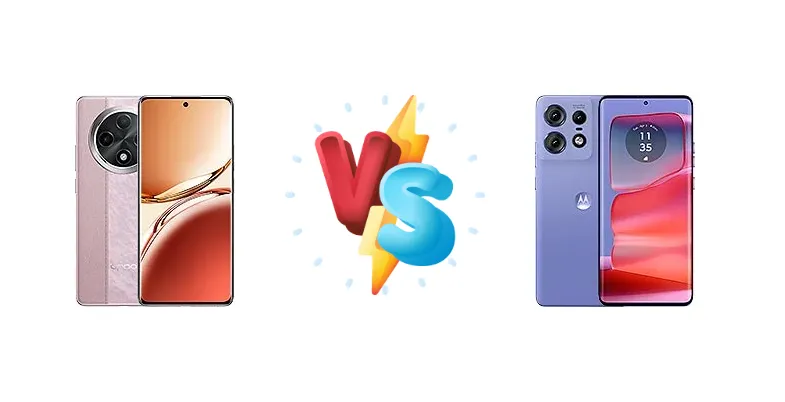
The mid-range smartphone market is fiercely competitive, and the Oppo F27 Pro and Motorola Edge 50 Pro represent compelling options. The F27 Pro aims for a balance of features and affordability, while the Edge 50 Pro pushes the boundaries with faster charging and a more modern chipset. This comparison dissects their key differences to help you choose the right device.
🏆 Quick Verdict
For the average user prioritizing all-around performance and future-proofing, the Motorola Edge 50 Pro emerges as the stronger contender. Its Snapdragon 7 Gen 3 chipset, coupled with a brighter display and significantly faster charging, justifies the potential price premium. However, the Oppo F27 Pro remains a viable option for budget-conscious buyers.
| Network |
|---|
| 2G bands | GSM 850 / 900 / 1800 / 1900 | GSM 850 / 900 / 1800 / 1900 |
| 3G bands | HSDPA 850 / 900 / 2100 | HSDPA 850 / 900 / 1700(AWS) / 1900 / 2100 |
| 4G bands | LTE | 1, 2, 3, 4, 5, 7, 8, 12, 13, 17, 18, 19, 20, 26, 28, 32, 38, 39, 40, 41, 43, 48, 66 |
| 5G bands | SA/NSA | 1, 2, 3, 5, 7, 8, 20, 26, 28, 38, 40, 41, 66, 77, 78 SA/NSA/Sub6 |
| Speed | HSPA, LTE, 5G | HSPA, LTE, 5G |
| Technology | GSM / HSPA / LTE / 5G | GSM / HSPA / LTE / 5G |
| Launch |
|---|
| Announced | Not announced yet | 2024, April 03 |
| Status | Cancelled | Available. Released 2024, April 08 |
| Body |
|---|
| Build | - | Glass front, plastic back or silicone polymer back (eco leather), aluminum frame |
| Dimensions | 162.7 x 74.3 x 7.5 mm or 7.9 mm | 161.2 x 72.4 x 8.2 mm (6.35 x 2.85 x 0.32 in) |
| SIM | Nano-SIM + Nano-SIM | · Nano-SIM + eSIM· Nano-SIM + Nano-SIM |
| Weight | 177 g or 182 g (6.24 oz) | 186 g (6.56 oz) |
| Display |
|---|
| Protection | - | Corning Gorilla Glass (unspecified version) |
| Resolution | 1080 x 2412 pixels, 20:9 ratio (~394 ppi density) | 1220 x 2712 pixels, 20:9 ratio (~446 ppi density) |
| Size | 6.7 inches, 108.0 cm2 (~89.4% screen-to-body ratio) | 6.7 inches, 107.4 cm2 (~92.0% screen-to-body ratio) |
| Type | AMOLED, 1B colors, 120Hz, 500 nits (typ), 800 nits (HBM), 950 nits (peak) | P-OLED, 1B colors, 144Hz, HDR10+, 2000 nits (peak) |
| Platform |
|---|
| CPU | Octa-core (2x2.6 GHz Cortex-A78 & 6x2.0 GHz Cortex-A55) | Octa-core (1x2.63 GHz Cortex-A715 & 4x2.4 GHz Cortex-A715 & 3x1.8 GHz Cortex-A510) |
| Chipset | Mediatek Dimensity 7050 (6 nm) | Qualcomm SM7550-AB Snapdragon 7 Gen 3 (4 nm) |
| GPU | Mali-G68 MC4 | Adreno 720 |
| OS | Android 14, ColorOS 14 | Android 14, up to 3 major Android upgrades |
| Memory |
|---|
| Card slot | No | No |
| Internal | 256GB 8GB RAM | 128GB 8GB RAM, 256GB 8GB RAM, 256GB 12GB RAM, 512GB 12GB RAM |
| Main Camera |
|---|
| Features | LED flash, HDR, panorama | Laser AF, LED flash, panorama, HDR |
| Triple | 64 MP, f/1.7, (wide), 1/2.0", 0.7µm, PDAF
8 MP, f/2.2, (ultrawide)
2 MP (macro) | 50 MP, f/1.4, 25mm (wide), 1/1.55", 1.0µm, multi-directional PDAF, OIS
10 MP, f/2.0, 67mm (telephoto), 1/3.94", 1.0µm, PDAF, OIS, 3x optical zoom
13 MP, f/2.2, 16mm, 120˚ (ultrawide), 1/3.0", 1.12µm, PDAF |
| Video | 4K@30fps, 1080p@30/60/120fps, gyro-EIS | 4K@30fps, 1080p@30/60/120/240fps, 10-bit HDR10+, gyro-EIS |
| Selfie camera |
|---|
| Features | - | HDR |
| Single | 32 MP, f/2.5, (wide) | 50 MP, f/1.9, 21mm (wide), 0.64µm, AF |
| Video | Yes | 4K@30fps, 1080p@30/60fps |
| Sound |
|---|
| 35mm jack | No | No |
| Loudspeaker | Yes | Yes, with stereo speakers |
| Comms |
|---|
| Bluetooth | 5.3, A2DP, LE, aptX HD | 5.4, A2DP, LE |
| Infrared port | Yes | - |
| NFC | Unspecified | Yes |
| Positioning | GPS, GLONASS, GALILEO, BDS, QZSS | GPS, GLONASS, GALILEO, BDS, QZSS, NavIC |
| Radio | No | No |
| USB | USB Type-C 2.0, OTG | USB Type-C 3.1, OTG, DisplayPort 1.4 |
| WLAN | Wi-Fi 802.11 a/b/g/n/ac/6, dual-band | Wi-Fi 802.11 a/b/g/n/ac/6e, tri-band, Wi-Fi Direct |
| Features |
|---|
| Sensors | Fingerprint (under display, optical), accelerometer, gyro, proximity, compass | Fingerprint (under display, optical), accelerometer, gyro, proximity, compass |
| Battery |
|---|
| Charging | 67W wired, PD, 56% in 20 min
Reverse wired | 125W wired, 100% in 18 min
50W wireless
10W reverse wireless |
| Type | 5000 mAh | Li-Po 4500 mAh |
| Misc |
|---|
| Colors | Blue, Pink, Mint | Luxe Lavender, Black Beauty, Moonlight Pearl, Vanilla Cream |
| Models | - | XT2403-2 |
| Price | - | € 410.57 / $ 399.00 / £ 369.99 / ₹ 22,995 |
| SAR | - | 1.08 W/kg (head) 1.08 W/kg (body) |
Oppo F27 Pro
- More affordable price point
- Decent performance for everyday tasks
- 67W fast charging is still respectable
- Older chipset architecture (Dimensity 7050)
- Slower charging compared to the Motorola
- Lacks wireless charging
Motorola Edge 50 Pro
- Faster and more efficient Snapdragon 7 Gen 3
- Significantly faster 125W wired charging
- 50W wireless and 10W reverse wireless charging
- Potentially higher price
- Battery capacity not explicitly stated
- May require more frequent charging if used heavily
Display Comparison
The Motorola Edge 50 Pro boasts a significantly brighter display, reaching a measured 1295 nits, compared to an unstated peak brightness for the Oppo F27 Pro. This translates to superior visibility under direct sunlight. While panel technology isn't specified for either, the Edge 50 Pro’s brightness advantage is a clear win for outdoor use. Bezels are likely comparable given the market segment, but the Motorola’s higher peak brightness is the defining factor. Color accuracy is unknown for both, requiring independent testing.
Camera Comparison
Without detailed camera specifications beyond the main sensors, a direct comparison is limited. However, the Motorola Edge 50 Pro is likely to benefit from Qualcomm’s superior image signal processor (ISP) within the Snapdragon 7 Gen 3, potentially leading to better dynamic range and noise reduction. The absence of information regarding sensor size and aperture for both devices makes a definitive judgment impossible, but the Motorola’s chipset advantage suggests a more capable camera system overall. We can safely assume both phones will include standard features like portrait mode and night mode.
Performance
The Motorola Edge 50 Pro’s Qualcomm Snapdragon 7 Gen 3 (4nm) offers a substantial architectural advantage over the Oppo F27 Pro’s MediaTek Dimensity 7050 (6nm). The 4nm process node inherently provides better power efficiency and thermal management, reducing the likelihood of performance throttling during sustained workloads. The Snapdragon 7 Gen 3’s CPU configuration – 1x2.63 GHz Cortex-A715, 4x2.4 GHz Cortex-A715, and 3x1.8 GHz Cortex-A510 – is also more modern and efficient than the Dimensity 7050’s 2x2.6 GHz Cortex-A78 & 6x2.0 GHz Cortex-A55. This translates to faster app loading times, smoother multitasking, and improved gaming performance on the Motorola.
Battery Life
The Motorola Edge 50 Pro excels in charging speed, supporting 125W wired charging, achieving a full charge in just 18 minutes. This is significantly faster than the Oppo F27 Pro’s 67W charging, which takes 20 minutes to reach 56%. The Edge 50 Pro also adds 50W wireless charging and 10W reverse wireless charging, features absent on the F27 Pro. While the Edge 50 Pro’s battery capacity isn’t specified, its active use score of 11:59h demonstrates excellent battery life. The faster charging speeds of the Motorola effectively mitigate any potential capacity difference.
Buying Guide
Buy the Oppo F27 Pro if you need a reliable daily driver with decent performance and prioritize a more conservative price point. It's ideal for users who primarily browse, use social media, and occasionally game. Buy the Motorola Edge 50 Pro if you prefer a smoother, more responsive experience, demand faster charging speeds, and value a brighter, more vibrant display – especially if you're a power user or mobile gamer.
Frequently Asked Questions
❓ Does the Snapdragon 7 Gen 3 in the Motorola Edge 50 Pro get hot during extended gaming sessions?
The Snapdragon 7 Gen 3’s 4nm process node is designed for improved thermal efficiency. While some heat generation is inevitable during demanding tasks like gaming, the Edge 50 Pro is less prone to significant throttling compared to devices with older, less efficient chipsets. Motorola likely incorporates thermal management solutions to further mitigate heat buildup.
❓ Is the 67W charging on the Oppo F27 Pro slow compared to the competition?
While 67W is considered fast charging, the Motorola Edge 50 Pro’s 125W charging is significantly quicker, fully charging the device in just 18 minutes. The F27 Pro takes 20 minutes to reach 56%, indicating a noticeable difference in charging speed. However, 67W is still adequate for most users and provides a reasonable top-up time.
❓ What type of display technology does the Motorola Edge 50 Pro use (e.g., AMOLED, LCD)?
The provided context data does not specify the display technology used in the Motorola Edge 50 Pro. However, given its price point and the focus on brightness, it is highly probable that the device features an AMOLED panel for vibrant colors and deep blacks. Independent reviews would be needed to confirm this.