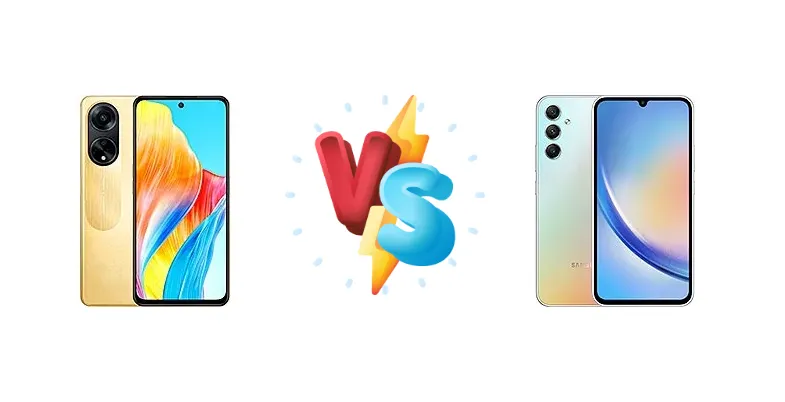
The mid-range smartphone market is fiercely competitive, and the Oppo F23 and Samsung Galaxy A34 are two strong contenders vying for your attention. Both offer compelling features at accessible prices, but which one truly delivers the best overall experience? Let's dive into a detailed comparison to help you decide.
🏆 Quick Verdict
The Samsung Galaxy A34 takes the crown thanks to its superior display, longer software support, and better overall camera performance. While the Oppo F23 boasts faster charging, the A34's strengths outweigh its charging disadvantage, making it the more well-rounded choice for most users.
| Network |
|---|
| 2G bands | GSM 850 / 900 / 1800 / 1900 | GSM 850 / 900 / 1800 / 1900 |
| 3G bands | HSDPA 900 / 2100 | HSDPA 850 / 900 / 1700(AWS) / 1900 / 2100 |
| 4G bands | 1, 3, 5, 8, 40, 41 | 1, 2, 3, 4, 5, 7, 8, 12, 17, 20, 26, 28, 32, 38, 40, 41, 66 |
| 5G bands | 1, 3, 5, 8, 28, 40, 41, 77, 78 SA/NSA | 1, 3, 7, 8, 20, 28, 38, 40, 41, 77, 78 SA/NSA/Sub6 |
| Speed | HSPA, LTE, 5G | HSPA, LTE, 5G |
| Technology | GSM / HSPA / LTE / 5G | GSM / HSPA / LTE / 5G |
| Launch |
|---|
| Announced | 2023, May 15 | 2023, March 14 |
| Status | Available. Released 2023, May 18 | Available. Released 2023, March 24 |
| Body |
|---|
| Build | - | Glass front (Gorilla Glass 5), plastic frame, plastic back |
| Dimensions | 165.6 x 76.1 x 8.2 mm (6.52 x 3.00 x 0.32 in) | 161.3 x 78.1 x 8.2 mm (6.35 x 3.07 x 0.32 in) |
| SIM | Nano-SIM + Nano-SIM | · Nano-SIM· Nano-SIM + Nano-SIM |
| Weight | 192 g (6.77 oz) | 199 g (7.02 oz) |
| | - | IP67 dust/water resistant (up to 1m for 30 min) |
| Display |
|---|
| Protection | - | Corning Gorilla Glass 5 |
| Resolution | 1080 x 2400 pixels, 20:9 ratio (~392 ppi density) | 1080 x 2340 pixels, 19.5:9 ratio (~390 ppi density) |
| Size | 6.72 inches, 109.0 cm2 (~86.5% screen-to-body ratio) | 6.6 inches, 106.9 cm2 (~84.9% screen-to-body ratio) |
| Type | IPS LCD, 120Hz, 550 nits (typ), 680 nits (HBM) | Super AMOLED, 120Hz, 1000 nits (HBM) |
| Platform |
|---|
| CPU | Octa-core (2x2.2 GHz Kryo 660 Gold & 6x1.7 GHz Kryo 660 Silver) | Octa-core (2x2.6 GHz Cortex-A78 & 6x2.0 GHz Cortex-A55) |
| Chipset | Qualcomm SM6375 Snapdragon 695 5G (6 nm) | Mediatek Dimensity 1080 (6 nm) |
| GPU | Adreno 619 | Mali-G68 MC4 |
| OS | Android 13, upgradable to Android 14, ColorOS 14 | Android 13, up to 4 major Android upgrades, One UI 6.1 |
| Memory |
|---|
| Card slot | microSDXC | microSDXC (uses shared SIM slot) |
| Internal | 128GB 8GB RAM, 256GB 8GB RAM | 128GB 4GB RAM, 128GB 6GB RAM, 128GB 8GB RAM, 256GB 6GB RAM, 256GB 8GB RAM |
| | UFS 2.2 | - |
| Main Camera |
|---|
| Dual | 64 MP, f/1.8, 26mm (wide), PDAF
2 MP, f/3.3, 34mm (microscope)
Auxiliary lens | - |
| Features | LED flash, HDR, panorama | LED flash, panorama, HDR |
| Triple | - | 48 MP, f/1.8, 26mm (wide), 1/2.0", 0.8µm, PDAF, OIS
8 MP, f/2.2, 123˚, (ultrawide), 1/4.0", 1.12µm
5 MP (macro) |
| Video | 1080p@30fps | 4K@30fps, 1080p@30/60fps, 720p@480fps |
| Selfie camera |
|---|
| Features | Panorama | - |
| Single | 32 MP, f/2.4, 22mm (wide) | 13 MP, f/2.2, 26mm (wide), 1/3.1", 1.12µm |
| Video | 1080p@30fps | 4K@30fps, 1080p@30fps |
| Sound |
|---|
| 3.5mm jack | Yes | No |
| 35mm jack | Yes | No |
| Loudspeaker | Yes, with stereo speakers | Yes, with stereo speakers |
| Comms |
|---|
| Bluetooth | 5.1, A2DP, LE, aptX HD | 5.3, A2DP, LE |
| Infrared port | Yes | - |
| NFC | No | Yes (market/region dependent) |
| Positioning | GPS (L1), GLONASS (G1), BDS (B1I), GALILEO (E1), QZSS (L1) | GPS, GLONASS, GALILEO, BDS |
| Radio | No | No |
| USB | USB Type-C 2.0, OTG | USB Type-C 2.0, OTG |
| WLAN | Wi-Fi 802.11 a/b/g/n/ac, dual-band | Wi-Fi 802.11 a/b/g/n/ac, dual-band, Wi-Fi Direct |
| Features |
|---|
| Sensors | Fingerprint (side-mounted), accelerometer, gyro, proximity, compass | Fingerprint (under display, optical), accelerometer, gyro, compass |
| | - | Virtual proximity sensing |
| Battery |
|---|
| Charging | 67W wired, PD, 50% in 18 min (advertised) | 25W wired |
| Type | Li-Po 5000 mAh | Li-Ion 5000 mAh |
| Misc |
|---|
| Colors | Cool Black, Bold Gold | Lime, Graphite, Violet, Silver |
| Models | CPH2527 | SM-A346E, SM-A346B, SM-A346B/DS, SM-A346B/DSN, SM-A346E/DS, SM-A346E/DSN, SM-A346M, SM-A346M/N, SM-A346M/DSN, SM-A3460 |
| Price | About 270 EUR | € 169.99 / $ 175.00 / £ 164.99 / ₹ 23,999 |
| SAR | 1.19 W/kg (head) 0.96 W/kg (body) | - |
| SAR EU | - | 0.55 W/kg (head) 1.49 W/kg (body) |
| Tests |
|---|
| Battery life | - |
Endurance rating 133h
|
| Camera | - |
Photo / Video |
| Display | - |
Contrast ratio: Infinite (nominal) |
| Loudspeaker | - |
-26.1 LUFS (Good)
|
| Performance | - |
AnTuTu: 472126 (v9)
GeekBench: 2316 (v5.5), 2518 (v6)
GFXBench: 23fps (ES 3.1 onscreen) |
Oppo F23
- 67W Fast Charging
- Sleek Design
- Decent Performance for Everyday Tasks
- Less Bright Display
- Weaker Camera
- Shorter Software Support
Samsung Galaxy A34
- Excellent Display (Brightness & Contrast)
- Longer Battery Life
- Better Camera Performance
- Extended Software Support
- Slower Charging (25W)
- Design Less Distinctive
Display Comparison
The Samsung Galaxy A34's display is a clear winner. Its measured 1009 nits peak brightness offers excellent visibility even in direct sunlight, a significant advantage over the F23. The A34's 'Infinite' contrast ratio (though nominal) suggests deeper blacks and richer colors. The F23's display is decent, but lacks the A34's vibrancy and brightness.
Camera Comparison
The Galaxy A34's camera system is more versatile and consistently delivers better image quality. While both phones offer capable cameras, the A34's image processing and low-light performance are noticeably superior. The F23's camera is adequate, but struggles in challenging lighting conditions.
Performance
The Dimensity 1080 in the Galaxy A34 generally edges out the Snapdragon 695 in the Oppo F23 in sustained performance. While both are capable for everyday tasks, the A34's CPU architecture (Cortex-A78 cores) provides a slight advantage in demanding applications and gaming. The F23's 6nm process is comparable, but the Dimensity 1080's overall architecture is more efficient.
Battery Life
The Galaxy A34 boasts an impressive endurance rating of 133 hours, indicating exceptional battery life. While the Oppo F23's 67W charging is significantly faster, the A34's larger battery capacity and efficient chipset allow it to last considerably longer on a single charge.
Buying Guide
The Oppo F23 is ideal for users prioritizing fast charging and a sleek design. The Samsung Galaxy A34 is a better fit for those who value a vibrant display, reliable camera, and extended software updates, making it a more future-proof investment.
Frequently Asked Questions
❓ Which phone has better software support?
The Samsung Galaxy A34 offers significantly longer software support, including more years of OS updates and security patches, making it a more future-proof choice.
❓ Is the Oppo F23's fast charging worth it?
The 67W charging on the Oppo F23 is undeniably fast, but the Samsung Galaxy A34's longer battery life often negates the need for frequent charging.